The Three Point Molly Strategy in Craps: Step-by-Step Guide With Real Examples
 Jake Wilfred
Three numbers. Maximum odds on each. A combined house edge below 0.50%. The Three Point Molly strategy is the closest thing craps has to an optimal play system. It uses only the table’s lowest-edge bets, the pass line, come bets, and free odds, and structures them so you always have three numbers earning money for you on every throw.
No proposition bets. No hardways. No center-table action at all. Just the mathematical cream of the craps table, stacked three layers deep. It’s the strategy that serious players use when they want multiple numbers working while paying the absolute minimum to the house.
This guide walks you through every step, with dollar amounts, real scenarios, and the math that makes the Molly the gold standard of craps betting systems.
- The Three Point Molly keeps three numbers active at all times: one pass line bet and two come bets, all backed with maximum free odds
- With 3x-4x-5x odds, the blended house edge drops to approximately 0.37%, among the lowest in any casino
- The strategy requires a session bankroll of at least 40 to 50 times your base bet ($400-$500 at a $10 table)
- A seven-out after the point is set wipes all three bets, but odds on come bets are typically returned during the come-out roll
- The Molly works best for disciplined players who can resist adding side bets that inflate the house edge
- Every bet in the Three Point Molly is self-service or handled by the dealer, making it executable at any table speed
What Is the Three Point Molly?
The Three Point Molly is a craps betting system built on a simple principle: keep three numbers working at all times using only the table’s lowest-edge wagers. Those wagers are the pass line bet (1.41% house edge), come bets (1.41% house edge), and free odds (0% house edge) behind each.
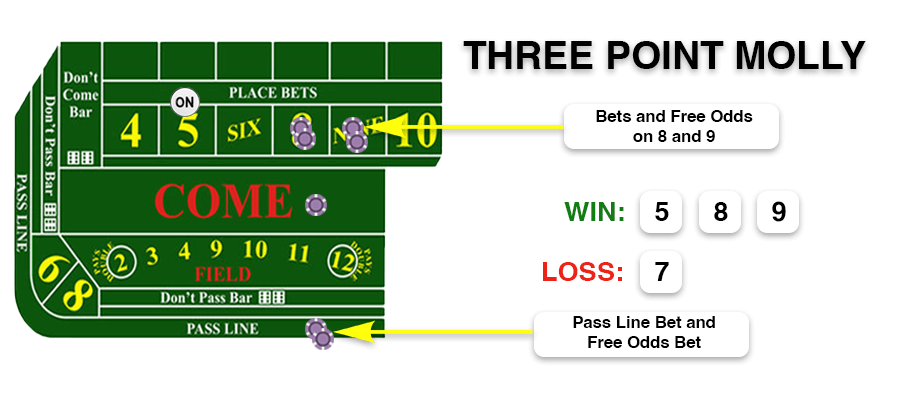
The “three points” in the name refer to the three active number positions you maintain on the craps table layout: the pass line point plus two come bet points. The “Molly” part? That’s lost to craps history, though some old-timers say it was named after a regular at a downtown Vegas table decades ago.
What makes the Molly special isn’t any single bet. It’s how the bets interact. With three numbers covered by the cheapest wagers available, you catch hot rolls across multiple numbers while keeping your cost per dollar wagered at rock bottom. It’s the strategy that math-focused players, many of the best craps books, and even craps casino gambling educators recommend as the standard approach for serious play.
The Three Point Molly isn’t a guaranteed winning system. No craps strategy eliminates the house edge entirely. The Molly minimizes it as far as mathematically possible while giving you meaningful table coverage. Over time, the house still wins. But at 0.37% combined edge with full odds, the house wins very, very slowly. That’s the whole point.
How to Execute the Three Point Molly: Step by Step
Here’s the full sequence at a $10 table with 3x-4x-5x odds. If you’re new to how craps works, read that guide first so the terminology makes sense.
Step 1: Bet the Pass Line
Place $10 on the pass line before the come-out roll. If the shooter rolls a 7 or 11, you win $10 (even money). If they roll 2, 3, or 12, you lose $10. Any other number (4, 5, 6, 8, 9, or 10) becomes the point.
Step 2: Take Maximum Odds on the Point
The puck flips to “ON.” Now place your free odds bet behind your pass line bet. With 3x-4x-5x odds at a $10 table:
Point of 4 or 10: take $30 in odds (3x). Point of 5 or 9: take $40 in odds (4x). Point of 6 or 8: take $50 in odds (5x).
This structure produces an identical maximum win of $60 on the odds regardless of the point. That’s the beauty of the 3x-4x-5x system: it standardizes the top payout.
You place $10 on the pass line. The shooter rolls an 8. The point is 8. You place $50 in odds behind your pass line bet. Total at risk on the pass line: $60 ($10 flat + $50 odds). If the 8 hits before a 7, you collect $10 (even money on flat) + $60 (6:5 on $50 odds) = $70 profit.
Step 3: Place a Come Bet
On the very next roll after the point is established, place $10 in the COME area. This acts like a fresh pass line bet for you personally. If the roll is a 7 or 11, your come bet wins $10 immediately (but note: a 7 also means the pass line loses, so it’s a mixed result). If the roll is 2, 3, or 12, the come bet loses. Any other number becomes your come point, and the dealer moves your $10 to that number’s box.
Step 4: Take Maximum Odds on the Come Point
Tell the dealer “odds on the come” and hand over the appropriate amount. The dealer stacks it on top of your come bet in the number box. The same 3x-4x-5x structure applies.
Step 5: Place a Second Come Bet
On the following roll, place another $10 in the COME area. Same process: the next roll determines your second come point. The dealer moves it to the number box, and you take max odds.
Step 6: You Now Have Three Numbers Working
At this stage, you have the pass line point plus two come points, all backed with maximum free odds. Three numbers. Three chances to win on every throw. The combined house edge across all your action: approximately 0.37%.
Stop adding bets after reaching three numbers. The goal of the Molly is three points, not four, not five. If one of your numbers hits, collect the payout, then immediately place a new come bet on the next roll to restore your third number. The cycle continues until the shooter sevens out.
A Full Three Point Molly Session: Worked Example
Let’s walk through a realistic session so you can see exactly how the pieces fit together.
Come-out roll: You bet $10 on the pass line. Shooter rolls 6. Point is 6. You take $50 in odds (5x). Pass line total: $60.
Roll 2: You place $10 in COME. Shooter rolls 5. Your come bet moves to the 5. You take $40 in odds on the 5. Come bet total on 5: $50.
Roll 3: You place $10 in COME. Shooter rolls 9. Your come bet moves to the 9. You take $40 in odds on the 9. Come bet total on 9: $50. You now have three numbers: 6 (pass), 5 (come), 9 (come). Total at risk: $160.
Roll 4: Shooter rolls 10. Nothing happens to your bets. No new bets needed.
Roll 5: Shooter rolls 5. Your come bet on the 5 wins! You collect $10 (flat) + $60 (3:2 on $40) = $70 profit. The dealer places your $10 flat + $70 in the COME area for you to pick up.
Roll 6: You place $10 in COME to replace your third number. Shooter rolls 4. Your come bet moves to the 4. You take $30 in odds (3x). Come bet total on 4: $40. You’re back to three numbers: 6, 9, 4.
Roll 7: Shooter rolls 7. Seven-out. Your pass line bet on 6 loses ($60). Your come bet on 9 loses the $10 flat but the $40 odds are returned (odds default to “off” on come-out; though this is a seven-out mid-game, some players confuse this: during a seven-out, you lose both flat and odds on come bets). Your come bet on 4 also loses flat + odds ($40). Total loss this roll: $60 + $50 + $40 = $150.
But you collected $70 profit on the 5 earlier. Net session result on this shooter: $70 – $150 = -$80. Painful, but one shooter’s turn. The next could be completely different.
A common point of confusion: when the shooter sevens out (rolls a 7 after a point is established), you lose both the flat bet and the odds on all active bets. The odds being “off” rule only applies during the come-out roll for come bets. During normal play, a seven-out kills everything. Our craps bets explained guide clarifies this distinction.
The Math Behind the Three Point Molly
The Molly’s power comes from one simple principle: your flat bets (pass line and come) carry a 1.41% house edge. Your odds bets carry 0%. The more of your total money that sits in odds, the lower the blended edge on everything combined.
| Odds Multiplier | Combined House Edge (Pass/Come + Odds) | Expected Loss Per $1,000 Wagered |
|---|---|---|
| No odds | 1.41% | $14.10 |
| 1x odds | 0.85% | $8.50 |
| 2x odds | 0.61% | $6.10 |
| 3x-4x-5x odds | 0.37% | $3.70 |
| 5x odds | 0.33% | $3.30 |
| 10x odds | 0.18% | $1.80 |
At 3x-4x-5x odds (the most common structure in 2026), you’re losing $3.70 per $1,000 in total action. Compare that to the Iron Cross at roughly $38.70 per $1,000, or hardways bets at $90 to $111 per $1,000. The Molly isn’t just a little better. It’s an order of magnitude cheaper.
Always max out your odds before adding a second or third come bet. A single pass line bet with maximum odds has a lower combined edge than two pass line/come bets with no odds. Depth (more odds per bet) always beats width (more bets with no odds). If your bankroll can only support one number with full odds, play one number. Add the second and third come bets only after maxing odds on each one. For the full ranking of every bet’s cost, check our craps payout chart.
Bankroll Requirements for the Three Point Molly
The Molly demands a larger bankroll than single-bet strategies because you have three positions active simultaneously, each backed with odds. Here’s what you need.
How Much Per Session
At a $10 table with 3x-4x-5x odds, your maximum exposure per roll is roughly $160 (three bets at $40-$60 each). A comfortable session bankroll is 40 to 50 times your base bet, which puts you at $400 to $500.
That might sound steep for a $10 table. But remember: most of that exposure sits in the odds portion, which carries 0% house edge. Your actual expected cost per hour is tiny compared to the total dollars at risk. The large bankroll isn’t about expected loss. It’s about variance. Cold streaks happen, and you need enough chips to survive them.
| Table Minimum | Max Exposure Per Roll (3 bets + odds) | Recommended Session Bankroll |
|---|---|---|
| $5 | $80 | $200 – $250 |
| $10 | $160 | $400 – $500 |
| $15 | $240 | $600 – $750 |
| $25 | $400 | $1,000 – $1,250 |
If your bankroll can’t support full odds on three numbers, scale down. Play pass line with max odds plus one come bet with max odds (two numbers instead of three). That’s still a sub-0.50% combined edge and requires a smaller session bank. Never reduce your odds to fund a third come bet. Max odds on two numbers beats partial odds on three, every time. Our bankroll management guide covers session sizing in detail.
What Happens During the Come-Out Roll
The come-out roll is the Molly’s trickiest moment. Here’s what goes on.
When the shooter makes the point (or sevens out, starting a new shooter’s turn), a new come-out roll begins. Your pass line bet resolves, but your two come bets remain active on their numbers. Their odds, however, default to “off” during the come-out unless you request otherwise.
This creates two scenarios players need to understand:
Come-out roll is a 7: Your new pass line bet wins $10 (a natural). But your two active come bets lose their flat portions (both $10). The odds on those come bets are returned to you since they were “off.” Net result: +$10 (pass line) – $20 (two come flats) = -$10.
Come-out roll hits one of your come bet numbers: That come bet wins. The flat bet pays even money and the odds are returned (since they’re “off”). You win $10 on the flat portion.
You can tell the dealer “odds working” to keep your come bet odds active during the come-out. If one of your come points hits on the come-out, you’d collect the full flat + odds payout instead of just the flat. The risk: if a 7 rolls on the come-out, you lose the flat AND the odds on both come bets. Most Molly players leave odds off during the come-out. The default protection is worth the occasional missed odds payout.
The Three Point Molly’s Biggest Weakness (and How to Handle It)
Every strategy has a vulnerability. The Molly’s is the seven-out after you’re fully loaded.
With three numbers active and fully backed with odds, a 7 wipes out roughly $120 to $160 in a single roll at a $10 table. That’s a painful hit. It happens. It will happen multiple times per session.
The key is understanding that this is built into the math. The 0.37% combined house edge already accounts for these losses. Over hundreds of decisions, the frequent small wins from hitting your three numbers more than offset the occasional devastating seven-out. But in a single session, variance can make the Molly feel brutal if three shooters in a row seven out early.
Three consecutive shooters seven out after just 2 to 3 rolls each. You lose approximately $120 to $160 each time. That’s $360 to $480 gone before you’ve had a single number hit. On your $500 session bankroll, that’s catastrophic. This is why you need the full 40 to 50 unit session bank. It gives you enough runway to survive 3 to 4 cold shooters and still have chips when the table turns warm.
The solution isn’t abandoning the Molly during cold streaks. It’s budgeting for them in advance. If your session bank is gone, walk away. Come back with a fresh bank later. Never chase losses with higher bets or by adding field bets or props. Those additions destroy the Molly’s mathematical advantage. For more on handling losses, see our how to win at craps tips.
Three Point Molly vs. Other Craps Strategies
How does the Molly compare to the alternatives?
| Strategy | Blended House Edge | Numbers Working | Session Bankroll ($10 table) | Best For |
|---|---|---|---|---|
| Three Point Molly (max odds) | ~0.37% | 3 | $400 – $500 | Math-first players, longer sessions |
| Pass Line + Max Odds Only | ~0.37% | 1 | $200 – $300 | Conservative players, smaller bankrolls |
| Pass + Place 6/8 | ~0.8% | 2-3 | $300 – $400 | Intermediate players wanting more action |
| Iron Cross | ~3.87% | 10 (all but 7) | $250 – $350 | Action lovers, short fun sessions |
The Molly and a single pass line with max odds have the same combined house edge (~0.37%). The difference is coverage. The Molly gives you three numbers working, which means you benefit from a wider range of rolls during a hot shooter’s turn. A single pass line with odds only profits when one specific number hits.
The Iron Cross sits at the opposite end of the spectrum. It wins on 83% of rolls but carries a blended edge roughly 10 times higher than the Molly. If you want frequent dopamine hits, the Iron Cross delivers. If you want the lowest long-term cost, the Molly is the clear winner. Our full craps strategy guide covers every system in detail.
- Combined house edge of ~0.37% with 3x-4x-5x odds, the lowest multi-number strategy in craps
- Uses only the table’s best bets: pass line, come, and free odds
- Three numbers working gives you meaningful coverage during hot rolls
- Simple, repeatable system that can be executed at any table speed
- No dealer negotiation needed; all bets are standard and familiar
- A seven-out wipes all three bets at once, losing $120-$160+ at a $10 table
- Requires a larger bankroll than single-bet strategies ($400-$500 per session at $10)
- Come-out 7s can pick off active come bets while winning your pass line, creating net losses
- Doesn’t cover as many numbers as the Iron Cross (3 numbers vs. 10)
- Can feel slow during periods where your specific numbers aren’t hitting
5 Rules for Running the Molly Like a Pro
The Molly’s math is bulletproof. The execution is where most players go sideways. Follow these five rules and the strategy works exactly as designed.
Rule 1: Max Odds on Everything, or Scale Down
If you can’t afford max odds on three numbers, play two numbers with max odds. Never dilute your odds to fund a third position. The odds portion is where your money works for free.
Rule 2: Replace Immediately When a Number Hits
If one of your come points wins, place a new come bet on the very next roll. The Molly runs on three numbers. Dropping to two because you got comfortable with a smaller position defeats the purpose.
Rule 3: No Side Bets. Period.
Every dollar you spend on hardways, horn bets, yo bets, or Any Seven carries an 11% to 16.67% house edge. Adding even $1 per roll in props can double your effective house edge for the session. The Molly works because it excludes everything expensive.
The stickman will call out proposition bets between rolls. “Horn bets, anyone?” “Hard eight!” Ignore it. Those calls are a sales pitch for the casino’s most profitable bets. Politely decline and let your Molly do its work. Proper craps etiquette doesn’t require you to bet center-table props just because the stickman offers them.
Rule 4: Set a Loss Limit and a Win Goal
Before the session starts, define your walk-away numbers. A loss limit of 50% of your session bank ($250 on a $500 bank) and a win goal of 30 to 50% ($150 to $250) are reasonable targets. Hit either one and leave. For the full framework, see our bankroll management guide.
Rule 5: Practice Before Playing Live
Run the Molly for 50 simulated sessions on our free craps simulator. Track your results. Get the bet placement rhythm down so you’re not fumbling at a live table in Vegas. The Molly requires placing a new come bet on every roll where you have fewer than three numbers. That cadence needs to be automatic.
The Three Point Molly: The Strategy the Math Says Is Best
The Three Point Molly isn’t flashy. It doesn’t win on 83% of rolls like the Iron Cross. It doesn’t produce 30:1 payouts like a boxcars bet. It doesn’t make the table erupt with cheering.
What it does is keep your money alive. At 0.37% combined house edge, the Molly costs you less per dollar wagered than any other multi-number craps strategy in existence. Three numbers. Max odds. Replace on every hit. That’s the system. It’s simple enough for your first session and sophisticated enough for your thousandth.
The players who use the Molly don’t make headlines for one dramatic win. They just keep showing up, keep grinding, and keep walking away with more money in their pockets than the player next to them who thought a $5 hardway “couldn’t hurt.” Over a year of regular play, the difference between 0.37% and 9% house edge adds up to hundreds or thousands of dollars. The Molly is how you keep that money on your side of the felt.
Best Online Craps Casinos (Last Updated September 2026)






Three Point Molly Strategy FAQs
The Three Point Molly keeps three numbers active: a pass line bet plus two come bets, all backed with maximum free odds. When one of your numbers hits, you collect the payout and replace it with a new come bet on the next roll. The combined house edge with 3x-4x-5x odds is approximately 0.37%.
Plan for 40 to 50 times your base bet per session. At a $10 table with 3x-4x-5x odds, that’s $400 to $500. Your maximum exposure across three fully loaded bets is roughly $160 per roll. The large bankroll accounts for variance during cold streaks where multiple shooters seven out early. See our bankroll management guide for detailed session sizing.
From a pure math standpoint, the Three Point Molly (with max odds) produces the lowest combined house edge of any multi-number strategy at approximately 0.37%. It’s the most recommended approach in craps strategy guides and craps books. No strategy eliminates the house edge entirely, but the Molly minimizes it as far as the math allows.
Your come bets stay active, but their odds default to “off” during the come-out. If a 7 rolls on the come-out, you win the pass line ($10) but lose the flat portions of both come bets ($20 total). The odds chips are returned. Net result: -$10. You can request “odds working” to keep them live, but most Molly players accept the default protection.
The Molly has a far lower house edge (~0.37% vs. ~3.87%) and is the better long-term mathematical choice. The Iron Cross wins on 83% of rolls and provides more constant action. Choose the Molly for serious, bankroll-preserving play. Choose the Iron Cross for short, fun sessions where entertainment matters more than expected value.
Yes. The Molly uses only three types of bets (pass line, come, and free odds), all of which are straightforward. The main challenge is maintaining the rhythm of placing a new come bet every time you drop below three active numbers. Practice on our free craps simulator until the pattern feels natural. Start with just pass line + one come bet if the full Molly feels like too much action at first.
