Big 6 and Big 8 Bets in Craps: Why You Should Never Make Them
 Jake Wilfred
Here’s a quick test. You place $6 on the Big 8. The shooter rolls an 8. You win $6. Your friend places $6 on a place bet on the 8. The shooter rolls the same 8. Your friend wins $7. Same number. Same dice. Same roll. Your friend made a dollar more because they picked the right box on the craps table layout.
That’s the Big 6 and Big 8 story in a nutshell. These bets pay even money (1:1) on an outcome that the place bet covers at 7:6. Same winning condition. Worse payout. The Big 6 and Big 8 carry a 9.09% house edge versus 1.52% for the place bet on the same numbers. That’s a six-fold difference in cost for an identical result.
No other bet on the craps table has such an obvious, cheaper alternative sitting right next to it. This guide explains how the Big 6 and Big 8 work, proves why they’re one of the worst wagers available, and shows you exactly what to bet instead.
- The Big 6 and Big 8 pay even money (1:1) when a 6 or 8 appears before a 7
- The house edge is 9.09%, six times higher than the place bet on 6/8 (1.52%) covering the identical outcome
- A $6 Big 8 bet pays $6 when it wins; a $6 place bet on 8 pays $7 for the same roll
- The Big 6/8 exists on the layout because it catches uninformed players; experienced players never touch it
- You place Big 6/8 yourself in the corner of the layout; the place bet on 6/8 goes through the dealer
- There is no scenario, no strategy, and no situation where the Big 6 or Big 8 is the correct bet
How the Big 6 and Big 8 Bets Work
The Big 6 and Big 8 are multi-roll bets that win if the shooter rolls a 6 (or 8, respectively) before rolling a 7. They lose if the 7 appears first. Every other number is irrelevant. The bets stay active roll after roll until one of those two outcomes settles them.

So, when it cYou’ll find the Big 6 and Big 8 in the corner section of the craps table layout, typically marked with large “6” and “8” text in a boxed area near the pass line. Unlike most craps bets, you place these yourself. No dealer required. Just drop your chips in the Big 6 or Big 8 box. The bet is live immediately.
The 6 has 5 dice combinations out of 36 possible outcomes (1+5, 2+4, 3+3, 4+2, 5+1). The 8 also has 5 combinations (2+6, 3+5, 4+4, 5+3, 6+2). The 7 has 6 combinations. So the race between your number and the 7 is 5 against 6. You lose slightly more often than you win.
The Big 6 and Big 8 can be placed at any time during a shooter’s turn, not just after the come-out roll. They can also be taken down at any time. These aspects are identical to place bets on the same numbers. The difference lies entirely in the payout. If you’re still learning the basics of the game, start with our how to play craps guide before studying individual bet types.
Big 6 and Big 8 Payout and House Edge
The payout tells the whole story. The Big 6 and Big 8 pay even money (1:1). Bet $10, win $10. That’s it.
The true odds of rolling a 6 or 8 before a 7 are 6:5 against. A fair payout would be 6:5. The place bet on 6/8 pays 7:6, which is close to fair odds. The Big 6/8 pays 1:1, which is far from fair. That gap between the true odds and the payout is where the house edge lives.
House edge on the Big 6 and Big 8: 9.09%.
That means for every $100 you wager on the Big 6 or Big 8, the casino expects to keep $9.09. Over a 2-hour session at $10 per bet, with maybe 15 to 20 resolutions, you’re looking at $15 to $20 in expected losses from this single bet.
You place $6 on the Big 8. The shooter rolls an 8. You collect $6 (even money). Total returned: $12. Your neighbor places $6 on the place bet for 8. Same roll. They collect $7 (7:6 payout). Total returned: $13. Same dice. Same outcome. Same $6 at risk. Your neighbor made $1 more. Over 100 resolutions, that $1 gap per win adds up to roughly $45 to $50 in lost value compared to what the place bet would have earned.
Big 6 and Big 8 vs. Place Bets: The Only Comparison That Matters
This is the comparison that exposes the Big 6 and Big 8 for what they are: a worse version of a bet that already exists on the same table.
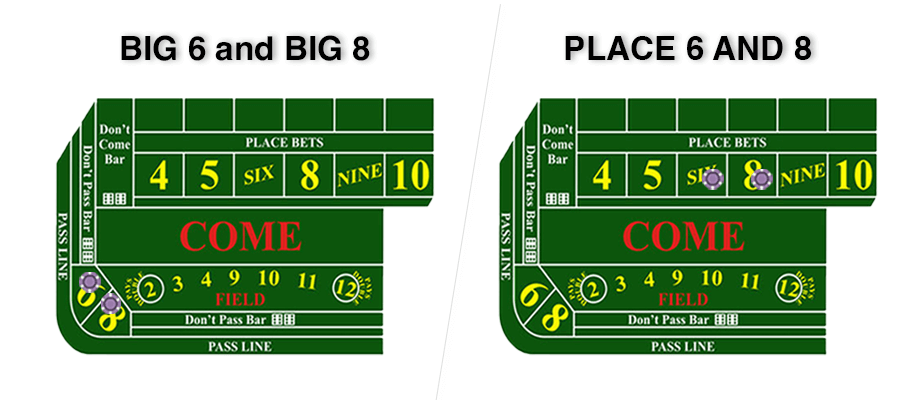
| Feature | Big 6 / Big 8 | Place Bet on 6 / 8 |
|---|---|---|
| Winning Condition | 6 (or 8) before 7 | 6 (or 8) before 7 |
| Payout | 1:1 (even money) | 7:6 |
| $6 Bet Pays | $6 | $7 |
| $12 Bet Pays | $12 | $14 |
| House Edge | 9.09% | 1.52% |
| Expected Loss Per $100 | $9.09 | $1.52 |
| Who Places It | Player (self-service) | Dealer (you tell them) |
| Can Be Taken Down? | Yes, anytime | Yes, anytime |
| Minimum Bet | Table minimum (any amount) | $6 (must be in multiples of $6) |
The numbers speak for themselves. The place bet on 6 and 8 costs 1.52% per dollar. The Big 6/8 costs 9.09%. That’s a ratio of nearly 6 to 1. You’re paying six times more for the identical outcome.
There is no mathematical scenario where the Big 6 or Big 8 is the correct bet. None. The place bet on 6/8 covers the exact same numbers, the exact same winning condition, and costs a fraction of the house edge. The Big 6/8 exists on the layout because it catches players who don’t know the difference. Now you know the difference. Tell the dealer “place the six and eight for twelve dollars” and skip the Big 6/8 forever. That single switch saves you roughly $7.57 per $100 wagered. Over a year of regular play, that’s hundreds of dollars.
Why the Big 6 and Big 8 Still Exist on the Layout
If the Big 6/8 is objectively worse than the place bet on 6/8, why does it still sit on the craps table in 2026? Two reasons.
First, the Big 6/8 is self-service. You place it yourself in the corner of the layout, right next to the pass line. No dealer interaction needed. For new players who feel intimidated by talking to the crew, it feels accessible. Place bets require you to hand chips to the dealer and say “place the six” or “place the eight.” That extra step of communication scares some beginners away. The casino knows this and profits from it.
Second, the Big 6/8 accepts any bet amount at table minimum, while place bets on 6 and 8 require multiples of $6 for clean payouts (since the payout is 7:6). At a $5 minimum table, you can put $5 on the Big 6. A $5 place bet on the 6 creates an awkward payout. Some players default to the Big 6/8 for simplicity without realizing the cost.
If you want the 6 or 8 and have less than $6 to bet, put that money behind your pass line bet as free odds instead (0% house edge). If the point is 6 or 8, your odds bet covers that number at a dramatically lower cost. If the point is a different number and you still want the 6/8, wait until you have $6 to place them properly. No amount of convenience justifies paying 9.09% when 1.52% is available for the same bet. For the full ranking of every bet by cost, see our best craps bets guide.
Some jurisdictions have actually removed the Big 6 and Big 8 from their craps table layouts. In Atlantic City, New Jersey gaming regulations eliminated the Big 6/8 from tables because it was considered deceptive, given that a better-paying option (the place bet) exists for the same outcome. If your casino still has it, that’s a sign you need to know the difference yourself since the casino won’t tell you.
The Math: Why 9.09% vs. 1.52% Matters So Much
Let’s translate the house edge difference into real session costs.
Big 8 at $10 per bet, 15 resolutions: Total action = $150. Expected loss: $150 x 9.09% = $13.64.
Place 8 at $12 per bet, 15 resolutions: Total action = $180. Expected loss: $180 x 1.52% = $2.74.
The place bet puts more money in action ($180 vs. $150) but costs $10.90 less in expected loss. You’re betting slightly more per resolution and losing dramatically less. That’s the power of a lower house edge.
Across a typical weekend session of 3 to 4 hours with the 6 or 8 active most of the time, the Big 6/8 could cost you $30 to $50 more than the place bet alternative. Over a year of monthly play, that gap reaches $360 to $600. For the identical outcome on the identical number. That’s real money left on the table for no reason.
How the Big 6 and Big 8 Compare to Other Craps Bets
Let’s put the Big 6/8 in context against the broader craps menu. The 9.09% house edge isn’t just bad relative to place bets. It’s bad relative to nearly everything on the table.
| Bet | House Edge | Cheaper Than Big 6/8? |
|---|---|---|
| Free Odds | 0% | Yes (infinitely) |
| Don’t Pass / Don’t Come | 1.36% | Yes |
| Pass Line / Come | 1.41% | Yes |
| Place 6 or 8 | 1.52% | Yes |
| Buy 4/10 (vig on wins) | 1.67% | Yes |
| Field (triple pay) | 2.78% | Yes |
| Place 5 or 9 | 4.00% | Yes |
| Field (standard) | 5.56% | Yes |
| Place 4 or 10 | 6.67% | Yes |
| Big 6 / Big 8 | 9.09% | Baseline |
| Hard 6 / Hard 8 | 9.09% | Same |
| Any Craps | 11.11% | No (worse) |
| Any Seven | 16.67% | No (worse) |
The Big 6/8 ties with hardways 6/8 at 9.09%, but hardways at least pay 9:1 on a specific pair. The Big 6/8 pays even money on any 6 or 8. It’s beaten by every line bet, every place bet, every buy bet, both field bet variants, and every lay bet. Only the center-table proposition bets (11% to 16.67%) cost more per dollar. For the complete payout breakdown, see our craps payout chart.
What to Bet Instead of the Big 6 and Big 8
If you want the 6 or 8 working for you, here are the correct options, ranked by house edge.
Option 1: Place Bet on 6 and 8 (1.52%)
Tell the dealer “place the six and eight for twelve dollars” (or $6 each). Pays 7:6. House edge: 1.52%. This is the direct replacement for the Big 6/8. Same winning condition. Better payout. Always bet in multiples of $6 for clean payouts.
Option 2: Come Bet With Odds (0.37% combined)
Place a come bet after the point is set. If the come bet moves to the 6 or 8, take maximum free odds behind it. The flat come bet costs 1.41%. The odds cost 0%. Combined edge: approximately 0.37% with 3x-4x-5x odds. This is the best way to have the 6 or 8 working if you’re willing to go through the come-out process. It’s also the foundation of the Three Point Molly strategy.
Option 3: Pass Line With Odds When the Point Is 6 or 8 (0.37% combined)
If the point established on the come-out roll is a 6 or 8, your pass line bet already covers that number. Take maximum free odds behind it. Combined edge: approximately 0.37%. You’re covered on the 6 or 8 at 24 times less cost than the Big 6/8.
If the point is 6 or 8, you already have that number working through your pass line bet. Adding a Big 6/8 on top is doubling your exposure on the same number at a terrible house edge. If you want additional number coverage, place the other number (the 6 if the point is 8, or vice versa) for $12. That gives you both the 6 and 8 at the table’s cheapest available edges. For the full craps strategy framework, see our dedicated guide.
- Self-service placement: no dealer interaction required, which feels easier for beginners
- Accepts any bet amount at table minimum (place bets need multiples of $6)
- Can be placed or removed at any time during a shooter’s turn
- 9.09% house edge, six times higher than the place bet on the same numbers (1.52%)
- Pays even money (1:1) on a bet the place version pays 7:6; you literally collect less per win
- Every dollar on the Big 6/8 is a dollar not on the place bet, pass line, or free odds
- No experienced player, no craps book, and no strategy guide recommends this bet
- Atlantic City removed it from their tables because it was considered misleading; that tells you everything
The Big 6 and Big 8: The One Bet You Should Never Make in Craps
The Big 6 and Big 8 teach one of the most valuable lessons in craps: two bets can look identical on the surface and cost wildly different amounts underneath. Same number. Same outcome. Six times the price. The casino put these boxes in the corner of the layout because they know some percentage of players will fill them without checking the craps payout chart first.
Don’t be that player. Tell the dealer “place the six and eight” and watch the 7:6 payouts hit your chip rail instead of the even-money scraps the Big 6/8 delivers. Practice the call on our free craps simulator if you’re not comfortable talking to the crew yet. That 30 seconds of practice is worth hundreds of dollars over your craps career. The Big 6 and Big 8 are the one bet where the answer is always the same, at every casino, in every situation, for every player: skip it.
Best Online Craps Casinos (Last Updated September 2026)





Big 6 and Big 8 Bets FAQs
The Big 6 and Big 8 are multi-roll bets that win if the shooter rolls a 6 (or 8) before rolling a 7. They pay even money (1:1) and carry a 9.09% house edge. They’re located in the corner of the craps table layout and are self-service bets placed by the player, not the dealer.
The place bet on 6/8 covers the exact same outcome (6 or 8 before 7) but pays 7:6 instead of even money, with a 1.52% house edge instead of 9.09%. You collect less and pay six times more in house edge for the identical result. There’s no mathematical reason to choose the Big 6/8 over the place bet. See our best craps bets for the full ranking.
Both pay even money (1:1). A $10 bet returns $10 in profit. Compare that to the place bet on 6/8, which pays 7:6. A $6 place bet on the same number returns $7 in profit. The Big 6/8 pays $1 less per $6 wagered for the identical outcome.
The house edge is 9.09%. For every $100 wagered, the casino expects to keep $9.09. The place bet on 6/8 costs only 1.52% ($1.52 per $100). The Big 6/8 is six times more expensive per dollar than its direct alternative. Full edge comparisons are in our craps payout chart.
No. Beginners should bet the pass line with free odds first. If you want the 6 or 8 working, tell the dealer “place the six” or “place the eight” for $6 (or multiples of $6). Dealers help beginners constantly; just say “I’m new” and they’ll walk you through it. The place bet costs 1.52% versus 9.09% for the Big 6/8. Learning to communicate with the crew is worth the effort. Practice first on our free craps simulator.
No. The Big 6 and Big 8 are multi-roll bets that stay active until the 6 (or 8) appears before the 7, or the 7 appears first. They can last for many rolls. You can take them down at any time. This is the same structure as place bets on the same numbers.
