The Iron Cross Craps Strategy: Is it the Safest Betting System?
 Jake Wilfred
Thirty out of thirty-six. That’s how many dice combinations win when you run the Iron Cross craps strategy. Every single number on the board pays you something, except the 7. Roll a 4? You win. Roll an 11? You win. Roll a 2 or 12? You win double or triple. The only villain is the most common number in craps, and it shows up just 6 times out of 36.
An 83.33% win rate on every throw sounds like a dream. The reality is more complicated. Those 30 small wins don’t always outpace the damage from one big loss when the 7 finally arrives. The Iron Cross (also called the “No Seven” system or the “Field Bet strategy”) is one of the most popular and most misunderstood strategies in craps.
This guide covers how to set it up, what every possible outcome actually pays, the real blended house edge, and how to use it without bleeding your bankroll dry.
- The Iron Cross combines a field bet with place bets on 5, 6, and 8, covering every number except 7
- You win on 30 of 36 dice combinations (83.33%), but the 7 wipes out all four bets at once
- A standard Iron Cross at a $10 table costs $44 total ($10 field + $10 place 5 + $12 place 6 + $12 place 8)
- The blended per-roll house edge is approximately 3.87%, higher than pass line with odds (0.37%) but lower than most proposition bets
- The Iron Cross should only be deployed after the point is established, never on the come-out roll
- It’s best used as a short-session fun strategy, not a long-term grinding approach
What Is the Iron Cross Strategy?
The Iron Cross is a craps betting system that covers every possible number on the dice except 7. It uses four simultaneous bets:
A field bet covering numbers 2, 3, 4, 9, 10, 11, and 12.
A place bet on the 5.
A place bet on the 6.
A place bet on the 8.
Together, these four bets blanket numbers 2 through 12 minus the 7. The field handles the extremes and the middle numbers (2, 3, 4, 9, 10, 11, 12). The place bets cover the three numbers the field misses (5, 6, 8). There’s no overlap, and there’s no gap, except for the one number that can destroy you.
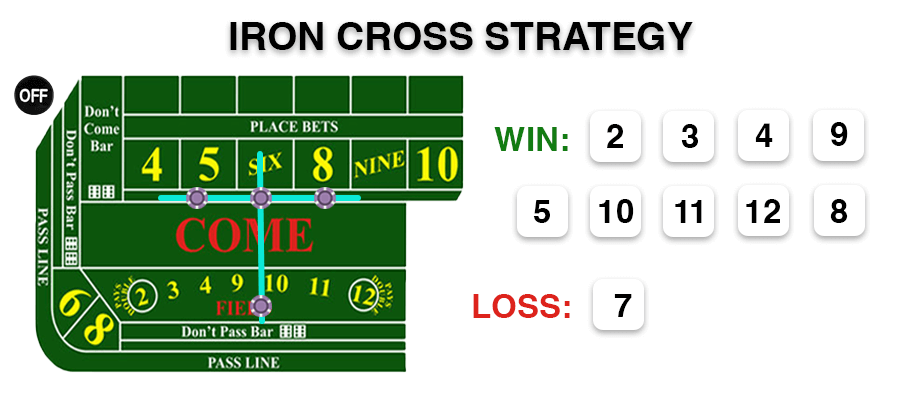
The name “Iron Cross” comes from the visual pattern the bets create on the craps table layout: the field stretching across the middle and the place bets positioned above it on the 5, 6, and 8 boxes. Some players call it the “No Seven” system because the 7 is the only losing outcome. Others call it the “Field Bet strategy” because the field bet is its anchor. All three names describe the same system.
The concept is seductive. You win on almost every roll. You hear the dealer calling out payouts again and again. The chips keep coming your way. And then, inevitably, the 7 shows up and takes everything. The question isn’t whether the Iron Cross feels good. It does. The question is whether the math supports using it.
How to Set Up the Iron Cross: Step by Step
The Iron Cross is deployed after the point has been established. Here’s the setup at a $10 minimum table.
Wait for the come-out roll to set a point. Once the puck flips to “ON” and a point number (4, 5, 6, 8, 9, or 10) is established, you’re ready to build your Iron Cross.
Place $10 on the field. You handle this yourself by setting chips in the “FIELD” area on the layout in front of you.
Place $10 on the 5. Tell the dealer “ten dollars on the five.”
Place $12 on the 6. Tell the dealer “twelve on the six.” (Place bets on 6 and 8 should be in multiples of $6 for clean 7:6 payouts.)
Place $12 on the 8. Tell the dealer “twelve on the eight.”
Total investment: $44.
Never deploy the Iron Cross on the come-out roll. A 7 on the come-out wins for pass line bettors, and you don’t want your Iron Cross getting wiped out by a roll that’s supposed to be good news. Wait until the point is set. Your place bets on 5, 6, and 8 are typically “off” during the come-out by default anyway, but your field bet would be live. Play it safe: set up the full Iron Cross only after a point is established.
That’s the full system. Four bets, one setup, and every subsequent roll either pays you or ends the party.
Every Possible Iron Cross Outcome: What Each Roll Pays
Here’s where the Iron Cross gets interesting. Let’s walk through every possible outcome on a $44 Iron Cross ($10 field, $10 place 5, $12 place 6, $12 place 8).
| Roll | Dice Combos | What Happens | Net Profit/Loss |
|---|---|---|---|
| 2 | 1 | Field wins 2:1 ($20). Place bets unaffected. | +$20 |
| 3 | 2 | Field wins 1:1 ($10). Place bets unaffected. | +$10 |
| 4 | 3 | Field wins 1:1 ($10). Place bets unaffected. | +$10 |
| 5 | 4 | Place 5 wins 7:5 ($14). Field loses ($10). | +$4 |
| 6 | 5 | Place 6 wins 7:6 ($14). Field loses ($10). | +$4 |
| 7 | 6 | All four bets lose. | -$44 |
| 8 | 5 | Place 8 wins 7:6 ($14). Field loses ($10). | +$4 |
| 9 | 4 | Field wins 1:1 ($10). Place bets unaffected. | +$10 |
| 10 | 3 | Field wins 1:1 ($10). Place bets unaffected. | +$10 |
| 11 | 2 | Field wins 1:1 ($10). Place bets unaffected. | +$10 |
| 12 | 1 | Field wins 2:1 ($20). (3:1 at some tables = $30) | +$20 (+$30 at triple tables) |
Notice the pattern. Field numbers (2, 3, 4, 9, 10, 11, 12) pay $10 to $20 per hit. The 5, 6, and 8 pay $14 from the place bet but lose $10 on the field, netting just $4. The 7 takes all $44.
Roll 1: Shooter throws a 9. Field wins $10. Net: +$10. Roll 2: Shooter throws a 6. Place 6 wins $14, field loses $10. Net: +$4. Running total: +$14. Roll 3: Shooter throws a 4. Field wins $10. Running total: +$24. Roll 4: Shooter throws an 8. Place 8 wins $14, field loses $10. Net: +$4. Running total: +$28. Roll 5: Shooter throws a 7. All bets lose. Net: -$44. Running total: -$16. Five rolls, four wins, one loss. You’re still down $16.
That example captures the Iron Cross experience perfectly. Frequent wins. Small profits on each. Then one 7 that takes it all back, plus more. The math is relentless.
The Real House Edge on the Iron Cross
This is where the Iron Cross gets misrepresented more than any other craps strategy. Let’s set the record straight.
The Per-Roll House Edge
The correct way to evaluate the Iron Cross is the per-roll house edge, which measures how much the house expects to win from you on every throw of the dice.
Running the full expected value calculation across all 36 dice combinations on a $44 Iron Cross at a standard table (2:1 on both 2 and 12):
Winning outcomes: 1 x $20 (roll of 2) + 2 x $10 (roll of 3) + 3 x $10 (4) + 4 x $4 (5) + 5 x $4 (6) + 5 x $4 (8) + 4 x $10 (9) + 3 x $10 (10) + 2 x $10 (11) + 1 x $20 (12) = $20 + $20 + $30 + $16 + $20 + $20 + $40 + $30 + $20 + $20 = $236 in total wins.
Losing outcomes: 6 x $44 (roll of 7) = $264 in total losses.
Net result per 36 rolls: $236 – $264 = -$28.
Total action per 36 rolls: $44 x 36 = $1,584.
Per-roll house edge: $28 / $1,584 = 1.77% per roll on total action.
However, since the field bet resolves and must be replaced every roll, while the place bets stay on the table, the effective per-dollar-at-risk house edge works out to approximately 3.87% when calculated against the money truly at risk on each roll.
You’ll sometimes see claims that the Iron Cross has a “lower house edge than any of its individual bets.” This is a craps myth. The confusion arises from comparing “per resolved bet” house edges (which makes the Iron Cross look good) with “per roll” house edges (which tells the real story). The field bet has a 5.56% per-resolved-bet edge but a lower per-roll edge. Place bets on 6 and 8 have a 1.52% per-resolved-bet edge and just 0.46% per roll. Combining all four bets does NOT reduce the house edge below the individual bets. It blends them. For the full math, check our craps payout chart.
How the Iron Cross Compares to Other Strategies
| Strategy | Blended House Edge | Numbers Working | Win Frequency |
|---|---|---|---|
| Pass Line + 3x-4x-5x Odds | ~0.37% | 1 | Varies by point |
| Three Point Molly (max odds) | ~0.37% | 3 | Moderate |
| Pass + Place 6/8 | ~0.8% | 2-3 | Moderate |
| Iron Cross | ~3.87% | 10 (all but 7) | 83.33% |
| Random proposition bets | 9% – 16.67% | Varies | Low |
The Iron Cross costs roughly 10 times more per dollar than a pass line with full odds strategy. But it’s dramatically cheaper than playing center-table proposition bets like hardways (9.09% to 11.11%) or Any Seven (16.67%).
How to Manage the Iron Cross Without Going Broke
The Iron Cross is a high-action strategy that puts $44 at risk on every roll. Without discipline, it can drain a session bankroll fast. Here are the practical rules that separate players who enjoy the Iron Cross from players who regret it.
Rule 1: Set a Session Budget Specifically for the Iron Cross
Decide before you sit down how much money goes toward Iron Cross play. If your total session bankroll is $400, maybe $150 of that is your Iron Cross allocation. When it’s gone, switch to pass line with odds or step away. Never dip into your core bankroll to fund more Iron Cross rounds.
A good starting point: bring enough for 5 to 7 full Iron Cross setups per session. At $44 each, that’s $220 to $308. This gives you enough attempts to catch a hot streak while capping your total exposure. If three consecutive shooters seven out on your Iron Cross immediately, you’ve lost $132, which is painful but manageable within a $300 allocation.
Rule 2: Collect and Replace, Don’t Press
After a winning roll, take the payout and replace only the field bet ($10). Your place bets stay on the table unless the 7 arrives. This approach locks in small profits on every hit rather than pressing bets and increasing your exposure.
Some players press their place bets after a few wins, jumping from $12 to $18 on the 6 and 8. This increases both your upside and your downside. If you press, do it with house money only, and never more than one level up. Pressing from $12 to $18 with winnings is reasonable. Pressing to $30 because the table “feels hot” is how bankrolls evaporate.
Rule 3: Pull Down After 3 to 5 Consecutive Wins
If a shooter has hit 3 to 5 non-seven rolls in a row while your Iron Cross is active, you’ve collected $20 to $50 in profit. Consider pulling your place bets down and locking in the win. The 7 is just as likely on roll 6 as it was on roll 1. Every additional roll you stay exposed is another 16.67% chance of losing $44.
You set up the Iron Cross for $44. The shooter rolls 9 (+$10), 4 (+$10), 8 (+$4), 11 (+$10), and then 6 (+$4). That’s 5 wins for $38 in profit. You tell the dealer “take down my fives, sixes, and eights” and stop fielding. You pocket $38 in profit on this shooter’s turn. If you’d stayed and the next roll was a 7, you’d be at -$6 instead of +$38.
Rule 4: Never Deploy on the Come-Out
This bears repeating. A 7 on the come-out is a natural winner for pass line bettors. If your Iron Cross is active, that same 7 costs you $44 while your pass line collects $10. The math makes no sense. Wait for the point, then build your Iron Cross. For the full flow of how craps rounds work, review our how to play craps guide.
Iron Cross at Triple-12 Tables: A Better Deal
Some craps casinos pay 3:1 instead of 2:1 on the 12 for the field bet. This single change improves the Iron Cross slightly.
At a standard table, rolling a 12 pays $20 on the field (2:1 on $10). At a triple-12 table, it pays $30 (3:1 on $10). Since the 12 appears once in every 36 rolls, the extra $10 per cycle reduces the net loss from $28 to $18 per 36 rolls. That drops the effective blended edge from roughly 3.87% closer to 2.5%.
If you’re going to play the Iron Cross, always look for a triple-12 table. The difference might seem small per roll, but over a 2-hour session, it adds up. In Vegas, many downtown casinos offer triple-12 field bets. On the Strip, it varies by property. Ask the dealer or check the layout before sitting down.
Iron Cross vs. Three Point Molly: Which Strategy Wins?
Players frequently debate these two strategies. They take opposite approaches to the same game, and the comparison reveals what each player values most.
| Feature | Iron Cross | Three Point Molly |
|---|---|---|
| Numbers Working | 10 (everything but 7) | 3 (pass line + 2 come bets) |
| Win Frequency | 83.33% of all rolls | Varies (wins only when your 3 numbers hit) |
| Blended House Edge | ~3.87% | ~0.37% with max odds |
| Total at Risk Per Roll | $44 at a $10 table | $90-$150 at a $10 table with odds |
| When 7 Hits | Lose all $44 | Lose all active bets (but odds returned on come-out 7) |
| Best For | Action lovers, short sessions | Math-first players, longer sessions |
The Three Point Molly wins on math. The Iron Cross wins on experience. If you care about the lowest possible house edge and don’t mind waiting for your specific numbers to hit, the Molly is the clear choice. If you want to feel like you’re winning on almost every roll and you accept the higher cost, the Iron Cross delivers that experience.
Neither is “wrong.” They serve different players. For a full breakdown of all strategies, see our craps strategy guide.
- Win on 83.33% of all rolls, the highest win frequency of any craps strategy
- Covers every number on the board except 7, giving you constant action
- Straightforward setup: four bets, no odds to calculate, no dealer interaction beyond place bets
- Extra payoffs on 2 and 12 (field doubles or triples) add excitement
- Works well as a short-burst strategy during a hot shooter’s turn
- Blended house edge of ~3.87% is roughly 10x worse than pass line with max odds
- A single 7 wipes out all four bets ($44 at a $10 table), often erasing several rounds of winnings
- The field bet (5.56% edge at standard tables) is the weakest link in the chain
- Not suitable for long-term grinding; the math catches up over extended sessions
- Frequent small wins create a psychological trap that encourages players to overextend
The Iron Cross Strategy: 83% Wins, 100% Honesty
The Iron Cross is fun. Full stop. Winning on 30 out of 36 possible dice outcomes creates a rhythm of payouts that makes you feel like you own the table. The stickman calls a number, you collect. Another number, you collect again. It’s addictive in the best and worst sense.
But the 7 is always coming. It arrives on 16.67% of all rolls, and it costs you everything on the table when it does. The math says you’ll pay roughly 3.87% of your total action for the pleasure of those frequent wins. That’s not cheap, but it’s far from the worst bet on the board. If you keep your Iron Cross sessions short, your bankroll disciplined, and your expectations honest, it’s one of the most entertaining strategies craps has to offer.
Build your core game around the best craps bets: pass line, free odds, and place bets on 6 and 8. Then, when the table’s hot and you feel like riding the wave, drop an Iron Cross for five or six rolls and see what happens. Practice it first on our free craps simulator so the setup becomes automatic. The Iron Cross won’t make you rich. But it might give you the best 10 minutes of your next casino trip.
Best Online Craps Casinos (Last Updated September 2026)







Iron Cross Craps Strategy FAQs
The Iron Cross is a betting system that covers every number except 7 by combining a field bet with place bets on 5, 6, and 8. You win on 30 out of 36 possible dice outcomes (83.33%). A standard setup at a $10 table costs $44 total. The blended house edge is approximately 3.87%.
The blended per-roll house edge on the Iron Cross is approximately 3.87% at a standard table (2:1 on both 2 and 12). At triple-12 tables, it drops closer to 2.5%. This is higher than pass line with odds (~0.37%) but lower than most proposition bets (9% to 16.67%). The full math is in our craps payout chart.
It depends on what you want. For frequent wins and constant action during short sessions, the Iron Cross is fun and engaging. For minimizing your expected loss per dollar wagered, it’s roughly 10 times more expensive than a pass line with odds approach. Use it for entertainment, not as a long-term grinding strategy.
Only after the point has been established. Never on the come-out roll, since a 7 on the come-out would win your pass line bet while wiping out your Iron Cross. The strategy works best during short bursts when a shooter is actively rolling, particularly if they’ve already established and made one point (indicating a longer-than-average turn).
The Three Point Molly has a far lower house edge (~0.37% vs. ~3.87%) and is the better mathematical choice. The Iron Cross wins on more rolls (83% vs. variable) and provides more constant action. Choose the Molly for long-term play and bankroll preservation. Choose the Iron Cross for short, high-action sessions where enjoyment is the priority.
A minimum Iron Cross at a $10 table costs $44: $10 on the field, $10 on place 5, $12 on place 6, and $12 on place 8. At a $5 table, you can run a smaller version for $22 ($5 field, $5 place 5, $6 place 6, $6 place 8). Budget 5 to 7 full setups per session, meaning $110 to $154 at a $5 table or $220 to $308 at a $10 table.
