Craps Strategy Guide: Proven Systems for Every Skill Level in 2026
 Jake Wilfred
Two players sit down at the same $10 craps table with $300 each. Player A bets $10 on the pass line, takes no odds, tosses $5 on hardways every other roll, and throws a few bucks at proposition bets when the stickman calls them out.
Player B bets $10 on the pass line, takes maximum free odds, and adds place bets on 6 and 8 after the point. Same table. Same dice. Wildly different expected results. After two hours, Player A’s blended house edge sits somewhere around 4 to 5%. Player B’s? Below 1%. That gap is what a craps strategy does. It doesn’t change the dice.
It changes where your money goes, and that changes everything. This guide covers strategies for beginners, intermediate players, and advanced grinders, along with bankroll management, dice control, and the math behind each approach.
- The single most impactful craps strategy is taking maximum free odds behind your pass line bet, dropping the combined house edge below 0.50%
- Beginners should start with pass line only (1.41% house edge), then graduate to pass line plus odds
- The Three Point Molly (pass line + 2 come bets, all with max odds) is the gold standard for intermediate and advanced players
- The Iron Cross covers every number except 7 but carries a blended house edge of roughly 3.9%, making it fun but not optimal
- No craps strategy eliminates the house edge; the goal is to minimize it while maximizing your time and enjoyment at the table
- Bankroll management matters as much as bet selection; without session limits and walk-away rules, even perfect strategy fails
Before You Pick a Strategy: The Foundation
Every craps strategy rests on the same three pillars. Get these right, and whatever system you choose will work as well as the math allows. Get them wrong, and the best strategy in the building won’t save your bankroll.
Know the Bets and Their Costs
Not all craps bets are created equal. The pass line costs you 1.41% per dollar wagered. The don’t pass costs 1.36%. Free odds cost 0%. Place bets on 6 and 8 cost 1.52%. Meanwhile, center-table proposition bets range from 9% to 16.67%.
Every dollar that moves from a low-edge bet to a high-edge bet increases your expected loss per hour. Strategy, at its core, is about keeping your money on the cheap side of the table.
| Bet | House Edge | Strategic Role |
|---|---|---|
| Free Odds | 0% | Core (always max out) |
| Don’t Pass | 1.36% | Core (dark side) |
| Pass Line | 1.41% | Core (right side) |
| Come / Don’t Come | 1.41% / 1.36% | Core (number expansion) |
| Place 6 or 8 | 1.52% | Supporting |
| Buy 4 or 10 (vig on win) | 1.67% | Supporting |
| Field (triple 12) | 2.78% | Situational |
| Hardways | 9.09% – 11.11% | Entertainment only |
| Any Seven | 16.67% | Avoid |
A complete breakdown of every wager’s odds is in our craps payout chart. Bookmark it. Refer to it before every session until the numbers are burned into memory. And if you’re still getting comfortable with how the game flows, start with our how to play craps guide before jumping into strategy.
Size Your Bankroll to Your Strategy
The most sophisticated strategy in craps is worthless if you run out of chips before it has time to work. A bankroll management plan sets your session size, loss limit, and win goal before you touch a chip.
Bring 30 to 50 times your base bet as a session bankroll. For a $10 table, that’s $300 to $500. Set a loss limit at 40 to 50% of that session bank and a win goal at 30 to 50%. Hit either number and walk. No exceptions. The discipline to leave a table is the single highest-value skill in craps, and no strategy guide can teach it. You have to practice it.
Practice Before You Risk Real Money
Our free craps simulator lets you test every strategy in this guide without risking a cent. Run each system for 50 simulated sessions. Track your results. Get the bet placement rhythm into muscle memory so you’re not fumbling with chips at a live table.
Beginner Craps Strategies
If you’re still learning the game or have fewer than 10 live sessions under your belt, these are your strategies. They’re built on the lowest-edge bets with the simplest execution.
Strategy 1: Pass Line Only
The simplest craps strategy that exists. Bet the table minimum on the pass line before the come-out roll. If 7 or 11 hits, you win even money. If 2, 3, or 12 hits, you lose. Any other number sets the point. You win if the point repeats before a 7; you lose if the 7 comes first.
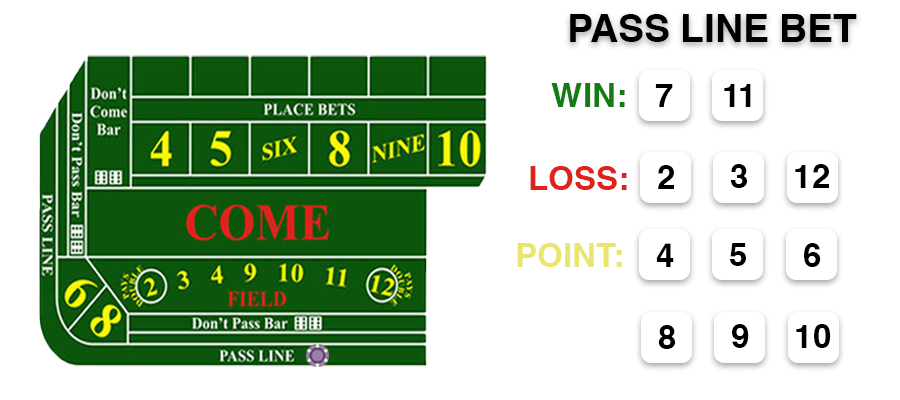
House edge: 1.41%. Expected loss: $1.41 per $100 wagered.
This is the cheapest standalone bet on the right side of the table. It’s where every craps player should start.
You buy in for $300 (30 units). Every come-out roll, you bet $10 on the pass line. No odds, no place bets, no props. Over a 2-hour session averaging 60 decisions, you’ll put roughly $600 in action. Expected loss: $600 x 1.41% = $8.46. That’s less than the cost of two drinks. You’ll have swings above and below that number, but mathematically, this is one of the cheapest sessions in the casino.
Strategy 2: Pass Line With Odds
This is Strategy 1 with a turbocharger. After the point is set, place additional chips behind your pass line bet. These odds bets pay at true mathematical odds with a 0% house edge.
The more odds you take, the lower your combined house edge drops. With 3x-4x-5x odds (the most common structure), the blended edge falls to approximately 0.37%. That’s 37 cents per $100 wagered.
The golden rule of craps strategy: min on the line, max on the odds. Your flat bet carries the house edge. Your odds bet carries nothing. The more of your total action that sits in odds, the less you pay the house overall. If you have $60 to bet per roll, you’re better off with $10 on the pass line and $50 in odds than $60 on the pass line with no odds. Same risk, drastically different cost.
Strategy 3: Don’t Pass With Lay Odds
The dark side mirror of Strategy 2. Bet don’t pass (1.36% house edge) and lay maximum odds after the point. Combined house edge with 3x-4x-5x lay odds: approximately 0.27%.
This is mathematically the cheapest line bet approach in craps. The trade-offs: you lose more often on the come-out roll (8 ways to lose on 7/11 vs. 3 ways to win on 2/3), and you’re betting against the table, which can feel socially awkward. See our don’t pass guide for the full breakdown on dark side play and craps etiquette for handling the table dynamics.
- Lowest house edges available (0.27% to 1.41% depending on approach)
- Simple execution: one or two bets per roll, minimal dealer interaction
- Easy to track wins and losses mentally
- Requires smaller bankroll than multi-bet strategies
- Only one number working at a time (less action)
- Hot rolls can pass you by without much benefit since you have limited table coverage
- Can feel slow compared to more active strategies
Intermediate Craps Strategies
Once you’re comfortable with the pass line, odds, and basic table flow, these strategies give you more numbers working while keeping the house edge low.
Strategy 4: Pass Line + Odds + Place 6 and 8
This is the most popular craps strategy among regular players, and for good reason. After the point is established, you take max odds and add place bets on 6 and 8 (1.52% house edge each). Now you have three numbers earning money for you on every roll.
The come-out roll is a 9. You have $10 on the pass line. You take $40 in 4x odds behind it. You place $12 on the 6 and $12 on the 8. Total at risk: $74. If the 9 hits, you win $10 (flat) + $60 (odds at 3:2) = $70. If the 6 or 8 hits, you win $14 (7:6 payout). A 7 costs you the full $74. The blended house edge across all your action is roughly 0.8%, which is excellent.
If the point is already 6 or 8, skip the place bet on that number since your pass line already covers it. Place the other number and consider adding a come bet for additional coverage.
If you want action on the 4 or 10 as well, buy them instead of placing them. The buy bet on 4/10 has a 4.76% house edge (or just 1.67% if the casino charges vig only on wins), compared to 6.67% for the place bet on those numbers. Always buy the 4 and 10; always place the 6 and 8.
Strategy 5: The Three Point Molly
The Three Point Molly is the gold standard for players who want low house edge and multiple numbers working simultaneously. It’s built entirely on the table’s best bets: pass line, come bets, and free odds on everything.
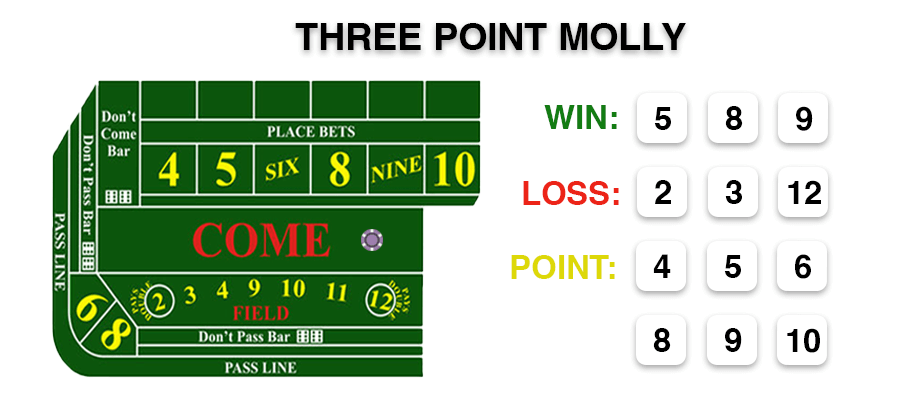
Here’s how it flows:
Place a pass line bet. Once the point is set, take maximum odds. On the next roll, place a come bet. When it moves to a number, take max odds on it. On the following roll, place another come bet and take max odds when it settles. You now have three numbers active: the pass line point plus two come points, all backed with maximum odds.
The goal: always have three numbers working. If one hits, collect the payout and immediately replace it with a new come bet.
Pass line bet: $10, point is 8. Odds: $50. First come bet: $10, moves to 5. Odds: $40. Second come bet: $10, moves to 10. Odds: $30. Total exposure: $150 across three numbers. Combined house edge on all of it: approximately 0.37%. If the 5 hits, you collect $10 (flat) + $60 (odds at 3:2) = $70 profit on that bet, then place a new come bet on the next roll.
The Three Point Molly’s weakness: a 7 after the point is set kills all three bets simultaneously. That hurts. But the odds portions on your come bets are typically returned on a come-out 7 (since odds default to “off” during the come-out), which softens the blow. Over time, the sub-0.50% blended house edge makes this one of the best mathematical positions available in any online craps casino.
The Three Point Molly requires a larger bankroll than single-bet strategies because you have $100 to $150+ at risk across three numbers. Budget 40 to 50 units for a session bank. At a $10 table with max odds, that’s $400 to $500. Our dedicated Three Point Molly strategy guide covers the full step-by-step with additional examples.
Advanced Craps Strategies
These strategies carry higher house edges than the foundational approaches but offer different risk-reward profiles and playing styles. They’re best suited for experienced players who understand the math and choose these systems with open eyes.
Strategy 6: The Iron Cross
The Iron Cross (also called the “No Seven” system) covers every number on the board except 7. After the point is established, you combine a field bet with place bets on 5, 6, and 8.
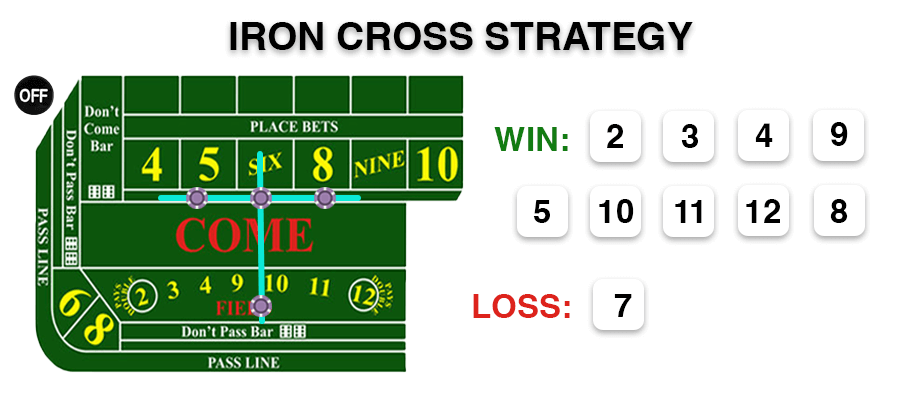
You win on 30 out of 36 dice combinations. Only the 7 (6 combinations) beats you. That 83% win rate feels incredible in practice. The catch: when the 7 hits, you lose everything on the table, and the winnings from those frequent small hits rarely make up for the one big loss.
Point is established. You bet $10 on the field, $10 on place 5, $12 on place 6, and $12 on place 8. Total: $44. A roll of 3 wins $10 on the field (1:1). A roll of 6 wins $14 on the place bet but loses $10 on the field (net +$4). A roll of 7 loses all $44. The blended house edge is roughly 3.9%.
The Iron Cross is often misrepresented as having a lower house edge than its individual bets. That claim is based on comparing “per resolved bet” edges rather than “per roll” edges. The per-roll house edge on the Iron Cross is higher than pass line with odds or the Three Point Molly. It’s a fun strategy that delivers frequent small wins, but it’s not mathematically optimal. Play it for the experience, not the expected value. Full details are in our Iron Cross strategy guide.
Strategy 7: Early Bet Regression
This is a professional-style approach that takes larger initial risk, captures quick wins, then reduces exposure. Here’s the concept:
Start with larger-than-normal inside bets ($22 inside or $44 inside). After hitting two winners, regress your bets by 50 to 66%. The initial hits pay for the reduced bets, leaving you with “house money” working at lower risk.
You place $44 inside ($10 each on 5 and 9, $12 each on 6 and 8). The 6 hits: $14 payout. The 9 hits: $14 payout. Total collected: $28. You tell the dealer “regress to $22 inside” ($5 on 5 and 9, $6 on 6 and 8). The $22 remaining is fully paid for by your $28 in winnings. You pocket $6 in guaranteed profit and continue with zero out-of-pocket risk on the inside numbers. If the 7 shows now, you’ve already locked in a win.
Regression requires the shooter to hit at least two inside numbers before the 7. If the 7 comes early, you take a full loss on the larger initial bet. The math doesn’t favor this approach over simply betting smaller from the start. But the psychological benefit of playing on house money after two hits is significant for many players.
Regression works best when you combine it with observation. If you’ve watched a shooter establish a point and make it once or twice already (meaning they’re already in a longer-than-average roll), that’s a reasonable time to set up an inside bet and plan a regression after two hits. It’s not guaranteed, but you’re entering during a shooter’s proven active turn. Our tips for winning at craps guide covers additional practical approaches.
Dice Control: The Controversial Strategy
Dice setting (also called dice control or precision shooting) is the most debated topic in craps. The premise: by holding the dice in a specific orientation and delivering them with a controlled throw, you can reduce the frequency of the 7 and shift the odds slightly in your favor.
How Dice Setting Works
The theory starts with the 36 dice combinations possible on two dice. A random throw produces a 7 roughly 16.67% of the time (6 out of 36 combinations). If a controlled throw can reduce that to, say, 15% or 14%, the player gains a mathematical edge on bets like the pass line and place bets.
Practitioners focus on three elements: the set (how you orient the dice before throwing), the grip (how you hold them), and the delivery (how you release them so they travel together with minimal rotation). The most popular set for beginners is the “Hard Ways set,” where both dice show matching pairs (like 3-3 on one face and 4-4 on the adjacent face). This set minimizes the faces that produce a 7 on the axis of rotation.
Dice control is scientifically unproven. No controlled laboratory study has confirmed that a skilled shooter can meaningfully influence outcomes in a casino setting. Mathematician Michael Shackleford (the “Wizard of Odds”) remains skeptical, while authors like Frank Scoblete and Stanford Wong argue it’s viable based on personal experience and private testing. The debate continues. Our dice setting guide and dice sliding vs. dice control article cover both sides in detail.
Practical Dice Control Tips
If you want to experiment with dice control, here are the basics. Hold the dice with a pinch grip: four fingers on the front, thumb on the back, pressing gently to keep them together. Position them parallel to the back wall. Release at about three-quarters of your arm’s forward motion, aiming to land the dice a few inches in front of the back wall so they touch it softly rather than slamming into it.
Practice at home on a regulation-length table (or at least on a felt surface with a back wall) before trying it in a casino. Track your results. If you can consistently reduce your sevens-to-rolls ratio below 1:6 over hundreds of throws, the theory says you have an edge.
Casino rules require the dice to hit the back wall on every throw. If you consistently short-throw (dice don’t reach the wall), the boxman will warn you and potentially take the dice away. Controlled shooting must work within these rules, not around them. Follow proper craps etiquette and you’ll have no problems.
Betting Systems That Don’t Work (and Why)
Progressive betting systems (Martingale, d’Alembert, Fibonacci) are popular in craps forums and terrible in practice. Let’s address them briefly.
The Martingale doubles your bet after each loss. One win recovers everything plus one unit. The problem: table limits cap your ability to double, and a streak of 7 losses (which happens regularly) pushes your bet to $1,280 on a $10 base. You’re risking $1,280 to win $10.
The d’Alembert adds one unit after a loss and subtracts one after a win. Gentler, but still based on the false assumption that wins and losses balance out. Each roll is independent. The dice have no memory. That’s one of the most persistent craps myths.
The Fibonacci follows the sequence (1, 1, 2, 3, 5, 8, 13…) after losses. Same flaw. No progression system changes the probability of any individual bet winning.
If someone tells you they have a “system” that beats craps, ask them one question: “Does your system change the house edge on any individual bet?” If the answer is no (and it’s always no), the system doesn’t work. It just rearranges your losses. The only things that actually lower your expected loss are bet selection (choosing low-edge bets) and odds (backing them with 0% house edge wagers). Everything else is window dressing.
Quick-Reference Strategy Comparison
| Strategy | Skill Level | Blended House Edge | Bankroll Needed (per session) | Numbers Working |
|---|---|---|---|---|
| Pass Line Only | Beginner | 1.41% | $150 – $200 | 1 |
| Pass Line + Max Odds | Beginner | ~0.37% | $300 – $400 | 1 |
| Don’t Pass + Lay Odds | Beginner | ~0.27% | $400 – $500 | 1 |
| Pass + Odds + Place 6/8 | Intermediate | ~0.8% | $300 – $500 | 2-3 |
| Three Point Molly | Intermediate/Advanced | ~0.37% | $400 – $600 | 3 |
| Iron Cross | Advanced | ~3.9% | $300 – $500 | 10 (all but 7) |
| Regression | Advanced | Varies | $300 – $500 | 4 (inside numbers) |
Choosing the Right Craps Strategy for Your Game
Your ideal strategy depends on three things: your bankroll, your experience level, and what you want from a session.
If your priority is minimizing losses, play don’t pass with maximum lay odds. The 0.27% combined edge is the cheapest position in the casino. You’ll win quietly and steadily.
If you want the best balance of action and math, the Three Point Molly is your answer. Three numbers working, all with max odds, all at sub-0.50% combined edge. It requires a bigger bankroll and more table confidence, but the math is nearly unbeatable.
If you want maximum action and frequent wins, the Iron Cross delivers. You’ll win on 83% of rolls, which feels fantastic. The 3.9% blended edge means you’ll pay more per hour than a Molly player, but you’ll have a lot more fun on the way there. It’s a great session strategy for Vegas trips where enjoyment matters as much as expected value.
If you’re brand new, start with pass line and single odds. Get comfortable with the rhythm of the table. Learn the craps table layout, the terminology, and the flow of a shooter’s turn. Then graduate to the Three Point Molly or the Pass + Place 6/8 approach once you can execute without thinking.
For a complete guide to which individual bets deserve your money, see our best craps bets page. For deeper reading on the game itself, our best craps books guide covers the top titles for every skill level.
The Only Craps Strategy That Truly Works: Math, Discipline, and Walking Away
Here’s the honest truth about craps strategy in 2026. No system eliminates the house edge. The casino will always have a mathematical advantage on every bet except free odds. What strategy does is minimize that advantage, stretch your bankroll further, and put you in position to walk away during the short-term swings where you’re ahead.
The players who consistently leave craps tables with money aren’t the luckiest. They’re the ones who bet minimum on the line, max on odds, skip the center-table props, set session limits, and actually walk when those limits are hit. They understand the math. They respect the math. And they play within it.
That’s the entire craps strategy playbook in one paragraph. The details above give you the specific structures. The discipline is on you.
Best Online Craps Casinos (Last Updated September 2026)






Craps Strategy Guide FAQs
Start with a pass line bet at table minimum and take maximum free odds after the point is set. This gives you a combined house edge of roughly 0.37% with 3x-4x-5x odds. It’s the simplest strategy with the best math, and it requires only one decision per come-out roll.
Strategy can’t change the house edge on any individual bet, but it can dramatically reduce how much of your money is exposed to high-edge bets. A player using pass line with max odds (0.37% blended edge) pays roughly 10 times less per dollar than a player betting proposition bets (9 to 16% edge). Strategy works by optimizing bet selection, not by beating the dice.
The Three Point Molly keeps three numbers working at all times: a pass line bet plus two come bets, all backed with maximum free odds. When one hits, you replace it. The combined house edge stays below 0.50%. It requires a larger bankroll ($400+ per session at a $10 table) but offers the best mathematical position for multi-number play.
The Iron Cross wins on 30 of 36 rolls (83%), which feels great. But the blended house edge is roughly 3.9%, significantly higher than pass line with odds (0.37%). It’s fun for short sessions and players who enjoy frequent small wins. It’s not optimal for long-term play or bankroll preservation. Use it occasionally, not as your default.
The free odds bet is the smartest bet in craps and the only one with a 0% house edge. It must be placed behind a pass line, don’t pass, come, or don’t come bet. Taking maximum odds on every qualifying bet is the single most impactful move you can make. See our best craps bets for the complete ranking.
Dice control (or dice setting) is debated. Advocates claim that controlled throws can reduce the frequency of sevens, creating a player edge. Skeptics point out that no controlled study has proven it works in casino conditions. If you’re interested, practice at home and track your seven-to-rolls ratio over hundreds of throws. But build your core strategy around bet selection and odds, not dice control.
