Hardways Bets in Craps: Payouts, Odds, and When to Use Them
 Jake Wilfred
Picture this: the shooter’s been rolling for ten minutes straight, numbers are hitting left and right, and the table is electric. Someone tosses a $5 chip to the stickman and calls out “hard eight!” Two rolls later, a pair of 4s lands face-up. The dealer pushes $45 across the felt.
That’s the allure of the hardways bet in craps, a high-risk, high-reward wager that every craps player should understand, even if they never place one. Hardways sit in the center of the craps table layout, right alongside other proposition bets.
They carry house edges between 9.09% and 11.11%, which puts them firmly in “know what you’re getting into” territory. This guide covers exactly how hardways work, what they pay, and whether they deserve a spot in your game.
- A hardways bet wins when a specific even number (4, 6, 8, or 10) is rolled as a matching pair before a 7 or any “easy way” combination
- Hard 6 and Hard 8 pay 9:1 with a 9.09% house edge; Hard 4 and Hard 10 pay 7:1 with an 11.11% house edge
- Unlike most proposition bets, hardways are “standing bets” that stay active across multiple rolls until they win or lose
- The hard 6 and hard 8 are the better hardways bets because each has 4 “easy way” losing combinations versus 6 for the hard 4 and hard 10
- Hardways work best as occasional side action alongside a core strategy built on pass line and odds bets
What Is a Hardways Bet in Craps?
A hardways bet is a wager that a specific even number will be rolled as a pair (the “hard way”) before it’s rolled any other combination (the “easy way”) or before a 7 appears. There are exactly four hardways bets available on every craps table:
Hard 4: Two 2s (2+2) before any other 4 or a 7. Hard 6: Two 3s (3+3) before any other 6 or a 7. Hard 8: Two 4s (4+4) before any other 8 or a 7. Hard 10: Two 5s (5+5) before any other 10 or a 7.
The name “hard way” exists because there’s only one dice combination that produces each of these outcomes. Rolling a 6 as 3+3 is hard. Rolling it as 4+2 or 5+1 is easy. Same total, very different odds.
You toss $5 to the stickman and say “hard eight.” The shooter rolls a 9. Nothing happens; your bet stays active. Next roll: 5-3 (that’s an easy 8). You lose. The 8 came up, but not as a pair of 4s. If instead the shooter had rolled 4-4 before any other 8 or a 7, you’d win $45 (your $5 bet times the 9:1 payout).
One critical distinction separates hardways from most other center-table bets. Hardways are standing bets, meaning they remain active across multiple rolls until they resolve. A horn bet or any craps bet lives and dies on a single roll. Your hard 8 can sit there through 30 rolls if neither a 7, an easy 8, nor a hard 8 shows up. You can also add to, reduce, or remove your hardways bets at any point during a shooter’s turn.
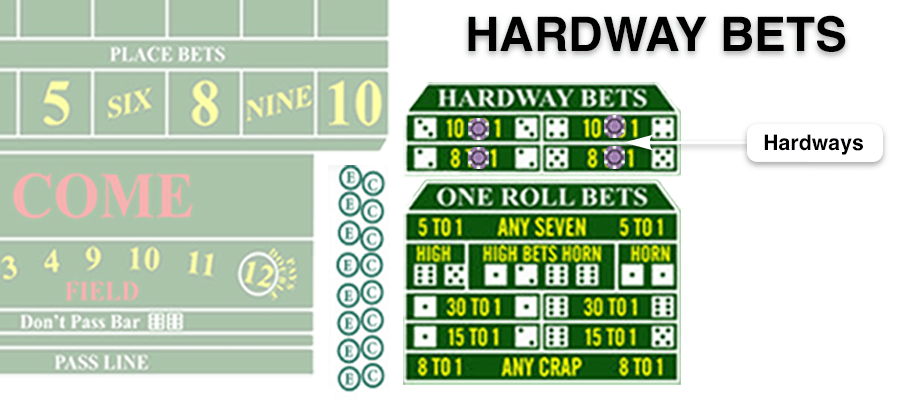
Hardways Payouts, True Odds, and House Edge
The gap between true odds and payout odds is where the craps casino makes its money on hardways. Let’s break down both pairs.
Hard 6 and Hard 8
There’s one way to roll a hard 6 (3+3) and one way to roll a hard 8 (4+4). Against those single winning combinations, there are 10 losing combinations: 6 ways to roll a 7, plus 4 easy ways to make the number (for a 6, that’s 1+5, 5+1, 2+4, 4+2; for an 8, it’s 2+6, 6+2, 3+5, 5+3).
That makes the true odds 10 to 1. The casino pays 9 to 1.
Some tables display the payout as “10 for 1” instead of “9 to 1.” These are the same thing. “For” means your original bet is included in the payout. “To” means the payout is on top of your bet. Always check whether the table uses “for” or “to” language. If you see “10 for 1,” don’t get excited thinking the payout is better. It isn’t.
The house edge on Hard 6 and Hard 8 is 9.09%.
Hard 4 and Hard 10
The hard 4 (2+2) and hard 10 (5+5) are tougher bets. There’s still only one way to win, but now there are only 2 easy-way losing combos (for a 4: 1+3 and 3+1; for a 10: 4+6 and 6+4) plus 6 ways to roll a 7. That’s 8 losing combinations against your 1 winner.
True odds: 8 to 1. Casino pays: 7 to 1 (or “8 for 1”).
The house edge on Hard 4 and Hard 10 is 11.11%.
| Hardways Bet | Winning Roll | True Odds | Payout | House Edge |
|---|---|---|---|---|
| Hard 4 | 2+2 | 8 to 1 | 7:1 | 11.11% |
| Hard 6 | 3+3 | 10 to 1 | 9:1 | 9.09% |
| Hard 8 | 4+4 | 10 to 1 | 9:1 | 9.09% |
| Hard 10 | 5+5 | 8 to 1 | 7:1 | 11.11% |
For context, compare those house edges to the pass line bet at 1.41% or the free odds bet at 0%. You’re paying roughly 6 to 8 times more per dollar wagered on hardways than on the table’s best bets. That’s the price of chasing a bigger single payout. The full breakdown of every bet’s edge is in our craps payout chart.
How to Place a Hardways Bet
Hardways bets live in the center of the table, which means you don’t place them yourself. Here’s the process:
Get the stickman’s attention. The stickman controls all center-table action. Wait for a pause between rolls, then toss your chip(s) toward the center of the table and clearly state your bet. Say something like “five dollar hard six” or “hard eight for five.”
The stickman places your bet. Your chips go into the hardways section of the layout, positioned to correspond with your spot at the table so the crew knows whose bet it is.
Wait for resolution. Your bet stays active until the hard number hits (you win), the easy version of that number hits (you lose), or a 7 is rolled (you lose). This could take one roll or fifty.
You can call hardways bets “on” or “off” during a shooter’s turn. Many players turn their hardways off during come-out rolls, since a 7 on the come-out is usually good for pass line bettors but would kill all active hardways. Just tell the stickman “hardways off” before the come-out. For more on proper table communication, check our craps etiquette guide.
If you’re new to calling bets at the center of the table, don’t stress. The stickman will confirm what you want. Just be clear, speak up, and toss your chips reasonably close to the center. If you need a refresher on the whole table flow, our how to play craps guide walks you through every step.
The Math Behind Hardways: Why the Odds Are Stacked
Understanding the dice probability behind hardways turns this from a mystery bet into a calculated decision. Here’s a closer look at what you’re up against.
Two six-sided dice produce 36 possible outcomes. Every hardways bet has exactly one winning combination out of those 36. But you’re not fighting all 36 outcomes. You’re only fighting the outcomes that matter: the 7 and the easy ways.
Hard 6 and Hard 8: The Numbers
For the hard 6, there’s 1 way to win (3+3). There are 4 easy ways to make a 6 (1+5, 5+1, 2+4, 4+2) and 6 ways to make a 7. That’s 10 ways to lose versus 1 way to win. The remaining 25 combinations? They’re irrelevant. They just mean another roll.
This gives you a 1 in 11 chance of winning on any given “relevant” roll (a roll that resolves the bet). True odds: 10:1.
Say you bet $5 on hard 6 repeatedly over a long session. On average, for every 11 resolved outcomes, you’ll win once ($45) and lose ten times ($50). Net loss: $5 over 11 decisions. That’s about $0.45 per decision, which works out to the 9.09% house edge. Over 100 resolved bets at $5 each, you’d expect to lose roughly $45.
Hard 4 and Hard 10: Tougher Still
The hard 4 has 1 winning combo (2+2), only 2 easy-way losers (1+3, 3+1), and 6 ways to roll a 7. That’s 8 losers versus 1 winner, giving you a 1 in 9 chance on relevant rolls. True odds: 8:1.
Even though the hard 4 has fewer “easy way” combos than the hard 6, the payout drops from 9:1 to 7:1, which actually creates a worse house edge (11.11% versus 9.09%). The casino’s cut is proportionally bigger on the 4 and 10.
Some players assume the hard 4 and hard 10 are “easier” because they have fewer easy-way losing combos. That’s technically true (2 easy ways vs. 4), but the 7 still has 6 ways to appear regardless. And the payout reduction more than offsets the slightly fewer losing combos. Always check the payout chart before making assumptions about which bets are better.
Are Hardways Bets Worth It?
The honest answer: it depends on what you’re trying to accomplish at the table.
If your primary goal is to minimize losses and play as long as possible, hardways bets don’t belong in your game. A 9.09% to 11.11% house edge will eat through your bankroll at roughly 6 to 8 times the rate of a pass line bet. Over a long session, that’s a significant difference. Players focused on smart, math-driven craps should stick with the best craps bets and avoid center-table action entirely.
But craps isn’t purely a math exercise. It’s also the most social, emotionally charged game in the casino. And hardways, when they hit, produce some of the loudest cheers on the floor.
- Standing bet structure means your wager can ride through multiple rolls, adding sustained excitement
- 9:1 and 7:1 payouts deliver meaningful wins on small wagers ($5 can return $45 or $35)
- They give you action on specific numbers without committing to place bets or come bets
- Hitting a hardway during a hot roll is one of the best feelings in the casino
- House edges of 9.09% and 11.11% are among the highest on the table
- The math doesn’t improve with any betting system or strategy
- Money spent on hardways is money not backing your pass line bet with odds
- They can become addictive because near-misses (easy ways) feel like you’re “close”
The bottom line? Treat hardways like hot sauce. A little bit adds flavor. Too much ruins the meal. If your core strategy is built on the pass line, odds, and maybe place bets on 6 and 8, a $1 or $2 hardways bet on the side won’t wreck your bankroll. But making it a centerpiece of your action? That’s a recipe for a short session.
Smart Strategies for Playing Hardways
No strategy can change the house edge on a hardways bet. But you can be smart about when, how much, and how often you place them.
The Hardways Budget Rule
Before you start a session, decide what percentage of your bankroll goes toward hardways. A good number is 5% or less. If you bring $300 to the table, that’s $15 for hardways action across the entire session. When it’s gone, it’s gone. This prevents the “just one more hard eight” spiral that costs players real money.
If you want hardways action without the full house edge exposure, turn them off during come-out rolls. A 7 on the come-out is great for your pass line but kills all active hardways. Tell the stickman “hardways off” before each come-out. Most experienced players do this automatically.
Pair With Core Bets
The smartest way to use hardways is as a complement to, not a replacement for, your primary bets. Say you have a $10 pass line bet with $20 in odds and $12 each on the 6 and 8 as place bets. Tossing $1 on the hard 6 and $1 on the hard 8 adds a bit of extra excitement on those numbers you already have working. If the hard way hits, you collect on both the hardways bet and the place bet. If the easy way hits, you still win the place bet.
The “Hit and Sit” Approach
If you land a hardway, resist the urge to immediately reload the same bet. Take the win. Let a few rolls pass. The probability of hitting the same hardway twice in quick succession is extremely low, and the emotional high of a win often pushes players to over-bet on the next round. Pocket the profit and return to your core strategy.
Wait for a Point
Some players only bet hardways after the shooter establishes a point. The logic is practical: during the come-out phase, you want 7s (for your pass line), but a 7 kills your hardways. Waiting until the point is set means every roll counts the same direction for all your bets. Your pass line wants the point. Your hardways want pairs. The 7 is the enemy for both.
For a complete breakdown of how to structure your overall approach, see our craps strategy guide.
Hardways vs. Other High-Payout Craps Bets
Hardways aren’t the only center-table bets that promise big payouts. How do they compare to the alternatives?
| Bet | Payout | House Edge | Type |
|---|---|---|---|
| Hard 6 or Hard 8 | 9:1 | 9.09% | Standing (multi-roll) |
| Hard 4 or Hard 10 | 7:1 | 11.11% | Standing (multi-roll) |
| Any Craps | 7:1 | 11.11% | One-roll |
| Yo (11) | 15:1 | 11.11% | One-roll |
| Snake Eyes (2) or Boxcars (12) | 30:1 | 13.89% | One-roll |
| Any 7 | 4:1 | 16.67% | One-roll |
| Horn Bet | Varies | 12.50% | One-roll |
The standing-bet nature of hardways actually makes them slightly more tolerable than one-roll propositions. With a yo eleven bet or snake eyes wager, you’re paying the house edge on every single roll. With hardways, many rolls are “neutral” (no resolution), which means your money sits idle without being at risk. You’re still paying a steep house edge per resolved decision, but the slower resolution rate means your bankroll lasts longer compared to hammering one-roll bets.
That said, hardways are still expensive bets by any objective standard. If you’re comparing them to place bets on 6 and 8 (1.52% house edge) or the field bet at 5.56%, hardways cost you 2 to 7 times more per dollar wagered. They belong in the “for fun” category, not the “for profit” column.
Should You Bet Hard 6 and Hard 8 or Hard 4 and Hard 10?
If you’re going to bet hardways, which ones should you choose? The math is clear.
Hard 6 and Hard 8 are the better bets. They pay 9:1 with a 9.09% house edge, compared to the Hard 4 and Hard 10’s 7:1 payout and 11.11% edge. That’s a 2% difference in house edge, which adds up fast over a session.
You bet $5 on hard 8 for 100 resolved outcomes. Expected loss: $5 x 100 x 9.09% = $45.45. Now bet $5 on hard 10 for 100 resolved outcomes. Expected loss: $5 x 100 x 11.11% = $55.55. That’s $10 more in losses for the same action, same bet size. Over a year of regular play, that gap becomes substantial.
There’s also a psychological factor. The hard 6 and hard 8 have more “easy way” losing combos (4 each), which means they resolve faster. Faster resolution means you get your answer sooner, which keeps the action moving. The hard 4 and hard 10 can sit unresolved for long stretches because only 2 easy-way combos (plus the 7) can knock them out. Some players enjoy that suspense. Others find it frustrating.
If you’re budgeting a small amount for hardways action, put it on the 6 and 8. Lower house edge, higher payout, and more action. There’s no mathematical argument for preferring the 4 or 10 unless you simply enjoy those numbers.
Hardways Bets: The Final Roll
Hardways bets are the sports car of the craps table: fast, exciting, and expensive to maintain. They won’t help you grind out long sessions on a tight bankroll. They won’t tilt the math in your favor. But on a hot roll, when the shooter is nailing pairs and the table is going wild, a well-timed hard eight hitting at 9:1 is one of those casino moments you don’t forget.
Know the numbers. Set a hard limit on what you’ll spend. Keep your foundation built on pass line bets with odds and smart bankroll management. Then, if the mood strikes and the table’s running hot, toss a few dollars on a hardway and enjoy the ride. That’s the right way to play these bets. Practice the feel of it risk-free on our craps simulator before you take it to a real table.
Best Online Craps Casinos (Last Updated September 2026)





Hardways Bets FAQs
A hard 8 pays 9 to 1 (sometimes listed as “10 for 1,” which is the same thing). A $5 bet on hard 8 returns $45 in profit plus your original $5 wager. The house edge is 9.09%. You can check all payouts in our craps payout chart.
A hard way is when an even number (4, 6, 8, or 10) is rolled as a matching pair: 2+2, 3+3, 4+4, or 5+5. An easy way is when the same total is rolled with two different numbers, like 6+2 for an 8 or 4+1 for a 5. Hardways bets only win on the pair. They lose on the easy way or on a 7.
Yes. Tell the stickman “hardways off” before the come-out roll. This is a common practice because a 7 on the come-out helps your pass line bet but kills active hardways. Most casinos default hardways to “off” during come-out rolls, but house rules vary. Always confirm with your dealer.
Mathematically, they’re bad bets. The house edges of 9.09% (hard 6/8) and 11.11% (hard 4/10) are much higher than the pass line’s 1.41%. As entertainment with a small portion of your bankroll, they’re fine. As a core strategy, they’ll drain your money quickly. Stick with the best craps bets for your main action.
Hard 6 and Hard 8 are the best hardways bets. Both pay 9:1 with a 9.09% house edge, compared to the Hard 4 and Hard 10 which pay 7:1 at 11.11%. The 2% lower house edge on the 6 and 8 makes a meaningful difference over time.
A hardways bet stays active until one of three things happens: the hard number hits (you win), the easy version of that number hits (you lose), or a 7 is rolled (you lose). It can last one roll or dozens. You can remove or change the bet at any time by telling the stickman.
