Street Craps: Rules, How to Play, and How It Differs From Casino Craps
 Jake Wilfred
No felt. No dealers. No pit boss watching from behind the table. Just two dice, a wall to bounce them off, and a group of players betting cash against each other on a sidewalk, a driveway, or a garage floor. That’s street craps in its purest form, the stripped-down, player-vs-player version of the game that predates every craps casino in existence.
Before John H. Winn redesigned the craps table layout and added the don’t pass bet in 1907, this was how craps was played: on the streets, on the docks, in military barracks, and in back alleys from New Orleans to New York. Street craps uses the same core mechanics as casino craps (come-out roll, point, seven-out) but drops the house entirely.
No house edge. No rake. No commission. Players fade each other’s bets directly. This guide covers the full rules, how a round flows, the bets available, how street craps compares to the casino version, and the legal reality of playing in 2026.
- Street craps is a player-vs-player dice game with no house, no felt, and no house edge
- The core rules mirror casino craps: 7 or 11 wins on the come-out, 2/3/12 loses, other numbers set the point
- The shooter must “fade” their bet (find someone willing to cover it) before rolling; no fade means no roll
- Side bets between players cover specific numbers, hardways, and other outcomes with negotiated payouts
- Street craps is illegal when played for money in public spaces in most US jurisdictions
- The same 36 dice combinations and probabilities from casino craps apply to street craps
How Street Craps Works: The Basic Rules
Street craps follows the same two-phase structure as bank craps. If you already know how to play craps at a casino, you know 90% of street craps. The differences are in the betting structure, not the dice.
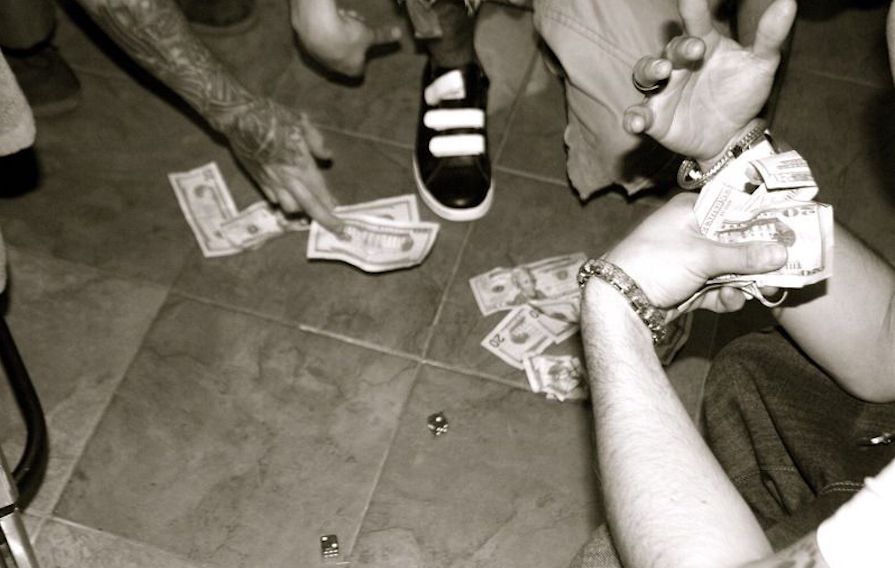
The Come-Out Roll
One player becomes the shooter. They announce their bet (“I’m shooting $20”) and place their cash on the ground or playing surface. Other players must “fade” that bet, meaning they put up their own money to cover it. If nobody fades the full amount, the shooter reduces the bet to whatever gets covered. No fade, no game.
Once the bet is covered, the shooter throws two dice against a wall or backstop. The come-out roll follows the same rules as casino craps:
7 or 11: The shooter wins. They collect the faded money.
2, 3, or 12: The shooter loses. The faders collect.
4, 5, 6, 8, 9, or 10: That number becomes the point. The game moves to Phase 2.
The come-out probabilities are identical to casino craps because the same 36 dice combinations apply. The 7 has 6 combos. The 11 has 2. The 2 has 1. The 3 has 2. The 12 has 1. The shooter has an 8-to-4 advantage on the come-out (8 winning combos vs. 4 losing), with 24 combos setting a point. This math doesn’t change whether you’re on a sidewalk or at a Vegas craps table.
The Point Phase
After a point is set, the shooter keeps throwing until one of two things happens. The point repeats (shooter wins) or a 7 shows (shooter loses). Every other number is irrelevant. This is the same logic as the pass line bet in casino craps.
If the shooter wins, they collect and can choose to shoot again. If they lose, the dice pass to the next player (typically clockwise).
You’re the shooter. You announce “$20 on the pass.” Two other players each fade $10. Total pot: $40. You roll a 9. Point is 9. You throw again: 4, then 11, then 6, then 9. Point made. You collect the $20 in faded money. You can keep shooting or pass the dice.
Street Craps Bets: Pass, Don’t Pass, and Side Action
Street craps is simpler than the casino version in terms of betting options. There’s no craps table layout with 30+ bet areas. But the bets that do exist follow the same core logic.
The Pass Bet
The shooter’s primary bet. They’re betting on themselves to win: hit a 7 or 11 on the come-out, or make the point before a 7. The faders take the opposite side. Pays even money.
The Don’t Pass (Fading the Shooter)
The players who fade the shooter are effectively making a don’t pass bet. They win when the shooter craps out (2, 3, or 12 on the come-out) or sevens out during the point phase.
In casino craps, the 12 on the come-out is a push for don’t pass bettors (the “bar 12” rule). In most street craps games, the 12 is a loss for the shooter with no push rule. This means the fader has a slight mathematical edge over the shooter in street craps, since they win on all three craps numbers (2, 3, 12) without giving any back. Experienced street craps players often prefer to fade rather than shoot. Some groups play with a bar 12 (push) rule; clarify before you start.
Side Bets
This is where street craps gets creative. Players (including bystanders who aren’t shooting or fading) can make side bets with each other on specific outcomes. Common side bets include:
Betting on specific point numbers to hit or miss. Wagering on hardways (a pair like 4+4 before a 7 or easy 8). Betting on specific totals appearing on the next roll (similar to hop bets in casino craps).
| Street Craps Bet | Casino Equivalent | How It Works |
|---|---|---|
| Pass (shooter’s bet) | Pass Line | 7/11 wins, 2/3/12 loses, point repeats wins |
| Fade (against shooter) | Don’t Pass | 2/3/12 wins (no bar 12 in most games), 7/11 loses, 7 before point wins |
| Side bet on a number | Place Bet / Come Bet | Negotiated between players; specific number before 7 |
| Hardway side bet | Hardways | Specific pair before 7 or easy way; negotiated payout |
| Prop side bet | Proposition Bet | One-roll call on a specific outcome; negotiated payout |
Side bet payouts in street craps are negotiated, not standardized. At a casino, a hardway 6 pays 9:1 with a 9.09% house edge. In street craps, two players might agree on 8:1, 10:1, or anything they shake on. If someone offers you “true odds” on a side bet, check the math. True odds on a hard 6 are 10:1. Anything below that favors the person taking the other side. Our craps payout chart lists the true odds for every combination so you can evaluate any street craps side bet offer.
The Rules of the Throw: How Dice Must Be Rolled
Street craps has physical rules about the throw that vary by group but follow general conventions.
The dice must be thrown with one hand only. They must bounce off a wall, curb, backstop, or other flat vertical surface. If the dice don’t hit the wall, the throw doesn’t count, and the shooter rolls again. Two-handed throws are invalid. Dice that leave the playing area require a re-roll.
The wall requirement exists for the same reason casino craps requires dice to hit the back wall: it introduces randomness. Without a wall bounce, a skilled thrower could potentially slide the dice and control the outcome. The wall scrambles the rotation and prevents that.
No body parts, hands, feet, or other objects should be in the shooting area when the dice are thrown. Blocking or interfering with the throw is grounds for a re-roll or, depending on the group, grounds for getting your invitation revoked. These informal rules mirror the craps etiquette at casino tables, where hands in the throwing lane are the fastest way to become unpopular.
Some street craps games are also played with dice setting in mind. The shooter might orient the dice a certain way before throwing. This is allowed, since the wall bounce is supposed to randomize the result. Whether dice control actually works is a separate debate covered in our dice control article.
How to Set Up a Street Craps Game
You don’t need much to get a game going. A pair of dice, a wall, and a few ground rules keep everything running clean from the first throw.
What You Need
Two standard six-sided dice. A flat playing surface (concrete, asphalt, hardwood, etc.). A wall or vertical surface for the dice to bounce off. Cash for betting. A group of 2 or more players.
That’s it. No table. No chips. No dealer.
Choosing the First Shooter
The first shooter is selected by the group. Common methods include rolling for it (highest roll shoots first), volunteering, or simply going clockwise from whoever organized the game. The dice pass clockwise after each shooter loses.
Establishing House Rules
Every street craps game should clarify a few points before the first roll. Does the 12 on the come-out push or lose for the shooter? What side bets are allowed? What’s the minimum and maximum fade amount? Are prop bets permitted? Getting these details straight before money hits the ground prevents arguments later.
Five friends decide to play in a garage. You grab two standard dice and designate the garage wall as the backstop. House rules: $5 minimum fade, $50 maximum. Bar 12 applies (push on come-out 12). Side bets are allowed between any two players at agreed terms. First shooter is whoever volunteers. The game starts.
If you’d prefer a more structured home game with a proper layout and chip system, our how to play craps at home guide covers how to set up a full craps table experience in your living room.
Street Craps vs. Casino Craps: The Key Differences
The dice are the same. The dice combinations are the same. The come-out and point phases are the same. But the experience and economics are completely different.
| Feature | Street Craps | Casino Craps |
|---|---|---|
| House Edge | 0% (no house) | 1.41% pass line, 0% free odds |
| Betting Structure | Player vs. player (fade system) | Player vs. house (casino bank) |
| Available Bets | Pass, don’t pass, negotiated side bets | 30+ standardized bets |
| Free Odds | Not available (unless agreed) | Yes (0% house edge) |
| Dice Regulation | Any standard dice | Casino-certified, serialized dice |
| Payout Guarantee | Based on trust | Guaranteed by casino |
| Legality | Illegal in public (most jurisdictions) | Legal (licensed casinos) |
| Crew | None | Boxman, stickman, 2 dealers |
| Bar 12 Rule | Varies by group | Standard (12 pushes for don’t pass) |
| Social Atmosphere | Informal, intense, personal | Loud, communal, regulated |
The biggest mathematical difference: casino craps has a built-in house edge (the casino always takes a cut). Street craps has none. The shooter and the faders are on roughly equal footing, with the only edge determined by whether the bar 12 rule is used (if the fader wins on 12 with no push, they have a slight mathematical advantage over the shooter).
The absence of a house edge sounds like a player advantage. In a sense, it is. But it also means there’s no regulation, no certified dice, no guaranteed payout, and no recourse if someone refuses to pay. Loaded dice, weighted dice, and outright theft are real risks in street craps. This is why John H. Winn’s invention of the standardized casino craps table in 1907 was such a milestone in craps history. The casino charges for fairness. Street craps gives you no such guarantee.
The Probabilities in Street Craps: Same Dice, Same Math
Since street craps uses the same two six-sided dice as casino craps, the probability structure is identical. Every number’s likelihood comes from the 36 possible dice combinations.
The 7 has 6 combinations (16.67%). The 6 and 8 each have 5 (13.89%). The 5 and 9 each have 4 (11.11%). The 4 and 10 each have 3 (8.33%). The 3 and 11 each have 2 (5.56%). The 2 and 12 each have 1 (2.78%).
This means the shooter’s probability of making the point is the same as in casino craps:
| Point | Ways to Roll It | Chance of Making It Before 7 |
|---|---|---|
| 4 or 10 | 3 | 33.33% |
| 5 or 9 | 4 | 40.00% |
| 6 or 8 | 5 | 45.45% |
Knowing these numbers helps you evaluate side bet offers in street craps. If someone offers you 2:1 that the shooter will make a point of 4, that’s a fair bet (true odds are 2:1 against). If they offer even money, they’re getting the better end of the deal.
Memorize the true odds for each point number. In street craps, there’s no payout schedule posted on a felt layout. The only protection against bad bets is your own math. A point of 6 has true odds of 6:5 against. A point of 10 has true odds of 2:1 against. If someone offers you a side bet, compare it to the true odds before accepting. Our craps payout chart has the full reference.
Is Street Craps Legal?
Short answer: playing street craps for money in public spaces is illegal in most US jurisdictions in 2026.
Most states classify unregulated gambling (games of chance played for money outside a licensed facility) as a misdemeanor or, in some cases, a felony depending on the amounts involved. The penalties range from fines to arrest. Playing in a private residence with friends is typically legal in most states, though local ordinances vary.
The enforcement reality is another matter. Street craps games happen constantly in cities across the country. Police enforcement varies by location, time, and visibility. But the legal risk is real, and if you’re caught, the consequences depend on your state and the discretion of the responding officers.
This guide covers the rules and mechanics of street craps for educational purposes. We don’t encourage or endorse illegal gambling. If you want to play craps for real money legally, find a licensed craps casino in your area or play online at a regulated site. If you want the street craps experience in a private, legal setting, our how to play craps at home guide covers how to set up a proper game with friends.
Protecting Yourself in a Street Craps Game
If you do play street craps in a private, legal setting, a few precautions help keep the game fair and friendly.
Watch for Loaded Dice
Weighted or shaved dice are the oldest cheat in craps history. Before playing, inspect the dice. They should be translucent (so internal weights are visible), perfectly cubical, and balanced. Cheap opaque dice from a board game are easy to tamper with. Casino-grade dice, which you can buy online for a few dollars per pair, are the gold standard.
Agree on Rules Before Money Hits the Ground
Does the 12 push or lose for the shooter? What’s the max bet? Who settles disputes? What side bets are allowed? Clarify everything before the first throw. Arguments over rules after money is on the line are how friendships end.
Keep the Stakes Reasonable
Street craps with friends should be fun. Set stakes everyone can afford to lose. A $5 to $20 fade range keeps the game accessible and low-pressure. Running a $500 street craps game in a garage is a recipe for trouble.
- No house edge: bets are player-vs-player with no casino cut
- No equipment needed beyond two dice and a flat surface
- Fast-paced, social, and can be played anywhere with a wall
- No minimum bet requirements or casino rules to follow
- Deep cultural and historical significance in American gaming
- Illegal in public spaces in most jurisdictions
- No regulation, no certified dice, no guaranteed payouts
- Loaded dice and cheating are real risks without casino oversight
- No free odds, place bets, or structured bet menu; limited strategic options
- Disputes over rules and payouts can escalate without a dealer or pit boss
Street Craps: The Rawest Form of the Oldest Dice Game
Street craps is where craps started. Before the felt, before the puck, before the stickman’s call, there were two dice and a group of people betting against each other with nothing but trust and a wall to bounce off of. It’s the most direct form of the game: no house edge, no middleman, no 30-bet layout to memorize. Just the shooter, the faders, and 36 dice combinations that determine who walks away with the cash.
It’s also the least protected. No casino regulation means no guarantee of fair dice, honest payouts, or legal cover. If you want the street craps experience with the safety of structure, set up a private home game using our craps at home guide, or practice the mechanics on our free craps simulator. And if the game draws you in and you want more numbers, more action, and more strategy, the casino version is waiting with the best craps bets in the building.
Best Online Craps Casinos (Last Updated September 2026)






Street Craps FAQs
Street craps follows the same core rules as casino craps. The shooter rolls two dice against a wall. A 7 or 11 on the come-out wins. A 2, 3, or 12 loses. Any other number sets the point, which must be repeated before a 7 for the shooter to win. The key difference: players bet against each other (not the house) through a “fade” system. There is no house edge.
Playing street craps for money in public spaces is illegal in most US jurisdictions. Penalties range from fines to arrest depending on the state and the amount of money involved. Playing in a private home with friends is typically legal in most states, though local laws vary. For legal craps, visit a licensed craps casino or play online at a regulated site.
The dice and core rules are identical. The difference is structure: casino craps is player vs. house with a 1.41% pass line edge, 30+ standardized bets, and regulated payouts. Street craps is player vs. player with no house edge, negotiated bets, and no regulation. Casino craps offers free odds at 0%; street craps typically doesn’t.
Fading means covering the shooter’s bet. If the shooter puts $20 down, other players must collectively put up $20 to “fade” the bet before the dice are thrown. If no one fades the full amount, the shooter reduces the bet to whatever gets covered. Fading the shooter is the street craps equivalent of the don’t pass bet in casino craps.
No. “7-11” (or “seven-eleven”) is a simplified dice game where the first roll determines the outcome: rolling a 7 or 11 wins, 2/3/12 loses. There’s no point phase. Street craps includes the full come-out and point structure, making it closer to standard casino craps. The two games share terminology but have different rules and gameplay depth.
In most US states, playing craps privately at home with friends for recreational stakes is legal. The key factors are that the game is private (not open to the public), no one takes a rake or house cut, and the stakes are reasonable. Check your local laws to confirm. Our how to play craps at home guide covers how to set up a proper home game with a real layout and chip system.
