Are you lThe Don’t Come Bet in Craps: How It Works, Lay Odds, and Dark-Side Strategy
 Jake Wilfred
The don’t pass bet gets all the attention on the dark side of the table. But the don’t come bet is its more versatile cousin, and it’s how experienced wrong-way bettors expand their number coverage after the point is set. Think of it this way: the don’t pass works on the come-out roll.
The don’t come works on every roll after that. Same mechanics. Same 1.36% house edge. Same ability to lay free odds at 0% to cut the combined edge below 0.30%. If you’re building a dark-side craps strategy with multiple numbers working against the shooter, the don’t come bet is how you get there.
This guide covers the full mechanics, every payout scenario with real dollar amounts, how lay odds work behind it, and the strategies that pair it with the don’t pass for a low-edge, multi-number position.
- The don’t come bet has a 1.36% house edge and works identically to the don’t pass, but can be placed after the point is established
- On the don’t come’s “come-out”: 2 or 3 wins, 12 pushes, 7 or 11 loses; any other number becomes the don’t come point
- After a don’t come point is set, you win if the 7 appears before that number; you lose if the number repeats first
- Laying free odds behind the don’t come (0% house edge) drops the combined edge to approximately 0.27% with 3x-4x-5x lay odds
- The don’t come bet can be removed after a point is set, but removing it is a mathematical mistake since the 7 is now more likely than the point
- Combining don’t pass + don’t come bets with max lay odds creates the cheapest multi-number position in craps
What Is the Don’t Come Bet?
The don’t come bet is a multi-roll wager that mirrors the don’t pass bet in every way except timing. The don’t pass must be placed before the come-out roll. The don’t come can be placed on any roll after the point is established. It gives dark-side players the ability to add more numbers to their position throughout a shooter’s turn.
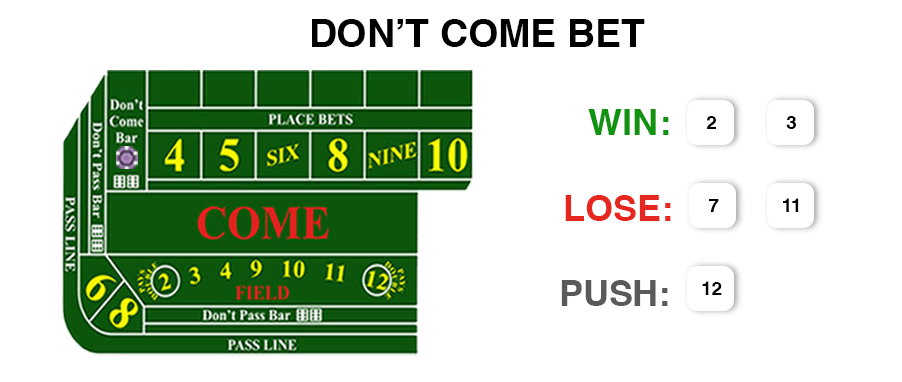
Place your chips in the “Don’t Come” area on the craps table layout. The very next roll acts as the don’t come bet’s personal “come-out.” Three outcomes are possible.
Roll a 2 or 3: You win immediately. Even money (1:1).
Roll a 12: Push. Your chips are returned. No win, no loss.
Roll a 7 or 11: You lose immediately.
Roll a 4, 5, 6, 8, 9, or 10: This number becomes your don’t come point. The dealer moves your chips to that number’s box in the “Don’t Come” area (typically behind the number). You now win if the 7 shows before that number repeats. You lose if the number repeats before the 7.
The don’t come is the dark-side equivalent of the come bet. The come bet wants the number to repeat. The don’t come wants the 7 first. Same structure, opposite sides of the math. If you’re still learning the core game flow, start with our how to play craps guide before working through the don’t come’s specifics.
The critical detail: once your don’t come point is established, the math shifts in your favor. The 7 has 6 dice combinations out of 36. A don’t come point of 4 or 10 has only 3 combinations. That’s a 2:1 advantage for the 7. Points of 5/9 give you a 3:2 advantage. Points of 6/8 give you a 6:5 advantage. After the point is set, you’re the favorite on every don’t come bet.
Don’t Come Bet Payouts and House Edge
The don’t come’s flat bet pays even money (1:1) when it wins. The house edge is 1.36%, identical to the don’t pass. That’s the second-cheapest line bet on the table, just ahead of the pass line at 1.41%.
The point is 8. You place $10 in the Don’t Come area. The shooter rolls a 5. Your don’t come point is now 5. The dealer moves your $10 behind the 5 box. Over the next several rolls, the shooter throws a 9, a 4, an 11, and then a 7. Seven-out. Your don’t come bet on the 5 wins because the 7 appeared before the 5 repeated. You collect $10 profit (even money). If the shooter had rolled a 5 before the 7, you’d have lost your $10.
Win Probability by Don’t Come Point
After your don’t come point is established, here’s how often you win:
| Don’t Come Point | Dice Combos for Point | Your Win Probability |
|---|---|---|
| 4 or 10 | 3 | 66.67% (you win 2 out of 3) |
| 5 or 9 | 4 | 60.00% (you win 3 out of 5) |
| 6 or 8 | 5 | 54.55% (you win 6 out of 11) |
After the point is set, you’re always the favorite. The 4 and 10 are the best don’t come points because the 7 has a commanding 2:1 advantage. The 6 and 8 are the tightest races, with the 7 holding a slim 6:5 edge.
The don’t come bet can technically be removed after a point is established. But this is a mathematical mistake. Once the point is set, you have the advantage. Removing the bet is like folding a winning poker hand. You survived the dangerous come-out (where 7 and 11 lose for you) and are now in a favorable position. Keep the bet active. Never take it down. This is the opposite of the pass line, which can’t be removed (and you’d want to remove it, since the house has the edge during the point phase).
Laying Free Odds on the Don’t Come Bet
After your don’t come point is established, you can lay free odds behind it. These odds pay at true mathematical rates with a 0% house edge. This is the same free odds bet available behind the don’t pass, and it’s the most important upgrade to any dark-side position.
Lay Odds Payouts
Since you’re betting the 7 will appear before the point, you risk more than you win. The 7 is more common, so the payout is inverted.
| Don’t Come Point | Lay Odds Payout | $30 Lay Odds Pays |
|---|---|---|
| 4 or 10 | 1:2 (win half) | $15 |
| 5 or 9 | 2:3 (win two-thirds) | $20 |
| 6 or 8 | 5:6 (win five-sixths) | $25 |
The lay odds payout looks small per dollar at risk, but remember: these bets carry 0% house edge. Every dollar in lay odds is a dollar working for free. The house takes nothing from this portion of your wager.
Point is 9. You place $10 on Don’t Come. The shooter rolls a 6. Your don’t come point is 6. You lay $50 in odds behind it (5x at a 3x-4x-5x table). The shooter rolls a 3, then a 10, then a 7. Seven-out. You win $10 on the flat (1:1) plus approximately $42 on the lay odds (5:6 on $50). Total profit: roughly $52. If the shooter had rolled a 6 first, you’d lose $60 ($10 flat + $50 odds).
How Lay Odds Reduce the Combined House Edge
Your flat don’t come bet carries 1.36%. Your lay odds carry 0%. The more money in odds, the lower the blended edge.
| Odds Level | Combined Edge (Don’t Come + Odds) |
|---|---|
| No odds | 1.36% |
| 1x | 0.68% |
| 2x | 0.45% |
| 3x-4x-5x | ~0.27% |
| 10x | ~0.12% |
At 3x-4x-5x lay odds, the combined edge drops to approximately 0.27%. That’s 27 cents per $100 wagered. It’s the cheapest resolved-bet position available in craps, slightly better than the pass line with max taking odds (~0.37%). For the complete payout and odds reference, see our craps payout chart.
The golden rule for dark-side players: min on the flat, max on the lay odds. Your $10 don’t come bet carries 1.36%. Your lay odds carry 0%. If you have $60 to commit to a don’t come position, put $10 on the flat and $50 in odds. That blended cost is a fraction of what a $60 flat bet with no odds would cost. This is the same principle that applies to the pass line with odds, just from the opposite side of the table.
Don’t Come Bet vs. Come Bet: Mirror Image Math
The come bet and don’t come bet are exact opposites. Same timing, opposite outcomes.
| Feature | Come Bet | Don’t Come Bet |
|---|---|---|
| House Edge | 1.41% | 1.36% |
| Come-Out Win | 7 or 11 (8 combos) | 2 or 3 (3 combos) |
| Come-Out Loss | 2, 3, or 12 (4 combos) | 7 or 11 (8 combos) |
| Come-Out Push | None | 12 (1 combo) |
| After Point Set | Want the number before 7 | Want the 7 before the number |
| With 3x-4x-5x Odds | ~0.37% | ~0.27% |
| Can Remove After Point? | No (contract bet) | Yes (but don’t) |
| Used in Strategy | Three Point Molly (right side) | Dark-side multi-number play |
The don’t come is mathematically cheaper by 0.05% on the flat bet. With max odds, it’s about 0.10% cheaper. The come bet has a better come-out (8 winning combos vs. 3 for the don’t come) but a worse point phase (fighting against the 7 instead of rooting for it). The don’t come has a tough come-out but a favorable point phase. Over thousands of bets, the don’t come costs less per dollar. The come bet is used in the Three Point Molly strategy; the don’t come is its dark-side equivalent.
The come bet is a contract bet; you can’t remove it after the come point is set. The don’t come can be removed. The irony: the bet you can take down (don’t come) is the one you should leave, because you have the mathematical advantage once the point is established. The bet you can’t take down (come) is the one you’d prefer to remove, since the house has the edge during the point phase. The rules protect the casino, not the player. Keep your don’t come bets working.
Dark-Side Strategies Using the Don’t Come Bet
The don’t come bet is the building block for multi-number dark-side play. Here are the strategies that use it most effectively.
Don’t Pass + Don’t Come With Max Lay Odds
This is the dark-side version of the Three Point Molly. Place a don’t pass bet before the come-out. Lay max odds after the point. Then place a don’t come bet. When it moves to a number, lay max odds on it. Add a second don’t come bet. Lay max odds. You now have three numbers where the 7 wins for you, all at a combined edge of approximately 0.27%.
Come-out roll: 6. You have $10 don’t pass. You lay $50 in odds (5:6 at 0%). You place $10 on don’t come. Shooter rolls 9. Your don’t come moves to the 9. You lay $40 in odds (2:3 at 0%). You place another $10 on don’t come. Shooter rolls 4. Don’t come moves to the 4. You lay $30 in odds (1:2 at 0%). You now have three numbers working against the shooter: 6, 9, and 4. Total at risk: $150. Combined house edge across all action: approximately 0.27%. If the 7 hits, you collect on all three positions. A big win.
The vulnerability: a 7 on the don’t come’s come-out roll kills your $10 don’t come bet while simultaneously paying your existing don’t pass and don’t come positions. It’s a mixed result, not a disaster. A point number repeating before the 7 costs you one position. The key is that you’re the mathematical favorite on every established point.
This strategy requires a larger bankroll than single-bet approaches because you have $120 to $160 at risk across three positions. Budget 40 to 50 times your base bet per session ($400 to $500 at a $10 table). The variance can be significant: three don’t come points getting picked off by quick point-repeats feels brutal. But the math is relentlessly in your favor over time. See our bankroll management guide for session sizing.
Don’t Pass + Don’t Come (No Odds)
For smaller bankrolls, skip the lay odds and run don’t pass plus one or two don’t come bets at the flat 1.36% edge. You won’t get the sub-0.30% combined edge that max odds deliver, but 1.36% is still cheaper than most bets on the table. This approach requires only $20 to $30 per shooter at a $10 table, making it accessible for players at any casino.
Dark-side play carries a social stigma at some tables. You’re winning when the rest of the table is losing. Some players will give you looks. Others won’t care at all. The math doesn’t change based on social pressure. If the atmosphere bothers you, bubble craps machines let you bet don’t come with complete anonymity at $3 to $5 minimums. Proper craps etiquette matters, but your bet selection is always your right.
The Don’t Come Bet’s Come-Out Roll Problem
The don’t come has one structural weakness: the come-out for each bet is unfavorable. On that first roll, 7 or 11 (8 combinations) beats you, while only 2 or 3 (3 combinations) wins. The 12 (1 combination) pushes. That’s an 8:3 disadvantage on the opening throw.
Here’s why it still works. Once you survive that come-out and establish a don’t come point, you’re the favorite for the rest of the bet’s life. On a don’t come point of 4, you win 66.67% of the time. On 6 or 8, you win 54.55%. The favorable point phase more than compensates for the unfavorable come-out. The net result is a 1.36% house edge, which reflects both phases averaged together.
The practical implication: you’ll lose don’t come bets on the come-out more often than you’d like. A 7 or 11 hits 22.22% of the time. Nearly one in four don’t come bets dies on arrival. That’s the price of entry for the favorable position you get afterward. Experienced dark-side players accept this and focus on the long-term math, not the short-term sting.
You place five consecutive $10 don’t come bets over a shooter’s turn. Results: Roll 1 is a 7 (lose $10). Roll 2 is a 5 (point set, later wins when 7 hits = +$10). Roll 3 is an 11 (lose $10). Roll 4 is a 9 (point set, later wins = +$10). Roll 5 is a 4 (point set, later wins = +$10). Three points established, two come-out losses. Net on the flat bets: +$10. Now add lay odds to those three established points, and the profit grows significantly on the 7-out.
Don’t Come Bet vs. Lay Bets: Two Ways to Bet Against a Number
Both the don’t come and lay bets bet against specific numbers (wanting the 7 first). The difference is how you get there and what it costs.
| Feature | Don’t Come + Lay Odds | Standalone Lay Bet |
|---|---|---|
| How You Get the Number | Random (next roll determines your point) | You choose the number |
| Come-Out Phase | Yes (7/11 can lose you before a point sets) | No (bet is placed directly on a number) |
| Free Odds Available | Yes (0% house edge) | No (5% vig charged on wins) |
| Best House Edge | ~0.27% with 3x-4x-5x lay odds | 1.67% (4/10, vig on wins only) |
| Can Remove? | Yes (but shouldn’t after point set) | Yes (anytime) |
| Best For | Multi-number dark-side strategy | Targeting specific numbers |
The don’t come with lay odds is mathematically superior (0.27% vs. 1.67%) because the odds portion carries no vig. The standalone lay bet charges a 5% commission on wins. However, the don’t come forces you through a come-out roll where you can lose to the 7 or 11 before your number is even established. The standalone lay bet skips that risk entirely.
Use the don’t come with odds as your primary tool. Use standalone lay bets only on numbers where you don’t already have a don’t come position, and only when you want to target a specific number (like laying the 4 or 10).
- 1.36% house edge, the cheapest line bet on the table (tied with don’t pass)
- Lay odds behind it at 0% drop the combined edge to approximately 0.27%
- Can be placed on any roll after the come-out, giving you timing flexibility
- After the don’t come point is set, you’re the mathematical favorite to win
- Can be removed at any time (though you shouldn’t once a point is established)
- Forms the core of multi-number dark-side strategies
- The come-out is unfavorable: 7 or 11 (8 combos) loses vs. 2 or 3 (3 combos) wins
- You can’t choose your don’t come point; it’s determined by the next roll
- Social awkwardness: you’re betting against the table, which can draw negative reactions
- A shooter who makes multiple points quickly can devastate a multi-number don’t come position
- Lay odds require risking more than you win since the 7 is the more common outcome
The Don’t Come Bet: The Dark Side’s Best-Kept Weapon
The don’t come bet is how dark-side players build their position. One don’t pass bet starts the turn. Don’t come bets expand it. Lay odds behind each one cut the cost to nearly nothing. At 0.27% combined edge with max lay odds, a three-number dark-side position is the cheapest multi-number bet structure available in any casino.
Yes, you’ll lose on the come-out more than you’d prefer. Yes, some tables will give you sideways glances. But the math doesn’t care about social dynamics. The 7 has 6 out of 36 dice combinations, and after the point is set, that number works for you, not against you. Practice the dark-side approach on our free craps simulator, then bring it to a live table where the numbers are the only thing that matters. For the complete framework of bet selection from both sides of the table, see our best craps bets ranking.
Best Online Craps Casinos (Last Updated October 2026)







Don’t Come Bet FAQs
The don’t come bet is a multi-roll wager placed after the point is established. It works like the don’t pass but with flexible timing. On the next roll: 2 or 3 wins, 12 pushes, 7 or 11 loses. Any other number becomes your don’t come point, and you win if the 7 appears before that number repeats. House edge: 1.36%.
The flat don’t come bet pays even money (1:1). Lay odds behind it pay at true odds: 1:2 on points of 4/10, 2:3 on 5/9, and 5:6 on 6/8. The lay odds carry 0% house edge. Full payout details are in our craps payout chart.
Yes, you can remove a don’t come bet after the don’t come point is established. However, doing so is a mathematical mistake. Once the point is set, the 7 is more likely to appear than any specific point number, putting you in a favorable position. Removing the bet surrenders that advantage. Leave it working and lay maximum odds behind it.
The house edge is 1.36% on the flat bet, identical to the don’t pass. Adding lay odds at 0% reduces the combined edge: 0.68% with 1x odds, 0.45% with 2x, and approximately 0.27% with 3x-4x-5x odds. This makes the don’t come with max odds the cheapest resolved-bet position in craps.
The don’t come (1.36%) has a marginally lower house edge than the come bet (1.41%). With max odds, the gap widens: ~0.27% (don’t come) vs. ~0.37% (come). The come bet has a better come-out roll (8 winning combos vs. 3). The don’t come has a better point phase (the 7 works for you). Choose based on your comfort with dark-side play and the craps etiquette dynamics at your table.
Yes. After your don’t come point is established, you can lay free odds behind it at 0% house edge. Tell the dealer “lay odds on my don’t come” and hand over your chips. The dealer places the odds near your don’t come bet in the number box. Most tables allow 3x-4x-5x lay odds. Always take maximum odds to reduce the combined edge as far as possible.
