Craps Dice Setting and Control: The Complete Guide to Precision Shooting
 Jake Wilfred
Picture this: you’re at a craps table in Vegas, and the shooter next to you picks up the dice, carefully arranges them with the threes forming a V shape on top, pauses, and delivers a smooth toss that barely kisses the back wall. The point hits. The table erupts.
Was that luck? Skill? A little of both?
Craps dice setting is one of the most debated topics in casino gambling. The idea is simple: by positioning the dice a specific way before throwing them, and by delivering a consistent toss, you might be able to shift the odds just enough to matter. Whether you’re a believer or a skeptic, understanding dice setting and control gives you a deeper appreciation for the mechanics behind every roll.
This guide covers every major dice set, the three pillars of dice control, what the experts say, and an honest look at whether any of this actually works.
- Dice setting involves arranging the dice in specific configurations before throwing to potentially influence outcomes
- The three components of dice control are the set, the grip, and the delivery, and all three must be consistent
- The Hardway Set is the most popular configuration for avoiding sevens after the point is established
- Dice control remains scientifically unproven, with experiments yielding inconclusive results
- Even proponents admit that dice control does not guarantee wins against the house edge
- Casinos require dice to hit the back wall, which makes controlled outcomes significantly harder
What Is Craps Dice Setting?
Dice setting is the practice of arranging both dice in a deliberate configuration before you throw them. The goal is to position specific numbers on specific faces so that, if the dice stay on axis during the toss, certain outcomes become more or less likely.
Think of it like this. A standard die has opposite faces that always add up to seven (1-6, 2-5, 3-4). By arranging the dice so that sevens can’t appear on the primary rotation axis, you’re theoretically reducing the chance of a seven-out.
That’s the theory, at least. In practice, it’s far more complicated. The dice must leave your hand together, spin at the same rate, travel on the same trajectory, land together, and then barely graze the rubber pyramid back wall. Pull that off consistently, and proponents say you can gain an edge.
If you’re still learning the fundamentals, our how to play craps guide is a good starting point before getting into advanced techniques.
Dice setting is legal in every casino. You’re allowed to arrange the dice however you want before throwing. What casinos won’t tolerate is sliding the dice without a proper toss or failing to hit the back wall. For more on the difference, read our breakdown of dice sliding vs. dice control.
The Three Pillars of Dice Control
Dice setting is just one piece of the puzzle. To practice what enthusiasts call “controlled shooting,” you need to master three components working together. Neglect any one of them and the whole system falls apart.
The Set
This is the arrangement of the dice before the throw. Each configuration targets different outcomes. Some sets aim to avoid sevens. Others try to produce specific numbers like sixes and eights. We’ll cover all nine major sets in detail below.
The key principle behind every set: opposite faces of a die always add up to seven. Once you internalize that, setting the dice in your hand becomes faster and more intuitive.
The Grip
The grip is how you hold the dice, and more importantly, how consistently you hold them. You can use anywhere from two to five fingers depending on your preferred style, but the pressure must be identical on both dice every single time.
If one die gets squeezed harder, it’ll spin differently. If your fingers aren’t placed the same way each throw, the release point changes. Consistency is everything.
Practice your grip at home before trying it at a craps casino. Set a pair of dice on your kitchen table and pick them up 100 times, focusing on identical finger placement. The goal is to make the grip automatic so you don’t have to think about it under pressure.
The Delivery
The delivery covers your arm motion, release angle, the arc of the dice through the air, and how they land on the felt. Controlled shooters aim for a smooth, pendulum-like arm swing that sends both dice on a low arc, landing them just inches before the back wall.
The ideal throw has both dice landing flat, bouncing once, and barely touching the rubber pyramids on the back wall. A high, looping toss that sends dice careening off the pyramids defeats the purpose entirely.
Every casino requires the dice to hit the back wall. If your throw consistently falls short, the boxman will warn you, and eventually the stickman will push the dice to another shooter. Practice a throw that lightly contacts the wall without creating a chaotic bounce.
The 9 Best Craps Dice Sets
Most players searching for dice control want a dice setting chart they can study and practice. Here are the nine most popular configurations used by controlled shooters, from beginner-friendly to advanced.
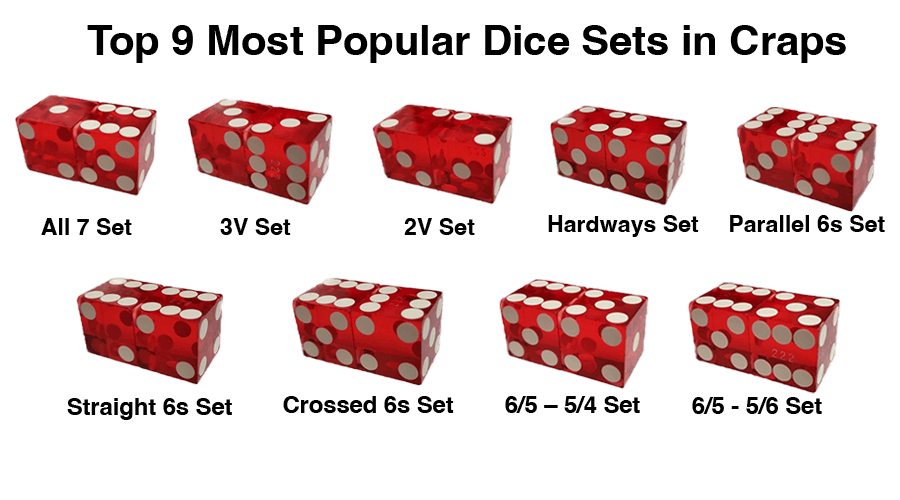
1. The Hardway Set

The Hardway Set is the most widely recommended configuration for beginners and intermediate shooters. It’s also the go-to set for avoiding sevens after the point is established.
To set it up, place any hardway combination on top of the dice. Hard ten (5+5) on top means hard six or hard eight shows on the front face, with hard four on the bottom. The key insight: no matter which primary face the dice rotate to, a seven cannot appear if the dice stay on axis.
This makes it the gold standard for protecting your pass line bet and any place bets you have working after the come-out roll.
Best for: Post-point play, seven avoidance, beginner shooters
2. The 3V Set
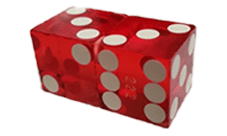
The 3V Set is a favorite among intermediate players who want to target inside numbers (5, 6, 8, 9). These numbers carry a lower house edge on place bets compared to outside numbers, making this set a logical pairing with a place betting strategy.
Position the dice so both threes form a V shape on top. The front faces will show combinations that add up to six or eight. For the set to work, both dice need parallel alignment, matching spin rates, and identical trajectories through the air.
Best for: Targeting sixes and eights, inside number strategies
Say the point is 8 and you have $12 place bets on both 6 and 8. Using the 3V Set, if the dice stay on axis, the primary outcomes on the rotation are 6, 8, and other inside numbers. A hit on either place bet pays $14. Meanwhile, sevens are reduced on the primary axis, theoretically extending your roll.
3. The 2V Set

Where the 3V targets inside numbers, the 2V Set is built for outside numbers: fours and tens. Place two and two on top of the dice, and the front faces will show combinations adding to four, ten, five, or nine.
For this set to produce results, the shooter must keep both dice rotating together on the same axis throughout the entire toss. Any deviation breaks the intended outcome.
Best for: Outside number strategies, targeting 4 and 10, buy bets
4. The All 7 Set
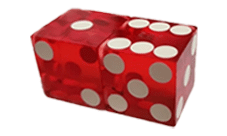
This is the simplest set to remember. Place one die with the 1 facing up and the other with the 6 facing up. The top adds to seven. Every primary rotation face also produces a seven.
That sounds counterintuitive for a game where sevens usually hurt you. But on the come-out roll, sevens are your best friend if you have a pass line bet working. A natural seven on the come-out is an instant win.
Best for: Come-out rolls with pass line bets
Never use the All 7 Set after the point is established. Once a point is set, rolling a seven means you seven-out and lose your pass line bet plus any place bets, come bets, or odds you have working. Switch to a seven-avoidance set like the Hardway Set as soon as the point is up.
5. The Crossed Sixes Set
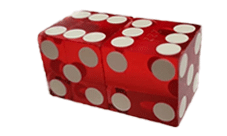
Popular among experienced controlled shooters, the Crossed Sixes Set involves positioning the dice so that the pip patterns on top create a crossed six pattern (4+1 on one die, 3+2 on the other, rotated 90 degrees relative to each other).
The configuration is effective at reducing seven combinations on the primary axis. It takes more practice to set quickly at the table because the arrangement is less intuitive than the Hardway Set.
Best for: Experienced shooters, seven avoidance with different axis coverage
6. The Straight Sixes Set
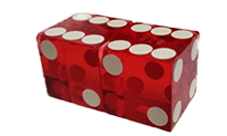
Both dice go six-up, creating a total of twelve on top. The ones sit on the bottom. This is a high-risk, high-reward configuration that reduces the chance of rolling a seven but also narrows the range of numbers you’ll hit.
The Straight Sixes requires a very skilled, consistent throw. Small deviations in delivery punish you more with this set than with forgiving options like the Hardway.
Best for: Advanced shooters comfortable with narrow outcomes, targeting specific hardways bets
7. The Parallel Sixes Set
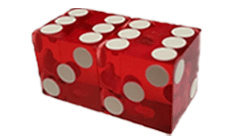
Position both dice with the 6 pips facing forward on top. This set produces four ways to roll a seven, plus the 2 and 12. Because of the high seven exposure, it’s primarily a come-out roll set.
Some controlled shooters who bet the don’t pass or the field bet after the point use this set strategically. But for most players, it’s too risky for post-point play.
Best for: Come-out rolls only, experienced shooters with don’t-side strategies
The Parallel Sixes is generally not recommended unless you have a very specific betting strategy built around it. For most sessions, the Hardway Set or 3V Set will serve you better after the point.
8. The 6/5 – 5/4 Set
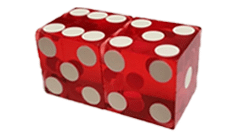
This is an excellent post-point set for controlled shooters who keep the dice consistently on axis. The configuration covers the full range of place numbers: 4, 5, 6, 8, 9, and 10. It offers only two ways to roll a seven, making it one of the strongest seven-avoidance sets available.
The catch? It demands a high skill level. Less consistent shooters will find the seven creeping in despite the set’s theoretical protection. If your delivery isn’t repeatable, stick with the Hardway Set instead.
Best for: Skilled shooters, full place-number coverage, minimal seven exposure
9. The 6/5 – 5/6 Set
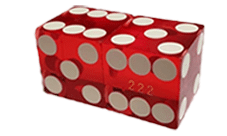
A personal favorite of many experienced shooters for the come-out roll. This set produces four sevens, two elevens, one twelve, one two, and the 4 and 10 hardways. That’s a strong come-out profile: the seven and eleven are instant pass line winners.
Some players pair this with a whirl bet on the come-out to cover the 2, 12, and 7 simultaneously. With a consistent delivery, the combination can be profitable on paper.
Best for: Come-out rolls, pass line plus whirl bet strategies
| Dice Set | Best Used For | Seven Exposure | Skill Level |
|---|---|---|---|
| Hardway Set | Post-point, seven avoidance | Zero (on axis) | Beginner |
| 3V Set | Inside numbers (5,6,8,9) | Low | Intermediate |
| 2V Set | Outside numbers (4,10) | Low | Intermediate |
| All 7 Set | Come-out roll | Maximum | Beginner |
| Crossed Sixes | Seven avoidance | Low | Advanced |
| Straight Sixes | Narrow targeting | Low | Advanced |
| Parallel Sixes | Come-out / don’t-side | High (4 ways) | Advanced |
| 6/5 – 5/4 | Full place coverage | Very low (2 ways) | Advanced |
| 6/5 – 5/6 | Come-out roll | High (4 ways) | Advanced |
How to Match Your Dice Set to Your Betting Strategy
Picking a dice set without connecting it to your bets is like tuning a guitar and then playing random notes. The set and the strategy need to work together.
If you’re a pass line player who backs bets with free odds, the Hardway Set is your bread and butter after the point. It protects against sevens while giving you the broadest coverage of point numbers. On the come-out, switch to the All 7 Set or the 6/5 – 5/6 to maximize your chance of an instant win.
If you prefer place betting inside numbers, the 3V Set pairs naturally with $12 six and $12 eight bets. These place bets already carry a reasonable 1.52% house edge, and the 3V theoretically concentrates outcomes on exactly those numbers.
For don’t-side players who bet the don’t pass and lay odds, the approach flips. You want sevens after the point. The Parallel Sixes or All 7 Set can be used post-point if you’re betting the dark side, though this is an unusual and advanced strategy.
Decide your betting strategy first, then choose the dice set that supports it. Too many aspiring controlled shooters pick a set because it looks impressive, then realize it doesn’t align with the bets they’re making. Your set and your bets should tell the same story. For a broader strategy framework, check out our craps strategy guide.
Does Dice Control Actually Work? The Honest Answer
This is the section nobody can dodge. Does dice setting and controlled shooting actually shift the odds?
The honest answer: nobody has definitively proven it under controlled scientific conditions.
The theory is sound enough on paper. If you can keep both dice rotating on a single axis and limit the bounce off the back wall, certain number combinations become more likely. Chris Pawlicki laid out the math and physics in his book Get the Edge at Craps, and Stanford Wong explored the concept further in Wong on Dice. Both are worth reading if you want to dig deeper. You can find more recommendations in our best craps books article.
Pawlicki and Jerry L. Patterson co-developed PARR (Patterson Rhythm Roll) in 1997, which claims to be the first structured course on dice setting and control. Since then, a small industry of dice control seminars and coaching has emerged.
Normally, there are 6 ways to roll a seven out of 36 possible dice combinations, giving a 16.67% probability. If a controlled shooter could reduce that by even one combination (to 5 out of 36, or 13.89%), the house edge on a pass line bet would flip from 1.41% in the casino’s favor to roughly 1.4% in the player’s favor. That’s a tiny shift, but over hundreds of rolls, it adds up.
But here’s the problem. The rubber pyramids on the back wall exist specifically to randomize the dice. Casino operations directors like Jim Klimesh of Indiana’s Empress Casino have acknowledged that without wall contact, techniques like the “army blanket roll” (a gentle slide named after the playing surface used in WWII dice games) can influence outcomes. That’s exactly why casinos require the dice to hit the back wall.
The experimental evidence? Inconclusive. No peer-reviewed study has conclusively demonstrated that controlled shooting overcomes the randomizing effect of the pyramid rubber in a statistically significant sample.
- The physics of axis rotation is mathematically sound in theory
- Skilled shooters report longer-than-average rolls in tracked sessions
- Some advantage gambling experts endorse the concept with caveats
- Even a tiny shift in seven-to-rolls ratio can mathematically flip the edge
- No controlled experiment has proven it works against pyramid rubber walls
- Confirmation bias heavily affects self-reported tracking results
- The required consistency is nearly superhuman over thousands of throws
- Casinos don’t seem worried about it, which tells you something
The pragmatic take? Dice setting won’t hurt your game. At worst, it’s a fun ritual that gets you focused. At best, it might provide a fractional edge that accumulates over long sessions. Just don’t count on it to pay your mortgage. This is one of the most persistent craps myths that lives in a gray zone between fact and wishful thinking.
Common Dice Control Mistakes to Avoid
Even players who take dice setting seriously often sabotage their own practice with avoidable errors. Here are the ones that show up most often.
- Spending too long setting the dice. Casinos and other players will lose patience if you take 30 seconds to arrange the dice each throw. Practice at home until you can find your set in 3-5 seconds. A slow setter draws attention, earns dirty looks, and may be asked to speed up.
- Inconsistent delivery. The set means nothing if your throw changes every time. A controlled shooter’s arm motion should look identical on throw number 1 and throw number 200. Same angle, same speed, same release point.
- Throwing too hard. A powerful throw sends the dice rocketing off the back wall. All your careful setting goes out the window the moment the dice bounce wildly off those rubber pyramids. Aim for a gentle lob that barely reaches the wall.
- Ignoring table position. Where you stand at the table affects your throw distance and angle. Most controlled shooters prefer to stand at one end, directly next to the stickman, for the shortest possible throw to the back wall.
Don’t forget basic craps etiquette while practicing dice control. Handle the dice with one hand only. Don’t pull them off the table. Don’t blow on them (yes, some casinos care about this). And always hit the back wall. Breaking these rules will get the boxman’s attention for all the wrong reasons.
How to Practice Dice Setting at Home
You don’t need a casino to build your skills. A practice station at home is the best way to develop consistency before risking real money.
Get a pair of regulation casino dice. They’re precision-machined to 3/4-inch with sharp edges, not the rounded dice from your board game drawer. You can find them online or pick them up at casino gift shops.
Set up a practice area on a table or countertop with a foam backstop to simulate the back wall. Some dedicated players build small tabletop rigs with pyramid rubber glued to a board. Others tape a piece of egg-crate foam to the wall.
Track your results. Write down your set, your throw count, and what numbers come up. After 500-1000 throws, look at whether your seven-to-rolls ratio differs from the expected 1-in-6. If it does, that’s encouraging. If it doesn’t, you need more practice or a different approach.
Record yourself throwing on your phone. Watch the slow-motion playback to check whether both dice are spinning in sync, traveling on the same arc, and landing together. Visual feedback catches problems your hands can’t feel. Combine this with a solid bankroll management plan before taking your practice to a real table.
The Final Roll: Is Dice Setting Worth Your Time?
Craps dice setting and control sits in a fascinating gray area. The physics make sense. The math checks out on paper. But the real-world execution, rolling two small cubes down 12 feet of felt into a wall of rubber pyramids and expecting precision, is a different challenge entirely.
Here’s what we know for certain: dice setting makes you a more deliberate, focused player. It forces you to think about which bets pair with which outcomes. It connects your physical throw to your mathematical strategy. And it adds a layer of engagement that turns craps from a guessing game into something that feels closer to a craft.
Will it make you rich? Almost certainly not. Will it make you a better, more disciplined craps player? That part isn’t up for debate. And sometimes, the ritual of setting the dice, finding your grip, and delivering a smooth toss is half the fun of standing at the craps table.
Best Online Craps Casinos (Last Updated September 2026)







Dice Setting FAQs
Yes. Every casino allows you to arrange the dice however you want before throwing. The only rules are that you must use one hand, the dice must hit the back wall, and you can’t take the dice off the table. Dice setting is completely within the rules. Dice sliding, where you slide the dice without a proper toss, is a different story and is not allowed.
The rubber pyramids on the back wall are designed to randomize the dice after they land. Without wall contact, a skilled shooter could potentially control outcomes with techniques like the army blanket roll. The wall requirement is the casino’s primary defense against dice influence.
Most dice control instructors recommend 10,000+ practice throws before you can expect any consistency. That translates to several months of regular home practice. Even then, results in a real casino environment (noise, pressure, longer tables) will differ from your living room.
Casino craps dice are made of transparent cellulose acetate so players and pit bosses can visually confirm they aren’t loaded or weighted. Opacity could hide internal modifications. Transparency is a fairness measure, just like the precision-machined edges and serial numbers stamped on each die.
In theory, a tiny reduction in seven frequency (even one fewer seven per 36 rolls) would flip the house edge on basic bets. In practice, no one has proven this is achievable under real casino conditions with back-wall contact. Treat dice control as a disciplined practice that might help, not a guaranteed path to profit.
