The History of Craps: From Rolling Bones to the Casino Floor
 Jake Wilfred
Picture a Roman soldier, exhausted from battle, crouching behind his shield. He tosses a carved pig knuckle onto the leather surface. His buddies lean in. That simple act, repeated thousands of times across centuries, eventually became the craps game you and I know today. The history of craps stretches back further than almost any other casino game still played in 2026, and every twist in its story shaped the rules, bets, and culture that surround the table right now.
This is the full story: from ancient dice made of bone, to medieval castles, to Mississippi riverboats, to the neon glow of Las Vegas, and finally to your phone screen. If you’ve ever wondered why we say “rolling the bones” or why a roll of 2, 3, or 12 is called “craps,” you’re about to find out.
- Craps traces its roots to the Roman Empire, where soldiers carved pig knuckles into crude dice
- The medieval English game of Hazard is the direct ancestor of modern craps
- French settlers brought the game to Louisiana in the 1700s, where it was simplified and renamed
- John H. Winn invented the “Don’t Pass” bet around 1907, creating the version we play today
- Las Vegas legalized gambling in the 1930s and turned craps into a casino icon
- Online craps launched in the late 1990s and continues to grow in 2026
Ancient Origins: Pig Knuckles, Bones, and the First “Dice”
Long before anyone shuffled chips or called out “seven out,” people were gambling with whatever they could get their hands on. The earliest evidence of dice-like objects dates back over 5,000 years to ancient Mesopotamia. But the story that connects most directly to craps starts with Rome.
Soldiers from the Roman Legions reportedly collected pig knucklebones, called “astragali,” and carved them into small cubes. They’d flip their shields upside down, turning them into makeshift tables, and toss these bones against the curved surface. That habit gave us the phrase “rolling the bones”, a term that still echoes at craps tables worldwide.
The materials people used for dice said a lot about their social standing. Enslaved people in Rome crafted dice from nutshells, clay, and animal teeth. Wealthy citizens, on the other hand, rolled with gold, ivory, silver, and porcelain. The game was the same. The stakes were real. Only the materials changed.
Archaeological digs have uncovered dice-like objects in Egyptian tombs, Sumerian ruins, and Viking settlements across Scandinavia. Gambling with small throwable objects appears to be one of the oldest human pastimes, predating written language in some regions.
These early dice games weren’t craps, of course. They didn’t have pass lines or come bets. But they established something fundamental: the thrill of a random outcome determined by a toss. That core experience hasn’t changed in thousands of years.
From Hazard to Craps: The Medieval Game That Started It All
The direct ancestor of craps is a game called Hazard. And its origin story reads like something out of a Hollywood script.
Sir William of Tyre and the Siege of Hazarth
According to legend, an English nobleman named Sir William of Tyre invented Hazard in 1125 AD during the Crusades. He and his fellow knights needed something to pass the time while they waited to besiege a castle called Hazarth (sometimes spelled Asart). The game they created took its name from that castle.
Whether this story is historically accurate or just a good campfire tale, Hazard became wildly popular across medieval England. Knights, merchants, and commoners all played it. By the 14th century, Geoffrey Chaucer was writing about it in The Canterbury Tales, which tells you how deeply the game had woven itself into English culture.
Hazard was considerably more complicated than modern craps. Players had to choose a “main” number between 5 and 9 before rolling, and the winning and losing conditions changed depending on that choice. It took real effort to learn. The simplification of Hazard into craps is a big part of why the game became so widespread.
The Arabic Connection
Some historians argue Hazard didn’t originate with Sir William at all. They point to an older Arabic game called “Azzahr” (sometimes written as “Al Zar”), which translates to “the die.” The theory suggests that Crusaders learned the game from their Arab opponents and brought it back to England.
The truth probably lies somewhere in between. Games involving dice existed across the Middle East and Europe for centuries. Hazard may have borrowed elements from Arabic gaming traditions and blended them with English gambling customs.
Hazard Conquers France
By the 17th and 18th centuries, Hazard had crossed the English Channel and caught fire in France. Members of the French aristocracy played it in lavish gambling houses, and the game quickly became a fixture of high society.
In the early 1700s, French mathematician Pierre Remond de Montmort published the formal rules of Hazard in his book on probability, “Essay D’analyse sur Les Jeux de Hazard” (Analysis of Games of Chance). This was one of the first times a dice game’s odds were laid out mathematically, a precursor to the payout charts and odds tables we reference today.
As Hazard’s popularity grew in France, the name of a losing throw (“crabs” in English) was adopted by French players as “crabes.” The French also started calling the game “crapaud,” meaning “toad,” possibly because of how street players crouched like toads while playing on sidewalks. Both terms eventually evolved into “craps.”
Here’s where the craps terminology we still use started taking shape. The word “crabs” (later “craps”) referred to the worst possible rolls: 2, 3, or 12. Sound familiar? Those numbers still lose on the come-out roll at any casino offering craps in 2026.
How Craps Crossed the Atlantic to America
The game didn’t sail to America on its own. It hitched a ride with French colonists, and the port city of New Orleans turned it into a phenomenon.
The Cajun Connection
In the early 1700s, France established the colony of Acadia in what is now Nova Scotia, Canada. French settlers brought Hazard (and its simplified variants) with them. When Britain took control of Acadia in 1755, these French settlers, known as Acadians or Cajuns, were forced south. Most ended up in Louisiana.
The Cajun people spread their version of the dice game throughout Louisiana’s bayous, riverfront towns, and eventually into New Orleans, the gambling capital of 19th-century America.
The journey from “Hazard” to “craps” followed the game across borders. In England: Hazard. In France: crapaud/crabes. In Louisiana: craps. By the mid-1800s, “craps” was the standard name, and the simplified rules we recognize today had largely replaced Hazard’s complicated structure.
Bernard de Marigny and the Streets of New Orleans
There’s another theory about how craps arrived in Louisiana. A wealthy French nobleman named Bernard de Marigny reportedly learned Hazard while visiting England and brought his own version back to New Orleans. Marigny was a legendary gambler, and he’s often credited with popularizing craps in the American South.
Whether it was Cajun settlers or a gambling aristocrat (probably both), New Orleans became ground zero for craps in America. The game spilled out of private homes and into the streets, where players crouched on sidewalks and in alleyways, rolling dice against walls and curbs.

From New Orleans, craps traveled up the Mississippi River on steamboats. Gamblers, hustlers, and entertainers played it on deck, spreading the game to cities like Memphis, St. Louis, and Chicago. By the late 1800s, craps had a national footprint.
Some historians argue that English settlers on the Mayflower brought dice games to America as early as 1620. While possible, the New Orleans connection through French and Cajun settlers is the most widely accepted origin story for American craps.
The Problem of Cheating and the Birth of Modern Craps
Early American craps had a serious flaw. The rules allowed players to exploit the house, and loaded dice were rampant. This era of the game was messy, corrupt, and in desperate need of a fix.
How Players Gamed the System
Bernard de Marigny’s version of craps gave players a structural advantage. Bettors could wager with or against the shooter, but the bet options were limited in a way that created opportunities for cheating. Players (or the house) could “load” the dice, weighting them so specific numbers appeared more often.
The result? Nobody trusted the game. Casinos and gambling houses couldn’t offer craps without the constant threat of being swindled. Something had to change.
Without the innovations that came next, craps might have died out as a casino game entirely. The cheating problem was that severe. The fix didn’t just save craps; it made it one of the fairest games on the casino floor.
John H. Winn: The Father of Modern Craps
In 1907, American dice maker John H. Winn revolutionized the game by introducing the Don’t Pass bet. This single innovation changed everything.
Before Winn, players could only bet with the shooter. The Don’t Pass bet allowed players to bet against the shooter, which eliminated the primary motivation for loading dice. If you loaded the dice to help the shooter, Don’t Pass bettors would simply bet the other way. The incentive to cheat vanished almost overnight.
Winn also redesigned the craps table layout, adding a dedicated Don’t Pass area and reorganizing the betting grid into something closer to what you’ll see at any table today. His contributions were so significant that he earned the title “Father of Modern Craps.”
| Before Winn (Pre-1907) | After Winn (Post-1907) |
|---|---|
| Players could only bet with the shooter | Players could bet with OR against the shooter |
| Loaded dice were a constant problem | Loaded dice became ineffective for cheating |
| Simple, exploitable table layout | Reorganized layout with Don’t Pass area |
| Houses struggled to maintain an edge | Fair house edge built into the game’s structure |
| Limited betting options | Foundation for all modern craps bets |
Winn’s redesign also laid the groundwork for the Pass Line bet with its 1.41% house edge, one of the best bets in any casino. The entire betting structure we use today, from Come bets to odds bets, grew from his framework.
Craps Becomes King in Las Vegas
The legalization of gambling in Nevada in 1931 changed the trajectory of craps forever. What had been a street game and steamboat pastime was about to become a centerpiece of the most glamorous gambling destination on Earth.

Players flocked to the craps tables at newly built Las Vegas casinos. The energy at a hot craps table, with a dozen players cheering for the shooter, was unlike anything else on the casino floor. It still is.
Several factors fueled the rise of craps in Vegas. First, the game was already well known across America thanks to its spread via New Orleans and the Mississippi River. Second, casinos introduced floormen, dedicated employees who oversaw the craps tables, monitored for cheating, and kept the action running smoothly. Their presence gave players confidence that the game was fair.
If you’re planning to play craps in Vegas for the first time, brush up on craps etiquette before you go. The table culture in Vegas is part of the experience, and knowing the basics will help you fit in from your very first roll.
World War II added another chapter. American soldiers played craps in barracks, on bases, and during downtime overseas. When they returned home, many brought their love for the game with them and headed straight to the Vegas tables. The 1950s and 1960s were arguably the golden age of craps, with the game rivaling blackjack and roulette as the most popular attraction on the Strip.
The Rat Pack era cemented craps in pop culture. Frank Sinatra, Dean Martin, and Sammy Davis Jr. were regulars at the craps tables. Their public love for the game gave it a cool, sophisticated image that persists to this day. Some of the biggest craps wins in history came during this era, adding to the game’s legendary status.
The Complete History of Craps Timeline
Here’s the full journey at a glance.
| Era | What Happened | Why It Matters |
|---|---|---|
| ~3000 BC | Earliest known dice-like objects appear in Mesopotamia and Egypt | Establishes dice gambling as one of humanity’s oldest pastimes |
| ~100 BC – 400 AD | Roman soldiers carve pig knuckles into dice, toss them on shields | Gives us “rolling the bones” and the direct cultural ancestor of craps |
| 1125 AD | Sir William of Tyre reportedly invents Hazard during the Crusades | Hazard becomes the direct gameplay ancestor of craps |
| 1400s-1600s | Hazard spreads across England and into France | The game gains aristocratic popularity and formal structure |
| Early 1700s | Montmort publishes Hazard’s mathematical rules | First formal probability analysis of a dice game |
| 1755 | Cajun settlers bring dice games to Louisiana | Craps arrives in America and begins its transformation |
| Early 1800s | Bernard de Marigny popularizes craps in New Orleans | New Orleans becomes the birthplace of American craps |
| Mid-1800s | Craps spreads via Mississippi River steamboats | The game goes national across the United States |
| 1907 | John H. Winn introduces the Don’t Pass bet | Eliminates the cheating problem and creates modern craps |
| 1931 | Nevada legalizes gambling | Craps becomes a Las Vegas casino staple |
| 1940s-1960s | WWII soldiers and the Rat Pack popularize the game | Craps reaches peak cultural status |
| Late 1990s | First online craps games launch | The game becomes accessible worldwide |
| 2026 | Online craps, live dealer games, and casino apps thrive | More people can play craps than at any point in history |
Online Craps and the Digital Revolution
The internet changed everything for craps, just as it changed everything else.
The first online casinos appeared in the mid-1990s, and craps was among the early offerings. These digital versions replicated the table layout, the bets, and the odds, but they couldn’t quite capture the roar of a hot table. Still, they made craps accessible to millions of people who had never set foot in a casino.
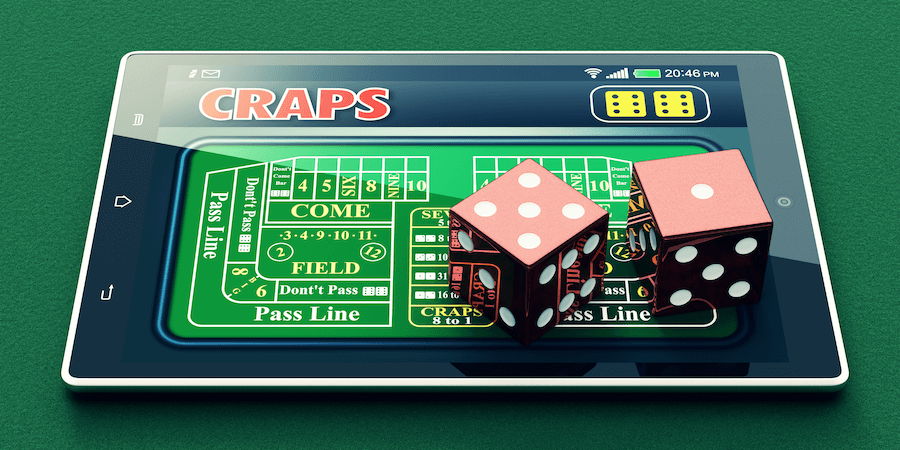
As of 2026, you can play craps in several digital formats. Standard RNG (random number generator) games let you play at your own pace. Live dealer craps streams a real table with a real dealer to your device, blending the convenience of online play with the energy of a real game. And if you just want to practice, a free craps simulator is one of the best ways to learn how to play without risking a cent.
- Play from anywhere, anytime, with no table minimums holding you back
- Lower minimums than most brick-and-mortar casinos
- Practice modes let beginners learn all the craps bets risk-free
- Live dealer games recreate much of the in-person experience
- The communal energy of a live casino table is hard to replicate on screen
- Some online versions limit bet types, cutting out options like hop bets or fire bets
- Faster pace can lead to quicker bankroll swings without proper bankroll management
Online casinos have also introduced craps variants that don’t exist in traditional casinos, including simplified versions and hybrid games. Bubble craps machines, which use a sealed dice chamber, have also become fixtures in many brick-and-mortar casinos for players who want a craps experience without the intimidation of a full table.
Where Craps Goes From Here
Craps has survived Roman battlefields, medieval sieges, riverboat hustlers, loaded dice scandals, and the shift to digital. Few games can claim that kind of resilience.
The game is healthier than many people think. Casino craps continues to draw crowds in Las Vegas, Atlantic City, and regional casinos worldwide. Online craps grows steadily each year. And the game’s fundamentals, the Pass Line at 1.41%, free odds with zero house edge, the electric energy of a hot shooter, remain as compelling as they were a century ago.
Understanding the history of craps isn’t just trivia. It helps you appreciate why the table looks the way it does, why certain bets exist, and why the game has outlasted so many others. Every time you place a Pass Line bet, you’re participating in a tradition that connects you to Roman soldiers, medieval knights, Cajun settlers, and Vegas legends.
That’s a pretty good lineage for a game built on two little cubes.
Best Online Craps Casinos (Last Updated September 2026)







History of Craps FAQs
The modern version of craps, called bank craps, was developed around 1907 when American dice maker John H. Winn introduced the Don’t Pass bet. However, the game’s roots go back to the medieval game of Hazard, which dates to roughly 1125 AD. Dice gambling itself is over 5,000 years old.
The most widely accepted explanation traces the name to the French word “crapaud,” meaning “toad,” a reference to how street players crouched like toads while playing on the ground. Another theory connects it to “crabs,” the English Hazard term for rolling a 2 or 3. Over time, “crabs” became “craps.” Both explanations likely contributed to the final name.
John H. Winn, an American dice maker, earned that title. In 1907, he introduced the Don’t Pass bet and redesigned the table layout, solving the loaded dice problem that had plagued the game for decades. His changes form the foundation of every craps table you’ll find in casinos today.
Craps evolved from Hazard, a medieval English dice game that was popular among knights and aristocrats. Hazard was more complex, requiring players to choose a “main” number before rolling. When the game reached France and then America, it was simplified into the version we call craps. For more on related games, check out our guide to dice games.
Yes. American soldiers played craps extensively during WWII, both in training camps and overseas. The game was easy to set up (all you needed was a pair of dice and a flat surface) and perfect for passing downtime. When these soldiers returned home, many became regular craps players in Las Vegas casinos, fueling the game’s postwar popularity boom.
