How to Win at Craps: 25 Pro Tips That Actually Work in 2026
 Jake Wilfred
Let’s get something out of the way immediately: you can’t guarantee a win at craps. Anyone who tells you otherwise is selling something. The house has a mathematical edge on almost every bet, and no strategy, system, or lucky charm changes that.
But here’s what you can do. You can play smarter than 90% of the people at the table. You can pick the bets that give the casino the smallest advantage. You can manage your money so that a bad session doesn’t wreck your week. And you can walk into a casino with enough knowledge to recognize which bets are traps and which ones give you a real shot.
That’s what this guide is about. Not magic. Not myths. Just honest, math-backed craps tips from someone who’s spent over 20 years at the felt. These are the habits that separate players who have fun and walk away with their bankroll intact from the ones who hand over their mortgage payment in 45 minutes.
- The free odds bet is the single best wager in any casino, with a 0% house edge
- Pass line + full odds is the foundation of every winning craps approach
- Avoiding proposition bets, hardways, and Big 6/Big 8 saves you more money than any “system” ever will
- Bankroll management is the only strategy that 100% of successful craps players use
- The house always has an edge; your goal is to minimize it, not eliminate it
- Discipline and knowing when to walk away matter more than any betting technique
Understanding the Rules: The Non-Negotiable First Step
You can’t win at a game you don’t understand. That sounds obvious, but you’d be surprised how many people walk up to a craps table and start throwing chips without knowing the difference between a come-out roll and a point.
Here’s the version that fits in your pocket. Craps uses two dice. The shooter (the person rolling) makes a come-out roll. If it’s a 7 or 11, pass line bets win immediately. If it’s a 2, 3, or 12, they lose. Any other number (4, 5, 6, 8, 9, 10) becomes the “point.” The shooter then keeps rolling until they hit the point again (pass line wins) or roll a 7 (pass line loses, called a “seven-out”).
That’s the skeleton. Everything else, the dozens of bet types, the table layout, the dealer procedures, hangs on that framework.
Before you spend a dollar at a live table, spend an hour with our free craps simulator. It lets you practice every bet, see how the game flows, and make mistakes without consequences. Our full how to play craps guide covers the rules in depth.
One critical thing to internalize early: craps myths are everywhere. “Hot tables,” “due numbers,” “lucky shooters,” they’re all fun to believe, but none of them change the math. Every roll is independent. The dice don’t remember what happened last time.
The Best Bets in Craps: Where Smart Players Put Their Money
Not all craps bets are created equal. The house edge ranges from 0% (yes, zero) to over 16% depending on what you choose. Learning which bets to make, and which to ignore, is the single most impactful thing you can do to improve your results. For a complete look at every option, our craps bets explained page covers the full menu.
The Pass Line Bet
The pass line is where every craps journey starts. It’s the most fundamental bet in the game, and it carries a house edge of just 1.41%.
You place it before the come-out roll. A 7 or 11 wins (even money). A 2, 3, or 12 loses. Anything else sets the point, and you need that number again before a 7 to win.
The pass line bet is simple, low-edge, and the foundation of nearly every winning approach. If you never learn another craps bet, this one alone will keep you competitive at any table.
You put $10 on the pass line. The come-out roll is 8. That’s now the point. The shooter rolls a 5, then a 9, then a 3, then an 8. Point made. You win $10. Your total risk was $10 at a 1.41% house edge, meaning the casino expected to earn about $0.14 from that bet. Compare that to a $10 proposition bet where the house expects $1.10 to $1.67. Same money at risk, dramatically different cost.
The Free Odds Bet: The Best Wager in Any Casino
Once a point is established, you can place an additional bet behind your pass line. This is the free odds bet, and it pays at true mathematical odds with zero house edge. No other bet in any casino game offers this.
The amount you can bet on odds depends on the craps casino you play at. Common structures are 1x, 2x, 3-4-5x, and 10x. Some casinos even offer 100x odds. The more you put on odds relative to your pass line bet, the lower your combined house edge becomes.
| Odds Multiple | Combined House Edge (Pass + Odds) |
|---|---|
| No odds (pass line only) | 1.41% |
| 1x odds | 0.85% |
| 2x odds | 0.61% |
| 3-4-5x odds | 0.37% |
| 10x odds | 0.18% |
| 100x odds | 0.02% |
At a 3-4-5x odds table (the most common in Vegas), your combined house edge drops to 0.37%. You won’t find a better deal anywhere on the casino floor.
Always take the maximum odds your bankroll allows. The pass line bet is just the entry fee. The odds bet is where the real value lives. If you can only afford $10 total, consider a $5 pass line with $5 odds rather than $10 on the pass line with no odds. The math favors the smaller base bet with maximum odds.
The Come Bet
The come bet works exactly like the pass line, but you place it after a point is already established. It gets its own point number and its own odds bet.

Why use it? The come bet lets you have multiple points working simultaneously. If the original point is 6, you can make a come bet and potentially establish a second point on 8, then a third on 5. Each one gives you another chance to win, and each one can carry odds.
The Three-Point Molly strategy is built entirely on this concept: one pass line bet plus two come bets, all backed by maximum odds. It spreads your action across three numbers while keeping the house edge razor thin.
Place Bets on 6 and 8
If the come bet feels too slow, place bets on 6 and 8 are the next best option. These bets win if the number is rolled before a 7, and they carry a house edge of just 1.52%.

The 6 and 8 each have five ways to be rolled (out of 36 dice combinations), making them the most likely point numbers after the 7 itself. Place bets on 6 or 8 pay 7:6, so always bet in multiples of $6 ($6, $12, $18, etc.) to avoid getting shorted on the payout.
Place bets on 4, 5, 9, and 10 carry higher house edges (4% to 6.67%). If you want to bet on those numbers, consider buy bets on 4 and 10 instead, which pay true odds minus a 5% commission and offer a lower effective house edge of about 4.76%.
The Don’t Pass: Betting the Dark Side
The don’t pass bet is the mirror image of the pass line. You win when the shooter sevens out. You lose on the come-out 7 or 11. A 12 on the come-out pushes (tie).
The house edge is 1.36%, slightly better than the pass line. Combined with lay odds, the math is marginally superior to the right side.
The downside isn’t mathematical. It’s social. You’re winning when everyone else is losing, which makes you unpopular at a communal table. Many experienced players call this “betting wrong,” though the term is just jargon with no moral weight.
If you prefer don’t pass, keep your celebrations muted. Collect your chips quietly. Don’t gloat. The table won’t love you for betting against the shooter, but they’ll tolerate you if you’re respectful about it. Read our craps etiquette guide for more on the social rules.
The Bets You Should Avoid (And Why the House Loves Them)
For every smart bet in craps, there are three terrible ones designed to separate impatient players from their chips. Knowing what to avoid saves you more money than any positive strategy.
| Bet | House Edge | Why It’s Bad |
|---|---|---|
| Any Seven | 16.67% | Worst bet on the table. For every $100 wagered, expect to lose $16.67. |
| Any Craps | 11.11% | High edge, one-roll bet. Exciting for about 3 seconds. |
| Hard 4 / Hard 10 | 11.11% | Sounds fun, costs a fortune over time. |
| Hard 6 / Hard 8 | 9.09% | Slightly better than Hard 4/10, still expensive. |
| Big 6 / Big 8 | 9.09% | Identical to placing 6/8 but with worse payouts. Never make this bet. |
| Horn Bet | 12.50% | Covers 2, 3, 11, 12. Flashy payout, ugly math. |
| Whirl (World) Bet | 13.33% | Horn plus any seven. Compounding two bad ideas. |
The Big 6 and Big 8 bets deserve special attention because they’re a perfect example of a casino trap. They pay even money (1:1) on a 6 or 8. A place bet on 6 or 8 pays 7:6 on the exact same outcome. Same number, worse payout. There is zero reason to ever make a Big 6 or Big 8 bet. Place the 6 or 8 instead.
The center of the craps table layout is where the worst bets live. Proposition bets, horn bets, hardways, the any seven. They all have house edges above 9%, and several exceed 16%. The stickman will encourage you to make these bets. That’s their job. Your job is to politely decline.
Bankroll Management: The Only Strategy That Never Fails
Every tip in this guide means nothing if you blow your bankroll in the first 20 minutes. Bankroll management isn’t glamorous. Nobody writes movies about the guy who set a loss limit and stuck to it. But it’s the single most reliable way to walk out of a casino with your finances intact.
Here’s a framework that works.
Set a session budget. Before you approach the table, decide how much you’re willing to lose. Not how much you hope to win. How much you can lose and still feel fine about it. That’s your session bankroll.
Divide your trips. If you’re in Vegas for a weekend and your total craps budget is $600, don’t bring it all to one session. Split it into three $200 sessions. If you lose one session’s bankroll, you walk away and come back later. This prevents the “one more roll” trap.
Size your bets to your bankroll. A good rule of thumb: your base bet (pass line or don’t pass) should be no more than 2-3% of your session bankroll. For a $200 session, that’s $5-$6 base bets. This gives you enough rolls to ride out variance and catch a hot streak if one comes.
You sit down with $200 at a $10 minimum table. You make $10 pass line bets with 2x odds ($20 behind the line). Each fully loaded bet risks $30 total. That gives you roughly 6-7 full sequences before you’re broke if nothing hits. That’s tight. At a $5 table with the same bankroll, your pass line is $5 with $10 odds, risking $15 per sequence. Now you’ve got 13+ chances, which is far more comfortable and gives variance room to work in your favor.
Set a win limit too. This is harder than a loss limit because your brain screams “keep going” when you’re winning. But doubling your bankroll is a great result. If you sat down with $200 and you’re sitting on $400, seriously consider walking away. The table doesn’t know you’re ahead. The math doesn’t shift because you’re winning.
Physically separate your profits. When you’re up, take your original buy-in amount off the rail and put it in your pocket. Play only with winnings from that point. This way, the worst outcome is breaking even for the session. You’ll never feel bad about walking away with your starting money intact.
The House Edge: What It Actually Means for Your Wallet
The house edge is the percentage of every bet that the casino expects to keep over time. It’s the reason casinos exist. Understanding it isn’t optional if you want to win at craps.
Here’s what confuses people: the house edge doesn’t mean you lose that percentage every roll. It’s a long-term average. In a single session, you might win $500 or lose $300. Variance creates those swings. But over thousands of bets, the casino’s profit converges on the house edge percentage.
A 1.41% house edge on the pass line means the casino expects to keep $1.41 for every $100 you wager. A 16.67% house edge on any seven means they expect $16.67 per $100. The difference between a smart craps player and a losing one is choosing which percentage they’re willing to pay.
| Your Approach | Average House Edge | Expected Loss per $1,000 Wagered |
|---|---|---|
| Pass line + full odds | ~0.37% | $3.70 |
| Pass line only | 1.41% | $14.10 |
| Pass line + place 6 and 8 | ~1.50% | $15.00 |
| Random mix of bets including props | ~5-8% | $50-$80 |
| Heavy on proposition bets | ~12-16% | $120-$160 |
The player putting $1,000 in action on pass line plus odds pays $3.70 in expected losses. The player spreading that same $1,000 across proposition bets pays $120 or more. Same game. Same amount wagered. Radically different results.
For the complete odds and payout information on every craps bet, our craps payout chart and odds page has every number you need.
“Expected loss” doesn’t mean you’ll lose exactly that amount. In a short session, you’ll experience variance that swings well above and below the average. But the longer you play, the closer your results will track to the house edge. This is why session limits matter: they keep you in the variance zone where winning sessions are common.
Advanced Strategies for Experienced Players
Once you’ve mastered the basics (pass line, odds, come bets, place 6/8, bankroll management), a few advanced techniques can refine your approach further. None of these override the house edge. They’re about optimizing within the mathematical reality of the game.
The Three-Point Molly
This is the strategy that most experienced low-edge players rely on. You make a pass line bet with odds. After the point is established, you make a come bet with odds. After that come bet moves to a number, you make one more come bet with odds.
Now you have three numbers working simultaneously, all backed by true-odds wagers. If the shooter rolls any of your three numbers, you win. The only thing that kills all three at once is a 7.
The Three-Point Molly keeps your effective house edge low while maximizing your exposure to potential wins. It’s the workhorse strategy of serious craps players.
$10 table, 3-4-5x odds. You bet $10 on the pass line. Come-out roll is 6. You place $30 in odds behind (5x for the 6). You make a $10 come bet. The roll is 9. Your come bet moves to 9, and you back it with $30 odds (3x for the 9). You make another $10 come bet. The roll is 5. Come bet moves to 5, backed with $40 odds (4x for the 5). You now have three numbers (6, 9, 5) with $120 total in play. If any hit, you collect at true odds. You stop making new bets and ride your positions.
The Iron Cross
The Iron Cross strategy places bets on the field plus place bets on 5, 6, and 8. This covers every number except 7, meaning you win on 30 out of 36 possible outcomes on each roll.
Sounds perfect, right? The catch: when the 7 hits (and it will, roughly once every six rolls), you lose everything. The combined house edge on the Iron Cross is about 3.87%, which is respectable but significantly higher than pass line with odds.
The Iron Cross works best as a short-term play during a hot streak. It generates frequent small wins that feel satisfying. Just recognize that the math isn’t as friendly as it appears and don’t overstay your welcome.
The Iron Cross is a “win small, lose big” strategy. You’ll win on most rolls, but the losses when the 7 hits are larger than the individual wins. Over many rolls, the house edge grinds you down. Use it strategically, not as your default approach. For a more comprehensive strategy framework, check our craps strategy guide.
Dice Setting
Dice setting involves arranging the dice in a specific configuration before throwing, then delivering a consistent toss with the goal of influencing the outcome. The Hardway Set, for example, positions the dice so that sevens theoretically can’t appear on the primary rotation axis.

The technique is legal in every casino. It’s also controversial. No controlled scientific experiment has proven that dice setting consistently overcomes the randomizing effect of the rubber pyramid back wall. Some experienced players swear by it. Many advantage gambling experts remain skeptical.
At worst, dice setting is a harmless ritual that makes you a more focused, deliberate shooter. At best, it might provide a marginal edge. Just don’t bet your strategy on it. Build your approach around bet selection and bankroll management first, and treat dice setting as a supplement.
For a deep look at every technique, our guides on dice setting and dice sliding vs. dice control cover the full picture.
Betting Progression Systems
The Martingale system (doubling your bet after every loss) and the Paroli system (doubling after every win) are the two most common progressions in craps.
The Martingale sounds logical: keep doubling until you win, and you’ll recoup everything plus one unit. The problem is table maximums and bankroll limits. A $10 starting bet doubled through seven consecutive losses becomes $1,280. A cold stretch can drain your entire session bankroll on a single chain of losses, and cold stretches happen more often than people expect.
The Paroli is safer. You increase bets only when winning, so losses stay at the base amount. After three consecutive wins, you reset. The risk is capped. But it also doesn’t change the house edge. It just changes the distribution of your results: fewer, bigger wins offset by many small losses.
No betting progression system changes the house edge. They change the shape of your outcomes (more volatile or less volatile), but the mathematical expectation stays the same. The house edge is baked into the payout structure, and no betting pattern can overcome it. Use progressions as tools for session management, not as winning strategies.
Reading the Table and Staying Sharp
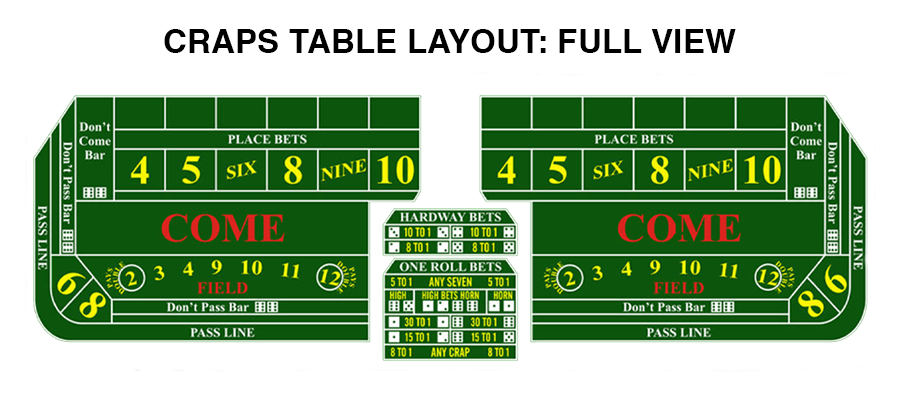
Smart craps players pay attention to more than just the dice. They read the table situation and adjust.
Watch your payouts. Dealers are human. They make mistakes. If you have a $12 place bet on 6 and it hits, you should receive $14. If the dealer pushes you $12, speak up politely. Verify every payout, especially on complex multi-bet positions.
Know when the table is too crowded. A packed table slows the game and increases the chance of dice hitting someone’s hand. If you’re waiting five minutes between rolls, your entertainment value per dollar drops. Fewer rolls per hour means fewer chances to win.
Identify your exit points. Before each session, set two numbers: a loss limit and a win target. If you hit either one, leave. This sounds simple. In practice, it’s one of the hardest things to do in a casino. The table is loud. The energy is infectious. “Just one more roll” is the most expensive phrase in gambling.
Observe other players for education, not for patterns. Watching an experienced player’s bet sizing and timing teaches you table rhythm. Watching dice outcomes for “patterns” teaches you nothing. Each roll is independent. The dice don’t streak, trend, or care about the last 20 results.
If you’re planning a casino trip, review our guide on how to play craps in Vegas. It covers table minimums, casino-specific rules, tipping conventions, and the practical details that help you play with confidence from your first roll. Knowing the etiquette also earns you better treatment from dealers.
The Discipline Factor: Why Most Players Lose
I’ve watched thousands of craps sessions. The players who lose the most usually know the math. They know the pass line is better than the any seven. They know they should take odds. They know proposition bets are expensive. They lose anyway.
Why? Discipline breaks. It happens in predictable ways.
- Chasing losses. You’re down $150 and your brain says “one big bet will get it all back.” So you throw $50 on a hardway 8 or a horn bet. Now you’re down $200 and thinking about an even bigger bet. This spiral accounts for more craps losses than any other single behavior.
- Getting greedy on a heater. You’ve doubled your bankroll. The table is hot. Instead of walking away, you start pressing every bet, adding new bets, and treating house money like free money. The seven comes. It always comes. And suddenly your $400 profit is $50.
- Drinking too much. Casinos offer free drinks for a reason. Alcohol impairs judgment. It makes proposition bets seem reasonable. It makes “one more roll” feel inevitable. Pace yourself or stick to water.
- Abandoning your strategy. You walked in planning to play pass line with odds. Two cold shooters later, you’re throwing money at field bets, hardways, and hop bets because “maybe the strategy needs to change.” It doesn’t. Cold streaks end. The math is the same.
The casino makes most of its craps revenue from undisciplined players, not from the house edge itself. A 1.41% edge is tiny. It takes hours of play to grind away a $200 bankroll at that rate. But one impulsive $100 proposition bet costs more in expected value than an entire evening of pass line play. The edge isn’t the enemy. Your impulses are.
10 Quick Craps Tips You Can Use Tonight
These are the compressed, take-to-the-table tips that put everything in this guide into practice.
| # | Tip | Why It Matters |
|---|---|---|
| 1 | Always take maximum odds behind your pass line | Reduces combined house edge to under 0.5% |
| 2 | Never bet Big 6 or Big 8; place the 6 or 8 instead | Same number, better payout (7:6 vs. 1:1) |
| 3 | Avoid every bet in the center of the layout | All carry house edges above 9% |
| 4 | Set a loss limit before every session and honor it | Prevents spiral betting and emotional decisions |
| 5 | Bet in correct increments: $6 multiples on 6/8, $5 multiples on 5/9 | Incorrect amounts get rounded down on payouts |
| 6 | Tip the dealers at least once per session | Better service, better atmosphere, good karma |
| 7 | Don’t say “seven” at the table | Superstition, but it genuinely annoys people |
| 8 | Practice online before playing live | Free simulators build confidence risk-free |
| 9 | Walk away when you’ve doubled your buy-in | Locking in profits is the hardest, smartest move |
| 10 | Keep your hands off the felt when dice are out | Basic etiquette that prevents table hostility |
Staying Positive: The Underrated Edge
Craps is supposed to be fun. It’s the most electric game on the casino floor, the one that draws crowds, generates stories, and turns strangers into temporary friends. If you’re grinding through sessions feeling stressed, anxious, or desperate, something has gone wrong.
The best craps players share a common trait: they enjoy the process regardless of results. They laugh at cold streaks. They celebrate hot ones. They know that variance creates both, and neither lasts forever.
Realistic expectations help. You’re not going to retire on craps winnings. You’re paying for entertainment, and smart play means paying less for it. A $200 session at pass line with odds might cost you $5-$10 in expected losses for several hours of genuine excitement. That’s cheaper than a concert, a nice dinner, or most hobbies.
Some of the biggest wins in craps history came from players who were just having a good time, not from people white-knuckling every roll. Stay loose. Play smart. Let the dice fall where they may.
If you want to study further, our collection of recommended craps books offers deeper reading from authors who’ve spent decades analyzing the game.
The Real Secret to Winning at Craps
There’s no hidden trick. No secret dice throw. No pattern on the layout that the casinos don’t want you to know. The “secret” to winning at craps is boring, and it’s been available to every player since the game was invented: pick the bets with the lowest house edge, back them with maximum odds, manage your money like it matters, and have the discipline to walk away when you’re ahead.
That combination won’t guarantee a profit. Nothing can. But it gives you the mathematical best chance, the longest sessions for your money, and the most enjoyable experience the casino has to offer. After two decades at the table, I can tell you that the players who follow these principles don’t just lose less. They have more fun. And at the end of the day, that’s what keeps you coming back to the felt.
Best Online Craps Casinos (Last Updated September 2026)






How to Win at Craps FAQs
The most effective approach combines three elements: stick to low house edge bets (pass line at 1.41%, don’t pass at 1.36%), always back them with maximum free odds (0% house edge), and practice strict bankroll management. No strategy eliminates the house edge, but this combination minimizes it as far as mathematically possible.
The free odds bet. It’s the only wager in any casino with a 0% house edge, paying at true mathematical odds. You can only place it after a pass line, don’t pass, come, or don’t come bet. Always take the maximum odds your bankroll and table rules allow.
No one can consistently beat craps over the long term. The house edge guarantees the casino profits over thousands of bets. What you can do is have winning sessions, which are common thanks to short-term variance. Smart bet selection and bankroll management maximize the frequency and size of those winning sessions.
Seven. With 6 out of 36 possible dice combinations producing it, the 7 has a 16.67% probability on every roll. This is why it wins pass line bets on the come-out and ends the shooter’s turn after a point is established.
Avoid any seven (16.67% house edge), proposition bets (11-16%), hardways (9-11%), and Big 6/Big 8 (9.09%). These bets look exciting but cost dramatically more per dollar wagered than the basic bets. The center of the layout is where the worst math lives.
You can’t. No strategy, system, or method guarantees a win at craps every session. The house always has a statistical edge. What you can do: play pass line with odds to minimize that edge, manage your bankroll to survive losing streaks, and walk away when you’ve reached your win target. Focus on making smart decisions, not on impossible guarantees.
