Best Craps Bets Ranked: The Smartest (and Dumbest) Wagers on the Table
 Jake Wilfred
There are over 40 different bets on a craps table. Some give the house less than a 1.5% edge. Others hand the casino a 16%+ advantage and might as well be a donation. The difference between a smart craps player and someone bleeding chips comes down to knowing which best craps bets to stick with and which ones to ignore completely.
Here’s the good news: you don’t need to memorize all 40+ options. A handful of bets carry favorable odds, and the rest range from “okay in small doses” to “the casino thanks you for your generosity.” This guide ranks every major craps bet from best to worst, with the actual math behind each one, so you can walk up to any craps table and know exactly where your money should go.
- The Free Odds bet has a 0% house edge, making it the single best bet in any casino
- Pass Line (1.41%) and Don’t Pass (1.36%) are the foundation of smart craps play
- Place bets on 6 and 8 offer a low 1.52% house edge and are the best non-contract bets available
- Any 7 carries a 16.67% house edge, the worst bet on the table by far
- Combining Pass Line + max Odds is the mathematically optimal craps strategy
- Prop bets look exciting but cost you 5x to 12x more per dollar wagered than smart bets
How We Ranked These Craps Bets
Before we get into the rankings, let’s talk about what actually makes a craps bet “good” or “bad.” It comes down to one number: house edge.
The house edge is the mathematical advantage the casino holds over you on every bet. A 1.41% house edge means that for every $100 you wager over time, the casino expects to keep $1.41. A 16.67% house edge means they expect to keep $16.67 from that same $100. Over hundreds of rolls, that difference is enormous.
Say you bet $10 on the Pass Line (1.41% house edge) and $10 on Any 7 (16.67% house edge) every roll for an entire session of 200 rolls. On the Pass Line, your expected loss is about $28.20. On Any 7, your expected loss is $333.40. Same bet size, same number of rolls, wildly different results. The payout on Any 7 is higher per win (4:1), but you lose so often that those wins can’t keep up.
We ranked every bet below using house edge as the primary factor, with payout structure and practical usability as secondary considerations. The full payout chart and odds breakdown is worth bookmarking if you want the complete numbers.
The 5 Best Craps Bets (Ranked)
These are the bets that experienced players build their entire game around. If you only learn five things about craps betting, make it these five.
1. Free Odds Bet (0% House Edge)
This is it. The holy grail. The Free Odds bet is the only wager in any casino that carries zero house edge. None. The casino makes nothing on this bet over time.
Here’s how it works. After a point is established on the come-out roll, you can place an additional bet behind your Pass Line or Don’t Pass wager. This “odds” bet pays at true mathematical odds, meaning the payout perfectly reflects the actual probability of winning.
| Point Number | True Odds | Payout (Pass Line Odds) | Payout (Don’t Pass Odds) |
|---|---|---|---|
| 4 or 10 | 2 to 1 | 2:1 | 1:2 |
| 5 or 9 | 3 to 2 | 3:2 | 2:3 |
| 6 or 8 | 6 to 5 | 6:5 | 5:6 |
The catch? You can’t place an Odds bet on its own. It must sit behind a Pass Line, Don’t Pass, Come, or Don’t Come bet. Each casino also caps how much you can wager on Odds, typically expressed as a multiple of your original bet (3x, 5x, 10x, or even 100x at some Vegas properties).
Always take the maximum odds your bankroll allows. Since the Odds bet has 0% house edge, every dollar you shift from the Pass Line to the Odds position reduces the overall house advantage on your combined wager. A $5 Pass Line bet with 5x odds ($25) has a combined house edge of just 0.33%.
2. Don’t Pass Line Bet (1.36% House Edge)
The Don’t Pass bet is mathematically the smartest “base” bet on the table. You’re betting against the shooter: you win if the come-out roll is 2 or 3, push on 12, and lose on 7 or 11. Once a point is set, you win if a 7 comes before the point.
The 1.36% house edge makes it slightly better than the Pass Line. The trade-off? You’ll be betting against the rest of the table. Most players root for the shooter, so winning a Don’t Pass bet while everyone else groans can feel socially awkward. Some players call it “playing the dark side.”
Don’t Pass is a perfectly legitimate bet, and no dealer will blink if you play it. But craps etiquette suggests you keep celebrations low-key when you win on the dark side. A quiet nod beats a fist pump when the table just lost.
3. Pass Line Bet (1.41% House Edge)
The Pass Line bet is the heartbeat of craps. It’s the first bet most players learn, and for good reason: it’s simple, social, and carries one of the lowest house edges in the entire casino at 1.41%.
You place your bet before the come-out roll. Roll a 7 or 11? You win even money. Roll a 2, 3, or 12? You lose. Anything else becomes “the point,” and the shooter keeps rolling until they hit the point again (you win) or roll a 7 (you lose).
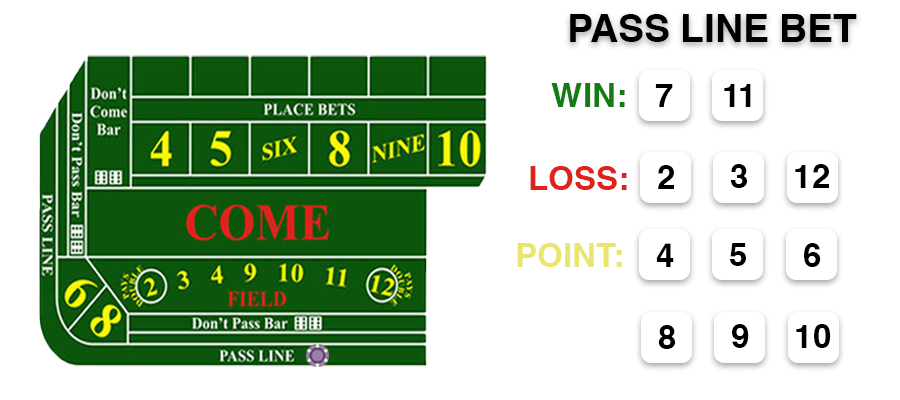
What makes the Pass Line so popular goes beyond the math. It’s a contract bet, meaning it stays active through multiple rolls. You get the thrill of riding along with the shooter, cheering for the same numbers, building that electric table energy that makes craps different from every other casino game.
The Pass Line is a contract bet. Once you place it and a point is established, you can’t remove it. The Don’t Pass bet, by contrast, can be taken down after the point is set (though doing so would mean removing a bet that’s now in your favor, which is a bad move mathematically).
4. Come Bet (1.41% House Edge)
Think of the Come bet as a Pass Line bet you can place at any time after the point is established. Same rules, same odds, same 1.41% house edge. The difference is timing.
After the come-out roll establishes a point, you drop your chips in the Come area. The next roll becomes your personal “come-out roll.” If it’s 7 or 11, you win. If it’s 2, 3, or 12, you lose. Any other number becomes your Come point, and you win when that number repeats before a 7.
Experienced players use Come bets to have multiple numbers working at once. Say the point is 8. You place a Come bet, and the shooter rolls a 5. Now you have the 8 (Pass Line) and the 5 (Come bet) both active. This approach spreads your action across the table and is the backbone of strategies like the Three Point Molly.
5. Place Bet on 6 or 8 (1.52% House Edge)
After 7, the numbers 6 and 8 are rolled most frequently. Each has five possible dice combinations out of 36, giving them a 13.89% probability per roll. A Place bet on 6 or 8 pays 7 to 6 and carries a house edge of just 1.52%.
That makes these the best non-contract bets on the table. Unlike Pass Line and Come bets, you can add or remove Place bets at any time. That flexibility is valuable.
You’re at a $10 table. The point is 9. You place $6 on both the 6 and the 8. The shooter rolls an 8. You win $7. She rolls a 6. Another $7. She rolls a 9 (point made). You’ve collected $14 from your Place bets on top of whatever your Pass Line paid. Place bets on 6 and 8 must be made in multiples of $6 to receive the full 7:6 payout.
The Complete Craps Bet Rankings: Best to Worst
Here’s every major bet on the table, ranked by house edge. This is your quick-reference cheat sheet.
| Rank | Bet | House Edge | Payout | Verdict |
|---|---|---|---|---|
| 1 | Free Odds | 0% | True odds | Best bet in the casino |
| 2 | Don’t Pass Line | 1.36% | 1:1 | Best base bet (dark side) |
| 3 | Pass Line | 1.41% | 1:1 | Best base bet (right side) |
| 4 | Come / Don’t Come | 1.41% / 1.36% | 1:1 | Same as Pass/Don’t Pass |
| 5 | Place 6 or 8 | 1.52% | 7:6 | Best non-contract bet |
| 6 | Field Bet (3x on 12) | 2.78% | Varies | Acceptable in short bursts |
| 7 | Place 5 or 9 | 4.00% | 7:5 | Below average |
| 8 | Field Bet (2x on 12) | 5.56% | Varies | Borderline bad |
| 9 | Place 4 or 10 | 6.67% | 9:5 | Bad |
| 10 | Hard 6 / Hard 8 | 9.09% | 9:1 | Sucker bet |
| 11 | Hard 4 / Hard 10 | 11.11% | 7:1 | Sucker bet |
| 12 | Any Craps | 11.11% | 7:1 | Sucker bet |
| 13 | 3 or 11 (Prop) | 11.11% | 15:1 | Terrible |
| 14 | 2 or 12 (Prop) | 13.89% | 30:1 | Terrible |
| 15 | Any 7 | 16.67% | 4:1 | Worst bet on the table |
The pattern is clear. The further down the list you go, the more you’re paying the casino for the privilege of playing. Stick to the top five and you’re in solid shape.
The 5 Worst Craps Bets (and Why Players Still Make Them)
Let’s flip the coin. These are the bets that experienced players avoid like a cold table. They all share the same problem: the house edge is so high that no payout can compensate for how often you lose.
1. Any 7 (16.67% House Edge)
The Any 7 bet is a single-roll wager that the next toss will be a 7. It pays 4 to 1. Sounds reasonable until you do the math.
Seven is the most common roll (probability of 16.67%), so it feels like a good bet. But the payout should be 5:1 to reflect the true odds. The casino pays 4:1 instead, pocketing the difference. That gap creates the highest house edge on the entire table at 16.67%.
Any 7 is the single worst wager you can place in craps. For perspective, a slot machine typically runs a 2-10% house edge. Any 7 is worse than most slots. If a dealer or fellow player suggests it, politely decline.
2. Snake Eyes or Boxcars: Betting on 2 or 12 (13.89% House Edge)
Snake Eyes (two ones) and Boxcars (two sixes) each have only one possible dice combination out of 36. That’s a 2.78% chance per roll. The 30:1 payout looks tempting, but true odds would pay 35:1. The casino keeps five units from every winning payout, translating to a 13.89% house edge.
These are classic proposition bets, and they’re placed in the center of the table for a reason: they’re designed to catch your eye and your money.
3. Any Craps (11.11% House Edge)
The Any Craps bet wagers that the next roll will be 2, 3, or 12. It pays 7:1 with an 11.11% house edge. Four possible combinations out of 36 give you an 11.11% chance of winning on any given roll.
Some players use this as “insurance” on their Pass Line bet during the come-out roll. The logic is that if you lose your Pass Line bet to a craps roll (2, 3, or 12), the Any Craps bet softens the blow. Mathematically, this “insurance” strategy costs more over time than simply accepting the occasional Pass Line loss. It’s the same flawed logic behind insurance bets in blackjack.
4. Hardways: Hard 4 and Hard 10 (11.11% House Edge)
A Hardways bet wagers that the shooter will roll a specific number as a matching pair (2+2 for Hard 4, 5+5 for Hard 10) before rolling that number any other way or rolling a 7.
Hard 4 and Hard 10 each pay 7:1 with an 11.11% house edge. Hard 6 and Hard 8 are slightly better at 9:1 and 9.09%, but “slightly better” still means you’re handing the casino roughly ten cents on every dollar.
Hardways are popular because they pay well and add excitement to a session. If you must play them, keep the wagers tiny, treat them as entertainment, and never build a strategy around them.
5. The Horn Bet (12.5% Combined House Edge)
The Horn bet is really four bets in one: equal wagers on 2, 3, 11, and 12. Since each of those individual bets carries a house edge between 11.11% and 13.89%, bundling them together doesn’t improve the math. It just means you’re making four bad bets simultaneously.
The combined house edge averages around 12.5%. You’ll hear dealers calling out Horn bets frequently because they generate significant revenue for the casino.
Why Smart Players Stick to Pass Line + Odds
If you read craps strategy guides, you’ll notice the same recommendation appearing again and again: Pass Line with maximum Odds. There’s a reason.
The Pass Line alone has a 1.41% house edge. Adding Odds at different multiples drops the combined edge dramatically:
| Odds Multiple | Combined House Edge |
|---|---|
| No Odds (Pass Line only) | 1.41% |
| 1x Odds | 0.85% |
| 2x Odds | 0.61% |
| 3x-4x-5x Odds | 0.37% |
| 5x Odds | 0.33% |
| 10x Odds | 0.18% |
| 100x Odds | 0.02% |
At 10x Odds, the combined house edge is 0.18%. That’s better than almost any bet in any game in any casino. At 100x Odds (rare, but some Vegas craps tables offer it), you’re practically playing a coin flip.
If your bankroll is limited, keep your Pass Line bet at the table minimum and put the rest of your planned wager on Odds. A $5 Pass Line bet with $25 in Odds is mathematically superior to a $30 Pass Line bet with no Odds, even though the total risk is the same.
The practical takeaway: your bankroll management should prioritize maximizing Odds bets. This is how you win at craps over time, or at least lose as slowly as possible.
The “Middle Tier” Bets: Not Great, Not Terrible
Not every craps bet falls neatly into “smart” or “stupid.” A few sit in the gray area.
The Field Bet
The Field bet is a single-roll wager covering 2, 3, 4, 9, 10, 11, and 12. That’s seven numbers out of eleven possible totals, which sounds like great coverage. The problem is that the missing numbers (5, 6, 7, and 8) are the most frequently rolled.
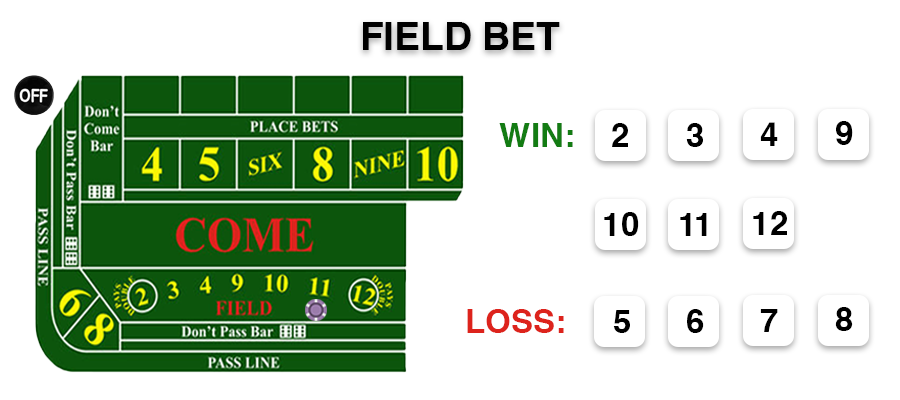
The house edge depends on the pay table. If the casino pays triple on the 12, the house edge drops to 2.78%. If they only pay double on the 12, it jumps to 5.56%. Always check the layout before placing a Field bet.
- Easy to understand: one roll, immediate result
- Covers seven different numbers
- House edge of 2.78% is acceptable at tables that pay 3x on 12
- The four missing numbers (5, 6, 7, 8) account for 20 of 36 possible dice combinations, or 55.56% of all rolls
- House edge jumps to 5.56% at tables paying only 2x on 12
- Single-roll structure means rapid bankroll swings
Place Bets on 5 or 9
These pay 7:5 with a 4% house edge. Considerably worse than placing the 6 or 8 (1.52%), but still better than any proposition bet. If you want additional numbers working and the 6 and 8 are already covered, these are your next option.
Buy Bets on 4 or 10
A Buy bet on 4 or 10 pays at true odds (2:1) but charges a 5% commission. If the casino collects the commission only on wins, the effective house edge drops to about 1.67%, making it competitive with Place bets on 6 or 8. If the casino charges the commission on every bet, the edge is 4.76%. Ask the dealer before placing.
Dice Probabilities: The Math Behind Every Craps Bet
Understanding dice combinations is the foundation of smart craps play. Two six-sided dice produce 36 possible outcomes. Here’s how they distribute:
| Dice Total | Combinations | Probability | Example Rolls |
|---|---|---|---|
| 2 | 1 | 2.78% | 1+1 |
| 3 | 2 | 5.56% | 1+2, 2+1 |
| 4 | 3 | 8.33% | 1+3, 2+2, 3+1 |
| 5 | 4 | 11.11% | 1+4, 2+3, 3+2, 4+1 |
| 6 | 5 | 13.89% | 1+5, 2+4, 3+3, 4+2, 5+1 |
| 7 | 6 | 16.67% | 1+6, 2+5, 3+4, 4+3, 5+2, 6+1 |
| 8 | 5 | 13.89% | 2+6, 3+5, 4+4, 5+3, 6+2 |
| 9 | 4 | 11.11% | 3+6, 4+5, 5+4, 6+3 |
| 10 | 3 | 8.33% | 4+6, 5+5, 6+4 |
| 11 | 2 | 5.56% | 5+6, 6+5 |
| 12 | 1 | 2.78% | 6+6 |
Notice the symmetry. Seven sits at the peak with 6 combinations. Everything else mirrors around it. This is why 7 is both the best number (come-out roll) and the worst number (after the point is set). It’s the most likely result no matter when you roll.
Count how far a number is from 7 to estimate its probability. The 6 and 8 are one step away (5 combinations each). The 5 and 9 are two steps away (4 each). The 4 and 10 are three steps away (3 each). The closer to 7, the more likely the roll.
Best Craps Bets for Beginners
If you’re still learning how to play craps, here’s a simple starting approach that keeps your house edge low while you get comfortable with the game.
Step one: Place a minimum Pass Line bet before the come-out roll. This gets you in the action and you’ll be rooting alongside the table.
Step two: Once a point is established, back your Pass Line with the maximum Odds bet your budget allows. Even 1x or 2x Odds makes a real difference.
Step three: After you’re comfortable with the rhythm, consider adding a single Come bet or a Place bet on 6 or 8. Don’t overextend. Having two or three numbers working is plenty for a new player.
Step four: Ignore the center of the table. Those proposition bets, horn bets, and hardways will still be there once you have more experience. For now, they’ll just eat your bankroll.
Don’t place a Big 6 or Big 8 bet. It pays even money on 6 or 8 with a 9.09% house edge. A Place bet on the same numbers pays 7:6 with a 1.52% house edge. They’re the same bet with wildly different returns. The Big 6/8 only exists because uninformed players don’t know the Place bet is available.
If you want to practice all of this with zero risk before hitting a real table, our free craps simulator lets you test every bet and see the results firsthand.
How the Best Craps Bets Compare to Other Casino Games
Craps actually holds up remarkably well against other table games, especially when you stick to the smart bets. Here’s how the best craps bets compare to other popular casino games:
| Game / Bet | House Edge |
|---|---|
| Craps: Pass Line + 10x Odds | 0.18% |
| Blackjack (basic strategy) | 0.50% |
| Craps: Pass Line + 2x Odds | 0.61% |
| Baccarat (banker bet) | 1.06% |
| Craps: Pass Line (no Odds) | 1.41% |
| Roulette (European, single zero) | 2.70% |
| Roulette (American, double zero) | 5.26% |
| Craps: Any 7 | 16.67% |
Picking the Right Bets for Your Craps Session
Choosing the best craps bets isn’t just about house edge. Your bankroll size, your risk tolerance, and how long you want to play all factor in.
If you have a modest bankroll and want to play for hours, stick to Pass Line with Odds. The low house edge stretches your money further. If you have a larger bankroll and want more action, add Come bets or Place 6 and 8 to have multiple numbers working.
And if you’re the type who plays craps for the adrenaline? Throw a dollar on the Yo (eleven) once in a while. Just know you’re paying a premium for the excitement. Keep 90%+ of your money on the smart bets and use the rest as your “fun tax.”
That’s what separates informed players from everyone else. You don’t need to be a mathematician. You just need to know where the value is, and this guide just showed you.
Best Online Craps Casinos (Last Updated October 2026)





Best Craps Bets FAQs
The Free Odds bet has a 0% house edge, making it the single best bet in craps (and in any casino game). However, it requires a Pass Line, Don’t Pass, Come, or Don’t Come bet as a foundation. Among standalone bets, the Don’t Pass Line at 1.36% is the mathematically strongest option, followed closely by the Pass Line at 1.41%.
Any 7 carries a 16.67% house edge, the highest on the craps table. It pays 4:1, but the true odds are 5:1, giving the casino a massive mathematical advantage. Proposition bets on 2 or 12 (13.89% house edge) and the Horn bet (12.5% combined) aren’t far behind.
It depends on the pay table. If the casino pays triple on the 12, the house edge is 2.78%, which is reasonable for a single-roll bet. If they only pay double on the 12, the edge jumps to 5.56%, and you’re better off with a Place bet on 6 or 8 at 1.52%.
Mathematically, yes. The 1.36% house edge is the lowest base bet available. Practically, many beginners prefer the Pass Line because it aligns with the rest of the table and is more social. Either bet is smart. Pick whichever feels more comfortable as you learn how to play.
As much as your bankroll allows, up to the table maximum. Since the Odds bet carries 0% house edge, every dollar placed on Odds lowers your overall cost. A good rule of thumb is to keep your Pass Line bet at the minimum and allocate the rest to Odds. For detailed budgeting guidance, see our craps bankroll management guide.
Start with a Pass Line bet, back it with the highest Odds you can afford, and leave the center of the table alone. As you gain confidence, add a single Come bet or Place the 6 and 8. This keeps your combined house edge well below 1% while giving you plenty of action. Our full craps strategy guide breaks down several approaches by experience level.
