How to Play Craps: The Complete Beginner’s Guide for 2026
 Jake Wilfred
Walk up to any craps table and you’ll hear it before you see it. Cheering, groaning, fist bumps, the clatter of dice bouncing off the back wall. No other casino game produces that kind of energy. And no other casino game scares away more beginners.
The table looks complicated. The bets seem endless. The pace feels fast. But here’s the truth: how to play craps comes down to one bet, one concept, and about five minutes of reading. The pass line bet has a 1.41% house edge, which makes it one of the cheapest wagers in the building. Everything else on the table is optional.
This guide walks you through the entire game from scratch: the table, the crew, the dice, the bets, the flow, and the strategy that’ll have you playing with confidence your first time at the rail.
- The pass line bet (1.41% house edge) is the only bet you need to start playing craps
- The game has two phases: the come-out roll (where 7 or 11 wins) and the point phase (where the shooter tries to repeat a number before rolling a 7)
- Adding free odds behind your pass line bet drops the combined house edge to as low as 0.37% with 3x-4x-5x odds
- The craps table has a crew of four: boxman, stickman, and two dealers, all of whom will help you if you ask
- You only need to understand 3 to 4 bets to play competently; the other 30+ wagers on the layout can wait
- Practice for free on our craps simulator before risking real money at a live table
The Craps Table: What You’re Looking At
The first thing that intimidates new players is the craps table layout. It’s big. It’s covered in boxes, numbers, and sections that look like a football playbook. But most of that layout is duplicated on both sides (one for each dealer), and a large portion of it contains bets you’ll never need to touch.
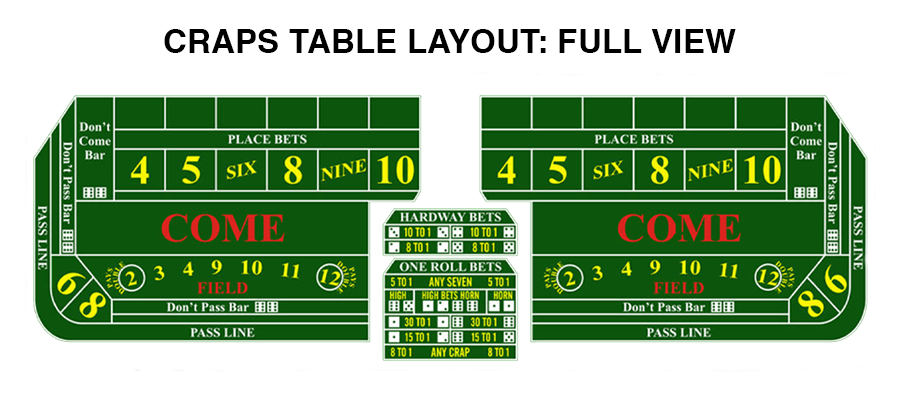
Here’s what matters for your first session.
The Pass Line runs along the front edge of the table on both sides. This is where you’ll place your primary bet. Right behind it is the Don’t Pass Bar, for players betting against the shooter. Above the pass line, you’ll find the Come area and the Field section. Across the top of the layout are the numbered boxes (4, 5, 6, 8, 9, 10) used for place bets, come bets, and buy bets.
The center of the table holds the proposition bets: hardways, horn bets, any craps, and others. These carry high house edges and are controlled by the stickman. For now, ignore the entire center section.
Focus on just one section of the layout for your first few sessions: the Pass Line. That single strip of felt is where 90% of beginners should keep their money. Once you’re comfortable with the game’s rhythm, you can explore place bets on 6 and 8 (1.52% house edge) and free odds (0% house edge). Everything else on the layout can wait until you’ve played at least 5 to 10 sessions.
The Craps Crew: Who Does What
Four casino employees run every craps table. Knowing who they are and what they do makes you feel less like a tourist and more like a regular.
The boxman sits behind the table in the middle, directly across from the stickman. They supervise the game, watch for errors, and handle any disputes. You’ll rarely interact with the boxman directly.
The stickman stands at the center of the player side. They control the dice, push them to the shooter with a curved stick, and announce each roll’s result. The stickman also handles all center-table bets (propositions, hardways, horn bets). They’re the voice of the table.
Two dealers stand on each side of the boxman. They handle chip payouts, place your bets in the numbered boxes, and manage come bets and odds. They’re your primary point of contact. If you have a question, ask your dealer. That’s literally their job.
Each dealer manages a puck, a round marker that’s white (“ON”) on one side and black (“OFF”) on the other. When no point is established, the puck shows “OFF” and sits in the Don’t Come area. Once a point is set, the puck flips to “ON” and moves to the corresponding number box. This puck tells you instantly whether the game is in the come-out phase or the point phase.
How Craps Works: The Two Phases of Every Game
Craps looks complicated because there are dozens of bets. But the core game has only two phases. Master these, and you understand the entire flow.
Phase 1: The Come-Out Roll
Every new craps game starts with the come-out roll. The shooter picks up two dice and throws them to the far end of the table. Three things can happen:
Roll a 7 or 11 (called a “natural”): Pass line bets win immediately. Even money payout. The shooter rolls again for a new come-out.
Roll a 2, 3, or 12 (called “craps”): Pass line bets lose immediately. The shooter rolls again for a new come-out. (The shooter keeps the dice unless they choose to pass them.)
Roll a 4, 5, 6, 8, 9, or 10: This number becomes the point. The dealer flips the puck to “ON” and places it on that number. The game moves to Phase 2.
You place $10 on the pass line. The shooter throws the dice and rolls a 9. The dealer flips the puck to “ON” and puts it on the 9 box. The point is now 9. Your pass line bet stays on the table, and the game moves to Phase 2. If the shooter had rolled a 7 instead, you’d have won $10 instantly and the come-out would restart.
Phase 2: The Point Phase
Now the shooter has a mission: roll the point number again before rolling a 7. Every other number is irrelevant to the pass line bet. A 4, 5, 6, 8, 9, 10, 11, 2, 3, or 12 that isn’t the point? The shooter just keeps rolling. Only two outcomes matter:
Shooter rolls the point: Pass line bets win at even money (1:1). The game resets to a new come-out.
Shooter rolls a 7 (called a “seven-out”): Pass line bets lose. The dice pass to the next shooter. New come-out begins.
That’s the entire game. Two phases. Three possible come-out outcomes. Two possible point phase outcomes. Everything else on the table (come bets, place bets, prop bets, odds) layers on top of this foundation.
A 7 on the come-out roll is good for pass line bettors (it’s a natural win). A 7 after the point is set is bad (it’s a seven-out loss). This is the most confusing part for new players. The 7 switches roles depending on the game phase. On the come-out, you want it. After the point, you don’t. Keep that straight and the rest falls into place.
How to Get Started: Buying In and Placing Your First Bet
Ready to play? Here’s the practical sequence.
Step 1: Find a Table
Look for a table with a minimum bet you’re comfortable with. In 2026, $10 and $15 minimums are standard at most craps casinos. Downtown Vegas sometimes has $5 tables. Weekends and evenings tend to have higher minimums than weekday mornings.
Step 2: Buy Chips
Walk up to the table and wait for a pause between rolls. Place your cash flat on the felt (never hand it directly to the dealer). Say “change, please” or “changing $200.” The dealer converts your cash into color-coded chips and slides them to you. Place them in the chip rail in front of you.
Step 3: Place a Pass Line Bet
Put one or more chips on the Pass Line, the long strip running along the edge of the table directly in front of you. You can do this yourself; no dealer needed. Make your bet before the come-out roll.
Step 4: Watch the Come-Out Roll
The shooter throws. If it’s a natural (7 or 11), collect your even-money win. If it’s craps (2, 3, or 12), you lose. If it’s a point number, the puck moves to that number and you move to Step 5.
Step 5: Take Odds (Optional but Highly Recommended)
After the point is established, place additional chips directly behind your pass line bet. This is the free odds bet, and it’s the best wager in the casino: 0% house edge. The payout depends on the point: 2:1 on 4/10, 3:2 on 5/9, 6:5 on 6/8.
Step 6: Wait for Resolution
The shooter keeps rolling until they either hit the point (you win the pass line + odds) or roll a 7 (you lose both). Collect your winnings or absorb the loss. Repeat from Step 3.
You buy in for $200 at a $10 table. You place $10 on the pass line. Come-out roll: 8. Point is 8. You place $50 in odds behind your pass line bet (5x odds on the 6/8). The shooter rolls a 5, then a 10, then a 3, then an 8. Point made. Your pass line pays $10 (even money). Your odds pay $60 (6:5 on $50). Total profit: $70. The game resets and you place another $10 on the pass line for the next come-out.
The Essential Craps Bets Every Beginner Should Know
The craps table offers 30+ different wagers. You need about four of them. Here’s what to focus on, in order of importance. For the complete list, see our craps bets explained page.
The Pass Line Bet
This is your bread and butter. Place it before the come-out roll. Wins on a natural (7 or 11), loses on craps (2, 3, 12), and otherwise tracks the point. Pays even money. House edge: 1.41%. It’s the cheapest line bet on the right side of the table and the starting point for every beginner.
The Free Odds Bet
The free odds bet is the only wager in any casino with a 0% house edge. Place it behind your pass line bet after the point is set. It pays at true mathematical odds: 2:1 on 4/10, 3:2 on 5/9, and 6:5 on 6/8. Most casinos allow 3x-4x-5x odds, which drops the combined house edge on your total action to approximately 0.37%.
The single best piece of advice for any craps player: min on the line, max on the odds. Bet the table minimum on the pass line (that’s the part with the house edge) and put as much as the table allows into the odds (that’s the part with zero house edge). A $10 pass line bet with $50 in odds costs you less per dollar than a $60 pass line bet with no odds. Same total risk, dramatically different math.
The Don’t Pass Bet
The don’t pass bet is the mirror image of the pass line. It wins on 2 or 3 on the come-out (12 is a push), loses on 7 or 11, and then wins if the 7 shows before the point. House edge: 1.36%, slightly better than the pass line. The trade-off? You’re betting against the shooter and the rest of the table, which can feel socially awkward. But mathematically, it’s the cheapest line bet available.
Place Bets on 6 and 8
If you want more numbers working without the learning curve of come bets, place bets on 6 and 8 are the next step. They pay 7:6 with a house edge of just 1.52%. Tell the dealer “place the six and eight for twelve dollars each” after the point is established. Bet in multiples of $6 so the 7:6 payout works out cleanly.
| Bet | House Edge | Payout | When to Learn It |
|---|---|---|---|
| Pass Line | 1.41% | 1:1 | Session 1 |
| Free Odds | 0% | True odds | Session 1 |
| Don’t Pass | 1.36% | 1:1 | Sessions 2-3 |
| Place 6/8 | 1.52% | 7:6 | Sessions 3-5 |
| Come Bet | 1.41% | 1:1 | Sessions 5-10 |
For a full ranking of every bet by house edge, bookmark our craps payout chart and our best craps bets guide.
Bets to Avoid as a Beginner
The craps table is designed to tempt you with flashy bets that carry terrible odds. The stickman will call them out between rolls. Other players will throw chips on them constantly. Ignore both.
These bets look exciting but carry house edges 5 to 12 times higher than the pass line. Every dollar you put here costs you dramatically more than the same dollar on the pass line with odds.
| Bet to Avoid | House Edge | Why It’s Bad |
|---|---|---|
| Any Seven | 16.67% | Worst standard bet on the table |
| Hardways (4/10) | 11.11% | Big payout but terrible odds |
| Hardways (6/8) | 9.09% | Slightly less terrible, still bad |
| Big 6 / Big 8 | 9.09% | Same as placing 6/8 but worse payout |
| Horn Bet | 12.50% | Splits across 4 high-edge numbers |
| Any Craps | 11.11% | One-roll bet, high cost per dollar |
The Big 6 and Big 8 deserve special mention. They pay even money on the 6 or 8, while the place bet on the same numbers pays 7:6. Same outcome, worse payout. There’s literally no reason to make this bet. The casino put it there hoping you won’t know the difference. Now you do.
Understanding Dice Probabilities
You don’t need to memorize probability tables to play craps. But understanding one core concept helps everything else make sense: some numbers show up more often than others.
Two dice produce 36 possible combinations. The 7 has six of them (1+6, 2+5, 3+4, 4+3, 5+2, 6+1), making it the most common roll. The 6 and 8 each have five combinations. The 5 and 9 have four. The 4 and 10 have three. The 2 and 12 have just one each.
This is why the 7 is the pivot point of the entire game. Before the point, it helps you (natural win). After the point, it hurts you (seven-out). And this is why the craps payout chart pays more for harder-to-roll numbers and less for easier ones. The entire payout structure is built on these dice combinations.
There are 3 ways to roll a 4 (1+3, 2+2, 3+1) and 5 ways to roll an 8 (2+6, 3+5, 4+4, 5+3, 6+2). Since the 4 is harder to hit, the odds payout is higher: 2:1 on the 4 versus 6:5 on the 8. The rarer the number, the better it pays. That’s the math behind every payout on the table.
The Shooter’s Role: How Rolling Works
Every player at the table gets a chance to be the shooter (the person throwing the dice). The dice move clockwise around the table. You can decline and pass the dice to the next player if you prefer.
To be the shooter, you must have a pass line or don’t pass bet active. The stickman pushes several dice toward you (usually five). You pick two. Hold them in one hand only (never two hands). Throw them to the far end of the table so they hit the back wall. Both dice must hit the wall on every throw.
Casino rules are strict about dice handling. Use one hand only. Don’t take the dice below the table edge or out of the dealer’s sight. Don’t rub them on the felt excessively. And always throw hard enough to reach the back wall. If your throw comes up short repeatedly, the boxman will warn you. For the full rundown on table behavior, see our craps etiquette guide.
Being the shooter is optional, and it doesn’t change the math. The dice are random regardless of who throws them. Some players enjoy the physical act of rolling. Others prefer to stand at the rail, bet, and let someone else do the throwing. Both approaches are perfectly normal.
Craps Etiquette: How to Act at the Table
Craps is the most social game in the casino. The energy is collective: everyone (except dark-side bettors) is cheering for the same outcomes. A few etiquette rules keep things running smoothly.
Don’t say “seven” during a shooter’s turn. It’s considered bad luck by many players. Use “Big Red” or just avoid the word. Is it superstition? Absolutely. Will it annoy the entire table if you say it? Also absolutely.
Keep your hands out of the table area when the dice are in the air. If a die hits your hand and changes direction, the entire table will blame you for whatever happens next. Tuck your hands against the rail before each roll.
Don’t throw cash on the table during a roll. Wait for a pause. Place your money flat on the felt. The dealer handles the exchange between throws.
If you’re brand new and feeling lost, tell the dealer. Say “I’m new, can you help me with a pass line bet?” They’ll walk you through it. This happens dozens of times a day at every casino. Nobody will judge you. For the complete social guide, check our craps etiquette article.
Watch one full shooter’s turn before placing your first bet. Stand at the rail, observe how bets are placed, how the crew operates, and how the game flows. Five minutes of watching teaches more than an hour of reading. Then jump in on the next come-out with a pass line bet and you’ll feel like you’ve been there before.
Your First Session: A Step-by-Step Game Plan
Here’s a concrete plan for your first ever craps session. Follow it exactly, and you’ll have a great experience.
Bankroll: Bring 30 times the table minimum. At a $10 table, that’s $300. For full bankroll management guidance, see our dedicated guide.
Bets: Pass line only for the first 15 to 20 minutes. Once you’re comfortable with the rhythm, add free odds behind your pass line (start with 1x or 2x odds, work up to max as confidence grows). If you want more action after that, add $12 place bets on 6 and 8.
Avoid: Everything in the center of the table. All proposition bets. The Big 6/8. The field bet (until you understand the math). Hardways.
Session limit: Set a loss limit (50% of your session bank, so $150) and a win goal (30 to 50%, so $90 to $150). Hit either number and walk.
Practice first: Our free craps simulator lets you run through the entire game with no money at risk. Play 20 to 30 simulated rounds before heading to a live table.
- The pass line bet (1.41% house edge) is among the cheapest wagers in any casino
- Free odds at 0% house edge are available on every table, something no other game offers
- The social atmosphere makes it fun even during cold streaks
- Dealers actively help new players; just ask
- You can play an entire session with just 2 bets (pass line + odds) and be mathematically optimized
- The table looks intimidating, which scares many beginners away (it’s simpler than it appears)
- Center-table proposition bets carry house edges of 9% to 16.67%, and the stickman will actively promote them
- The pace can be fast; take a breath and ask the dealer if you’re unsure
- It’s easy to get swept up in the excitement and bet more than planned
Where to Go From Here
Once you’re comfortable with the pass line and odds, the game opens up. Here’s the natural progression for building your craps knowledge.
Learn the come bet, which is essentially a second pass line bet you can place after the point is established. Then explore the Three Point Molly strategy, which keeps three numbers working at all times, all with maximum odds, for a combined house edge below 0.50%.
If you want more variety, the Iron Cross strategy covers every number except 7 and wins on 83% of rolls (at a higher house edge of ~3.9%). It’s fun for short sessions.
For a complete roadmap of every approach from beginner to advanced, our craps strategy guide covers it all. And if you want to understand every single bet on the table, our craps bets explained page is your encyclopedia.
How to Play Craps and Win: Start Simple, Play Smart, Have Fun
Craps has been the most exciting table game in the casino for over a century. The cheers from a hot table carry across the entire floor. The feeling of a shooter nailing the point after 20 rolls of suspense is something you don’t get from any other game.
And the math? It’s on your side, if you let it be. A pass line bet with full odds costs you less per dollar than basic strategy blackjack at most tables. That’s not a guess; that’s arithmetic. Add solid bankroll management, skip the center-table traps, and you’re playing one of the cheapest games in the building while having more fun than anyone at the slot machines.
Start with the pass line. Take the odds. Ask the dealer for help. And enjoy the ride. The craps table is waiting.
Best Online Craps Casinos (Last Updated September 2026)






How to Play Craps FAQs
No. The core game (pass line bet, come-out roll, point phase) takes about 5 minutes to understand. The table layout looks overwhelming, but you only need one bet (the pass line) to start playing. Dealers will help you place bets and answer questions. Practice on our free craps simulator to build confidence before visiting a live table.
The pass line bet with free odds. The pass line has a 1.41% house edge, and the odds bet behind it has 0%. With 3x-4x-5x odds, the combined edge drops to about 0.37%. It’s the cheapest position in the casino and requires only two simple bets. See our best craps bets guide for the full ranking.
Bring 30 to 50 times the table minimum for a single session. At a $10 table, that’s $300 to $500. This gives you enough chips to survive normal cold streaks. Set a loss limit at 40 to 50% of your session bank and a win goal at 30 to 50%. Our bankroll management guide covers session sizing in detail.
It depends on the game phase. On the come-out roll, a 7 is a “natural” that wins pass line bets instantly. After a point is established, a 7 is a “seven-out” that loses pass line bets and ends the shooter’s turn. The 7 is the most commonly rolled number (6 out of 36 dice combinations), which is why it’s the centerpiece of the entire game.
Yes. Our free craps simulator lets you play with no download and no real money. It’s the best way to practice bet placement, learn the game flow, and test strategies before risking real chips. Most experienced players recommend 20 to 30 practice rounds before your first live session.
It varies by bet. The pass line is 1.41%. The don’t pass is 1.36%. Free odds are 0%. Place bets on 6/8 are 1.52%. Center-table proposition bets range from 9% to 16.67%. The complete breakdown is in our craps payout chart.
