The Any Seven Bet in Craps: Odds, Payouts, and Why It’s the Worst Bet on the Table
 Jake Wilfred
Here’s a number that should stop you cold: 16.67%. That’s the house edge on the any seven bet in craps. For perspective, the pass line bet gives the house just 1.41%. So for every dollar you wager on Any Seven, the casino expects to keep nearly 12 times more than it would on a pass line bet. The Any Seven is the single worst standard bet on the craps table, and it’s not close.
Yet players keep throwing chips on it, every single session, at every single casino. Why? Because 7 is the most common number on two dice, and a 4:1 payout sounds reasonable until you do the math. This guide breaks down exactly how the Any Seven works, what it really costs you, and whether there’s ever a scenario where it makes sense to bet it.
- The Any Seven bet pays 4:1 but carries a 16.67% house edge, the highest of any standard craps wager
- A 7 has a 16.67% probability of appearing on any roll (6 out of 36 combinations), but the payout doesn’t reflect those true odds
- The true odds of rolling a 7 are 5:1; the casino pays only 4:1, pocketing the difference
- No betting system (Martingale, d’Alembert, or otherwise) can overcome a 16.67% house edge over time
- Your money is almost always better placed on pass line, don’t pass, or come bets with odds
How the Any Seven Bet Works
The Any Seven (sometimes called “Big Red” in craps terms) is about as simple as craps gets. You’re betting that the very next roll of the dice will be a 7. That’s it. No waiting for a point. No multi-roll resolution. One roll, one answer.
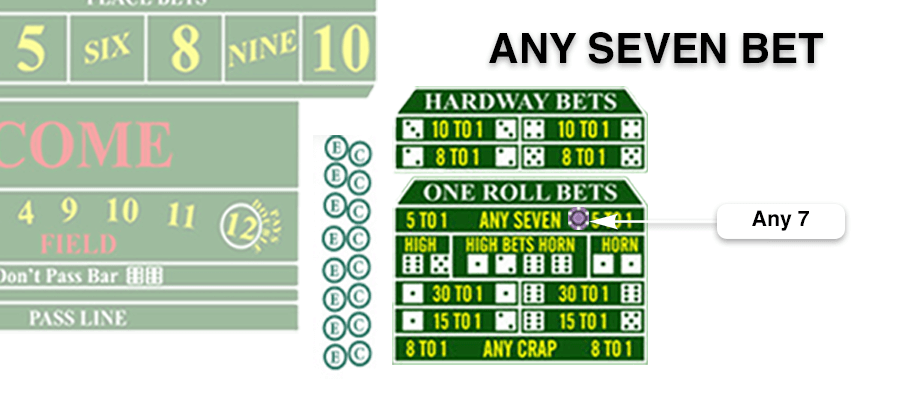
You place this bet by tossing your chips toward the center of the craps table and telling the stickman “any seven” or “Big Red.” The bet sits in the center layout alongside other proposition bets. If the next roll is a 7 (any combination: 1-6, 2-5, 3-4, 4-3, 5-2, or 6-1), you win. If it’s anything else, you lose. Your chips are gone.
The Any Seven is a one-roll bet. It lives and dies on a single throw. Unlike hardways bets or place bets that stay active across multiple rolls, there’s no waiting around. You either win immediately or lose immediately. This means the house edge hits you on every single roll you bet it.
The bet is available at any point during the game, whether the shooter is on a come-out roll or working toward a point. There are no restrictions on timing, which is part of what makes it tempting. You can throw it down whenever you feel the itch.
Any Seven Bet Payout and True Odds
Here’s where the Any Seven falls apart. The math looks friendly on the surface but crumbles under even basic scrutiny.
There are 36 possible outcomes when rolling two dice. Six of those produce a 7: (1,6), (2,5), (3,4), (4,3), (5,2), and (6,1). That means there are 30 ways to lose and 6 ways to win. The true odds of rolling a 7 on any single throw are 30:6, which simplifies to 5:1.
A fair payout would be 5:1. The casino pays 4:1.
That gap between 5:1 (what the bet should pay) and 4:1 (what it actually pays) is the house edge. And it’s enormous.
Say you bet $5 on Any Seven for 36 rolls (one full theoretical cycle of all dice combinations). You’d win 6 times at $20 each ($5 x 4:1 = $20 profit per win), collecting $120 in profit. You’d lose 30 times at $5 each, losing $150. Net result: down $30 on $180 total wagered. That’s a 16.67% loss rate, matching the house edge perfectly.
Compare that to other one-roll bets on the table:
| Bet | True Odds | Payout | House Edge |
|---|---|---|---|
| Any Seven | 5:1 | 4:1 | 16.67% |
| Any Craps | 8:1 | 7:1 | 11.11% |
| Yo (11) | 17:1 | 15:1 | 11.11% |
| Snake Eyes (2) | 35:1 | 30:1 | 13.89% |
| Boxcars (12) | 35:1 | 30:1 | 13.89% |
The Any Seven doesn’t just have the worst house edge on the craps table. It has one of the worst house edges in the entire casino. Only a handful of slot machines and novelty side bets come close to taking 16.67 cents from every dollar wagered. For a full comparison, check our craps payout chart.
Why the Any Seven Bet Is a Trap
The Any Seven tricks players through a combination of frequency and simplicity. Let’s unpack why it catches so many people off guard.
The 7 feels common. And it is. A 7 has a 16.67% chance of appearing on any roll, making it the single most likely outcome. No other number comes close. Players see 7s hit constantly and start thinking “this bet must be a good deal.” But frequency of the outcome has nothing to do with the quality of the payout. The craps online casino already accounted for that frequency when it set the 4:1 odds.
The payout sounds decent. Quadrupling your money on a single roll feels like a fair deal. But a fair deal on a 7 would pay 5:1, not 4:1. That missing unit is the casino’s profit margin, and it’s the largest margin on the standard craps layout.
It resolves instantly. There’s something psychologically satisfying about immediate feedback. You don’t sit and wait. You know right away. But that instant resolution also means you’re exposed to the 16.67% edge on every single roll you participate in. Compare that to a hardways bet at 9.09% to 11.11%, where many rolls are neutral (no resolution), giving the house fewer bites at your bankroll per hour.
If you want quick, one-roll action with better odds, the field bet pays even money on most numbers (2:1 or 3:1 on the 2 and 12) with a house edge of 5.56% at standard tables, or just 2.78% at tables paying triple on the 12. That’s a third of the Any Seven’s edge. Still not great, but dramatically less punishing.
Can Betting Systems Beat the Any Seven?
Short answer: no. Longer answer: absolutely not, and here’s why.
You’ll find articles (including the original version of this one) suggesting systems like the Martingale, d’Alembert, or Oscar’s Grind as strategies for the Any Seven. Let’s be honest about what those systems do and what they don’t do.
The Martingale System
The Martingale tells you to double your bet after every loss. Win once, and you recover all previous losses plus one unit of profit. It sounds bulletproof on paper.
You start with $5. Lose. Bet $10. Lose. Bet $20. Lose. Bet $40. Lose. Bet $80. Win. You collect $320 (your $80 bet x 4:1 payout). Total wagered across five bets: $155. Total returned: $400 ($320 + $80 original bet). Profit: $245… but wait. You lost $5 + $10 + $20 + $40 = $75 on the four losing bets. Net profit: $245 – $75 = $170? Actually, let’s recalculate: you collect $320 profit plus your $80 stake back = $400 total. Minus the $155 total invested across all five bets = $245 net. Sounds great, right? Now imagine losing 8 rolls in a row. Your eighth bet would be $640. Total at risk: $1,275. And the table maximum will stop you long before you get there.
The Martingale fails because it asks you to risk enormous amounts for tiny net gains, and because table limits cap your ability to double. A losing streak of 7 or 8 consecutive non-seven rolls (which happens regularly, since you lose 83.3% of the time on each roll) can wipe out an entire session’s worth of small wins.
The d’Alembert and Oscar’s Grind
Both are milder progression systems. The d’Alembert adds one unit after a loss and subtracts one after a win. Oscar’s Grind increases by one unit after a win and holds steady after a loss.
These systems slow down your losses compared to the Martingale. They don’t eliminate them. Over thousands of bets, you’ll still lose approximately 16.67% of everything you wager. The progression just changes the shape of your results: smaller swings, same destination.
No betting system, progressive or flat, can change the house edge of a bet. Systems alter your bet sizing pattern. They don’t alter probability. The dice combinations that produce a 7 are fixed at 6 out of 36. The payout is fixed at 4:1. No arrangement of bet sizes changes those two facts. If someone tells you they have a “winning system” for Any Seven, they’re selling something. For real strategy that works with the math (not against it), see our craps strategy guide.
Is There Ever a Reason to Bet Any Seven?
In the interest of fairness, let’s consider the handful of scenarios where players actually bet Any Seven, and whether any of them hold up.
Hedging the Come-Out Roll
Some don’t-pass bettors place an Any Seven bet on the come-out roll as a “hedge.” The logic: the 7 is bad for your don’t pass bet on the come-out (since a 7 means don’t pass loses). An Any Seven bet would offset that loss.
Does it work mathematically? No. The hedge costs more in expected value than it saves. You’re adding a 16.67% house edge bet to protect a 1.36% house edge bet. That’s like buying a $500 insurance policy to protect a $50 item. The combined house edge of both bets together is higher than just letting the don’t pass ride alone.
Pure Entertainment
If you’re at the table for fun, you’ve set a loss limit, and you want the thrill of a quick one-roll wager, a single $1 Any Seven bet won’t ruin your life. The problem is rarely one bet. It’s the habit. One-roll bets are addictive precisely because they resolve fast, and before you know it, you’ve thrown $1 on Any Seven for 40 straight rolls. That’s $40 in action with an expected loss of $6.67. Not devastating, but that same $40 on the pass line would have cost you about $0.56 in expected loss.
In some casinos, the stickman will actively call out “Any Seven” and similar proposition bets between rolls. This is part of the game’s atmosphere, but it’s also a sales pitch. The center-table bets generate the highest margins for the casino. The stickman’s job is to keep that action flowing. Don’t confuse enthusiasm for advice. For more on table dynamics, see our craps etiquette guide.
Any Seven vs. Better Alternatives
If the urge to bet on the 7 is strong, consider what else that money could do.
| Bet | Payout | House Edge | Expected Loss per $100 Wagered |
|---|---|---|---|
| Any Seven | 4:1 | 16.67% | $16.67 |
| Field Bet (triple 12) | 1:1, 2:1, 3:1 | 2.78% | $2.78 |
| Place 6 or 8 | 7:6 | 1.52% | $1.52 |
| Pass Line | 1:1 | 1.41% | $1.41 |
| Don’t Pass | 1:1 | 1.36% | $1.36 |
| Pass Line + 3x-4x-5x Odds | Varies | ~0.37% | $0.37 |
The numbers speak for themselves. A $5 Any Seven bet costs you roughly $0.83 in expected value per roll. That same $5 on the pass line costs you about $0.07. Over a 2-hour session with 100 rolls, that’s the difference between an expected loss of $83 and an expected loss of $7.
If you’re new to the game and looking for bets that actually give you a fighting chance, start with our guide to the best craps bets. If you want to understand every option available, our craps bets explained page covers the full menu. And if you want to practice without risking a penny, try the free craps simulator.
The Any Seven Bet: Know It, Skip It, Move On
The Any Seven is the tax that impatient players pay at the craps table. It looks appealing because the 7 is common. It resolves fast. The payout sounds like a good deal. But 16.67% of every dollar you put on it goes straight to the house, and no system, no pattern, no gut feeling changes that math.
Know what the Any Seven is. Understand why it exists (casinos love it). And then put your money somewhere it has a real chance to work for you. A pass line bet with full odds gives you the best mathematical position in the building. That’s where your chips belong. Build your game around low-edge bets, manage your bankroll with discipline, and leave Big Red for the players who haven’t read this page.
Best Online Craps Casinos (Last Updated September 2026)





Any Seven Bet FAQs
The Any Seven bet pays 4:1. If you bet $5 and the next roll is a 7, you win $20 in profit plus your $5 bet back. The true odds should pay 5:1, but the casino keeps the difference, which creates the 16.67% house edge. Full payout details are in our craps payout chart.
A 7 appears on average once every 6 rolls, giving it a 16.67% probability per throw. There are 6 dice combinations that produce a 7 out of 36 total possible outcomes: (1,6), (2,5), (3,4), (4,3), (5,2), and (6,1). This makes 7 the most frequently rolled number on two dice.
No. The Any Seven carries a 16.67% house edge, the worst of any standard craps bet. For every $100 wagered, you can expect to lose $16.67 over time. Compare that to the pass line at $1.41 per $100 or the don’t pass at $1.36 per $100. Your money works far harder on low-edge bets. Check our best craps bets guide for smarter options.
“Big Red” is casino slang for the Any Seven bet. Some players and dealers use this nickname because the 7 section on the craps table layout is often displayed in red. Calling it “Big Red” instead of saying “seven” is also a superstition at many tables, since some players consider it bad luck to say “seven” out loud during a roll.
You can, but it won’t change the house edge. The Martingale doubles your bet after each loss, aiming to recover everything with one win. The problem: with a 16.67% win rate per roll, losing streaks of 6 to 8 rolls happen frequently. That drives your bet sizes into table-maximum territory fast. No betting progression overcomes a 16.67% edge. See our craps strategy guide for approaches that work with the math.
It depends on the phase of the game. On the come-out roll, a 7 is great for pass line bettors since it’s an automatic win. After a point is established, a 7 means the shooter “sevens out,” which loses the pass line bet. For don’t pass bettors, the opposite applies. The 7’s role shifts based on game state, which is part of what makes craps so dynamic.
