Craps Table Layout Explained: Learn All the Bets on The Table
 Jake Wilfred
Picture this: you walk into a casino, and there it is. A 12-foot green felt battlefield surrounded by screaming players, a crew of four running the show, and a layout covered in boxes, circles, and numbers that might as well be hieroglyphics. That’s the craps table. And if you don’t understand what you’re looking at, you’re basically handing over your chips blindfolded.
The craps table layout is actually logical once you know how to read it. Every line, box, and section exists for a specific bet with specific odds. This guide breaks down every inch of the table so you can walk up with confidence instead of confusion.
- The craps table is divided into two mirror-image side sections and one shared center section, each with different bet types
- Self-service bets (Pass Line, Don’t Pass, Come, Field) sit in the side sections where you place your own chips
- The center section holds proposition bets managed by the stickman, and most carry house edges above 9%
- A standard casino craps table measures 12 to 14 feet long with room for up to 16 players
- Crapless craps tables remove the “craps” numbers from the come-out roll but increase the house edge significantly
- Four crew members run each table: two base dealers, one stickman, and one boxman
What the Craps Table Actually Looks Like
A full-size craps table is a large, padded, rectangular surface standing about 28 inches from the floor to the felt. The padded armrests sit at roughly 40 inches from the ground. Most craps casino tables run 12 to 14 feet long and about 4 feet wide.
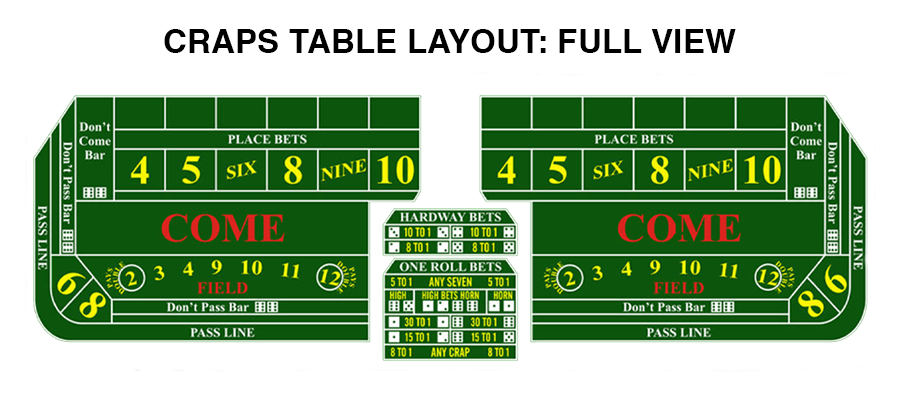
Here’s the thing most people miss on their first look: the layout is symmetrical. The left half mirrors the right half almost exactly. That’s intentional. It means two groups of players on opposite ends of the table can place the same bets without reaching across each other.
The felt is divided into three distinct zones. Two side sections occupy each end, and a single center section runs along the middle. If you’re new to craps, start with our how to play craps guide to get the full picture before focusing on the layout.
Table sizes vary. Some casinos use smaller 8-foot or 10-foot tables, especially in crowded pits or for lower-limit games. The layout stays the same; everything just gets a bit more compact.
The rubber diamond-shaped pyramids lining the inside walls aren’t decoration. Casinos require shooters to bounce the dice off the far wall, and those pyramids make the bounce random. If you’ve ever wondered why the pit boss glares when someone short-throws the dice, now you know.
The Side Sections: Where You’ll Spend Most of Your Time
Each side section is a mirror copy of the other, and this is where the majority of your betting happens. These areas contain what experienced players call “self-service bets,” meaning you place your own chips directly on the felt without a dealer’s help.
The side sections include the Pass Line, Don’t Pass Bar, Come, Don’t Come, Field, and the numbered Place bet boxes (4, 5, 6, 8, 9, and 10). Some older tables also include Big 6 and Big 8 in the corners, though most modern casinos have dropped them because the Big 6 and Big 8 bets carry a 9.09% house edge. That’s a terrible deal when a Place bet on 6 or 8 gives you the same win at just 1.52%.
Only touch your own chips in the self-service areas. Never reach into the dealer’s working area or grab chips from the Place bet boxes. Those are managed by the dealer, and reaching across the layout is a quick way to get a warning.
The side section is also where you’ll find the point marker, a black-and-white puck the dealer flips to “ON” when a point is established. When it’s sitting on a number (4, 5, 6, 8, 9, or 10), the game is in the point phase. When it reads “OFF” and sits in the Don’t Come area, a new come-out roll is about to happen.
Understanding the Self-Service Betting Areas
Self-service means you physically place your own chips on these sections. The Pass Line bet runs as a long strip near the edge closest to you, making it easy to reach. The Don’t Pass bet sits just above it, slightly smaller.
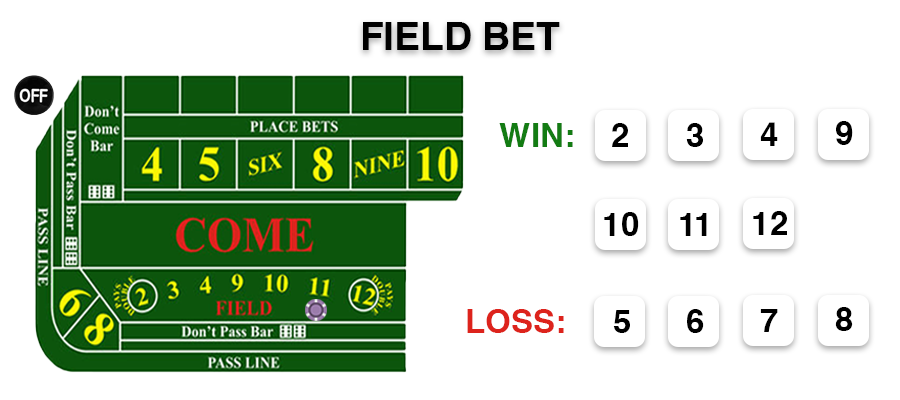
The Come and Don’t Come boxes sit further inside the layout. The Field bet takes up a large area in the middle of the side section, labeled with the numbers it covers: 2, 3, 4, 9, 10, 11, and 12.
If you’re a beginner, plant yourself near the center of the table’s long side. You’ll have easy access to the Pass Line and Field without stretching. Save the corner spots for experienced players who bet heavy on Place numbers.
Key Betting Areas on the Craps Table Layout
Let’s walk through every major betting area you’ll see on the felt, starting with the bets that have the lowest house edge and working toward the riskier ones.
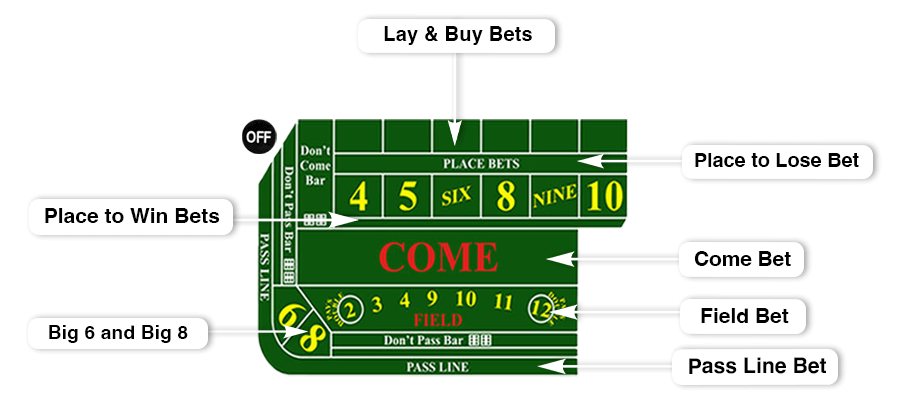
Here are the key betting areas you’ll need to know:
Pass Line
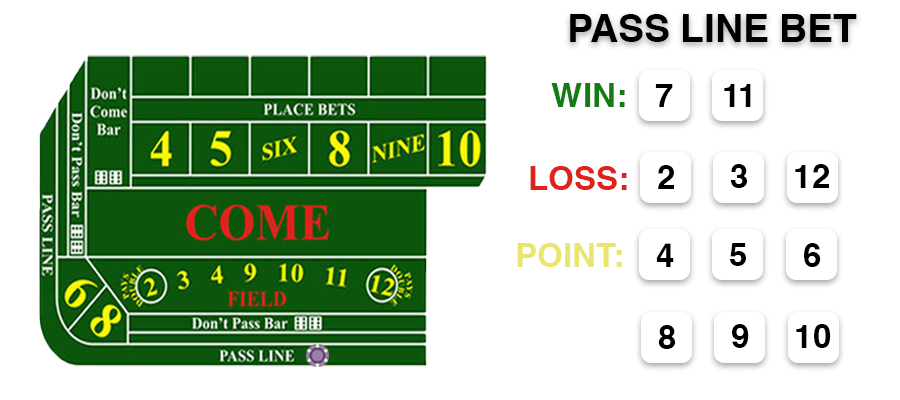
This is the bread and butter of craps. The Pass Line wraps around the player’s edge of each side section. You bet here before the come-out roll, and you win if the shooter rolls a 7 or 11. You lose on 2, 3, or 12. Any other number becomes “the point,” and the shooter needs to roll that number again before a 7 to win.
The house edge sits at 1.41%. That’s one of the best bets on the entire table. For the full breakdown of how this bet works, check out our Pass Line bet guide.
Don’t Pass Line
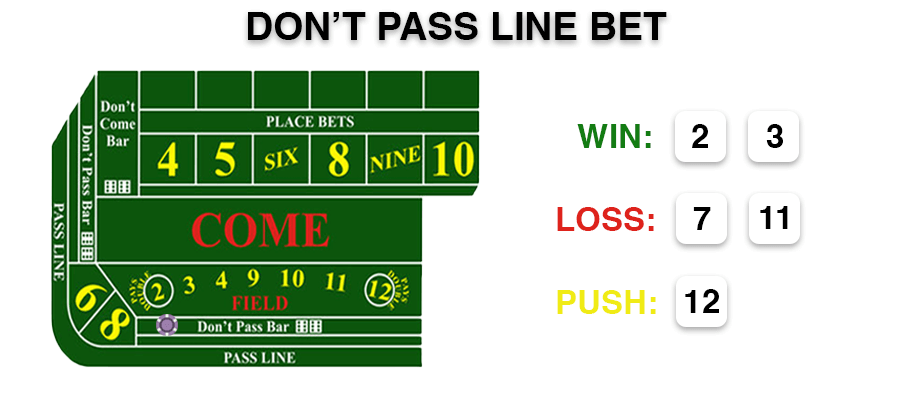
Directly above the Pass Line, you’ll see a smaller strip labeled “Don’t Pass Bar.” This is the opposite bet: you win on a come-out roll of 2 or 3, push on 12, and lose on 7 or 11. Once a point is set, you want a 7 to show before the point number.
The house edge is 1.36%, making it technically the best bet on the layout. Fair warning, though: betting Don’t Pass means you’re rooting against the shooter, which can make you unpopular at a hot table. Our Don’t Pass guide covers the social dynamics along with the math.
Come and Don’t Come
These work identically to Pass and Don’t Pass, but you place them after a point has been established. The Come bet creates its own mini-game within the larger round. The Don’t Come bet does the same for dark-side players.
The point is 8. You place $10 on the Come box. The next roll is a 5. The dealer moves your $10 to the number 5 box. Now you have a personal “point” of 5. If the shooter rolls a 5 before a 7, you win $10. If a 7 comes first, you lose.
Field
That big section in the middle of the side layout labeled with 2, 3, 4, 9, 10, 11, and 12? That’s the Field. It’s a one-roll bet, meaning it resolves on the very next throw.
The catch is that 5, 6, 7, and 8 are all losers for Field bettors. Those four numbers combined account for 20 out of 36 possible dice combinations. The house edge lands around 5.56% on most tables (2.78% on tables that pay triple on the 12). Our Field bet breakdown has the full odds table.
Place Bets (4, 5, 6, 8, 9, 10)
The numbered boxes at the top of the side section are for Place bets. You’re betting that a specific number will roll before a 7. The dealer handles these bets for you; just toss your chips to the center of the layout and say something like “Place the 6 for $12.”
| Place Number | House Edge | Payout | Correct Bet Amount |
|---|---|---|---|
| 4 or 10 | 6.67% | 9:5 | Multiples of $5 |
| 5 or 9 | 4.00% | 7:5 | Multiples of $5 |
| 6 or 8 | 1.52% | 7:6 | Multiples of $6 |
Notice how the 6 and 8 are far better than the 4 and 10? That’s a critical detail. Smart players focus their Place bets on 6 and 8 because the 1.52% edge is close to the Pass Line’s 1.41%. For a deeper look at picking the best craps bets, we’ve got a full ranking.
The Odds Bet (The Best Bet That Isn’t Printed on the Felt)
Here’s something funny about the craps layout: the single best wager you can make isn’t even marked on the table. The Odds bet (also called “Free Odds”) is placed behind your Pass Line or Don’t Pass bet after a point is established. It pays at true odds, meaning zero house edge.
Most casinos allow 3x, 4x, 5x, or even 10x odds depending on the table. If you’re going to play craps seriously, backing your Pass Line bet with maximum odds is the single best mathematical move available to you.
Always ask the dealer what the max odds are at a given table. A $10 Pass Line bet with 3-4-5x odds can reduce your combined house edge to about 0.37%. That’s practically a fair game.
The Center Section: Proposition Bets and One-Roll Wagers
The center strip running down the middle of the table is managed exclusively by the stickman. This is where the proposition bets live, and it’s where the casino makes a lot of its money.
These bets look exciting. They have big payouts printed right on the felt: 30:1, 15:1, 7:1. But those payouts are deliberately set below true odds, creating house edges that range from 9.09% all the way up to 16.67%.
The center section typically includes:
| Center Bet | What It Is | Payout | House Edge |
|---|---|---|---|
| Any Craps | Next roll is 2, 3, or 12 | 7:1 | 11.11% |
| Any Seven | Next roll is 7 | 4:1 | 16.67% |
| Hard 6 / Hard 8 | Doubles (3-3 or 4-4) before a 7 or easy way | 9:1 | 9.09% |
| Hard 4 / Hard 10 | Doubles (2-2 or 5-5) before a 7 or easy way | 7:1 | 11.11% |
| Yo (Eleven) | Next roll is 11 | 15:1 | 11.11% |
| Snake Eyes (2) | Next roll is 2 | 30:1 | 13.89% |
| Boxcars (12) | Next roll is 12 | 30:1 | 13.89% |
You’ll also find multi-number bets here like the Horn bet, C & E, and Whirl bet. These combine several proposition wagers into one.
You can’t place center bets yourself. Toss your chips to the stickman and clearly state your bet. Say “Horn high yo for $5” or “Hard 8 for $2.” If the stickman doesn’t hear you clearly, the bet doesn’t count.
Are center bets always a bad idea? For consistent play, yes. But an occasional $1 yo-eleven for fun won’t wreck your bankroll. Just don’t build a strategy around them. For a full look at all craps bets explained, we’ve mapped out every wager on the layout.
Crapless Craps Table vs. Regular Craps Table
Walk through enough casinos and you’ll eventually spot a table labeled “Crapless Craps.” The layout looks similar to a standard table, but there’s a significant difference in the rules.
On a regular table, rolling 2, 3, or 12 on the come-out roll is an automatic loss for Pass Line bettors (that’s “craps,” and it’s where the game gets its name). On a crapless craps table, those numbers become point numbers instead. Sounds great, right? No more instant losses on the come-out.
The trade-off is steep. By converting 2, 3, 11, and 12 into point numbers, the house edge on the Pass Line jumps from 1.41% to 5.38%. That’s nearly four times worse.
- – No instant loss on 2, 3, or 12 during the come-out roll
- – Simpler for beginners to understand (fewer automatic loss scenarios)
- – The 11 also becomes a point instead of an automatic win, but some players like the extended action
- – Pass Line house edge balloons from 1.41% to 5.38%
- – Don’t Pass and Don’t Come bets are removed entirely
- – Hard to find odds above 2x or 3x at most crapless tables
The bottom line: crapless craps is a worse deal mathematically. It exists because the name sounds player-friendly and the come-out roll feels safer. But the numbers don’t lie.
The Craps Table Crew: Who Does What
Every craps table runs with a four-person crew. Understanding who handles what will save you from confusion (and from accidentally annoying the wrong person).

The Boxman sits at the center of the table on the casino side. This person supervises the entire game, watches for disputes, and guards the chip bank. The boxman has final say on any bet disagreement.
The Stickman stands opposite the boxman and controls the center section. They push the dice to the shooter with a long curved stick, announce every roll result, and handle all proposition bets. If you want to make a center bet, you talk to this person.
The Two Base Dealers each manage one side section. They pay winners, collect losers, place Come and Don’t Come bets on numbers, and handle Place, Buy, and Lay bets. When you “toss your chips to the dealer and say Place the 8,” you’re talking to your base dealer.
You want to put $12 on Place 6. You set your chips on the layout in front of you (not on a betting area) and say “Place the 6 for twelve.” The dealer picks up your chips and places them in the 6 box in a specific spot that corresponds to your position at the table. If the 6 hits, the dealer places $14 in winnings next to your original stack.
For a complete breakdown of craps terms the crew uses, including calls like “yo eleven,” “winner winner,” and “seven out, line away,” we have a dedicated glossary.
Craps Table Etiquette: How to Act Like You Belong
The craps table has its own unwritten social code. Follow these rules and you’ll blend right in. Break them and you’ll get icy stares from everyone, dealers included. We have a full craps etiquette guide if you want the deep version, but here are the essentials.
Handle the dice with one hand only. When you’re the shooter, pick up the dice with one hand. Don’t switch them between hands or pull them below the table rail. Casinos enforce this to prevent dice switching.
Don’t throw cash on the layout mid-roll. Wait for the dealer to call “bets are working” or for a pause between rolls. Toss your cash down during a dead period and say “change, please.”
Keep your hands out of the landing zone. Once the stickman pushes the dice to the shooter, pull your hands back. If the dice hit your fingers, it’s considered bad form, and if a 7 comes out, every Pass Line bettor at the table will blame you.
Say your bets clearly. Don’t mumble. Don’t point. The dealers handle dozens of bets per minute, and they need verbal clarity. “Ten-dollar hard 6” beats a vague hand gesture every time.
Tipping the dealers is customary and appreciated. The most common way: place a $1 or $5 bet for the dealers on the Pass Line and say “two-way.” If it wins, they get paid too. It’s more fun than just sliding them a chip, and it gives them some action.
Common Craps Table Myths, Debunked
The craps table generates more superstition per square foot than any other spot in a casino. Here’s what’s actually true and what’s pure fiction. For even more, check out our full breakdown of craps myths and craps superstitions.
“Certain numbers are overdue.” No. Each roll is an independent event. The dice combinations create fixed probabilities. A 7 has a 1-in-6 chance on every single throw, whether the last ten rolls were all 7s or none were.
“Dealers can influence the dice.” They can’t. The shooter throws the dice, and the pyramids on the back wall randomize the bounce. Dealers manage the table. That’s it.
“The table layout changes the odds.” The felt pattern, the rubber walls, the size of the table: none of it alters the mathematical probability of any given roll. The layout is designed for functionality and fairness, not to tilt odds in anyone’s direction.
“Prop bets are the way to win big.” They can pay big on a single roll, sure. But the house edge on proposition bets ranges from 9% to nearly 17%. Over time, these bets drain your bankroll faster than almost anything else on the table.
If you’re interested in legitimate approaches to improving your play, our craps strategy guide covers the math-based methods that actually move the needle.
“Online craps is rigged.” Licensed and audited online craps platforms use Random Number Generators (RNGs) that replicate true dice probabilities. If the casino holds a license from a reputable jurisdiction, the games are independently tested for fairness.
How to Read the Craps Table Layout at a Glance
You don’t need to memorize every inch of the felt before your first session. Here’s a practical cheat sheet for reading the layout quickly.
Start with the edges. The Pass Line and Don’t Pass are always closest to you. These are the foundational bets, and they’re placed in the most accessible spots for a reason.
Move inward. The Come and Don’t Come sit just above the Pass Line area. The Field takes up a prominent space in the middle, clearly labeled with all the numbers it covers.
Look up at the numbered boxes. The 4, 5, 6, 8, 9, and 10 boxes sit at the top of each side section. These are for Place, Buy, and Lay bets.
Look at the center. That’s the stickman’s territory. Proposition bets, hardways, and one-roll wagers live here.
| Layout Zone | Managed By | Bet Types | House Edge Range |
|---|---|---|---|
| Player edge (closest to you) | You (self-service) | Pass/Don’t Pass, Field | 1.36% to 5.56% |
| Inner side section | Base dealer | Come/Don’t Come, Place, Buy, Lay | 1.36% to 6.67% |
| Top boxes (numbered) | Base dealer | Place 4/5/6/8/9/10 | 1.52% to 6.67% |
| Center strip | Stickman | Propositions, Hardways, Horn | 9.09% to 16.67% |
See the pattern? The further you move from the edge toward the center, the worse the house edge gets. The layout itself is a map of risk. The best bets sit right where your hands naturally rest.
If you want to practice reading the table before putting real money down, try our free craps simulator. It replicates the full layout and lets you experiment with every bet type at zero cost.
Best Online Craps Casinos (Last Updated September 2026)






Craps Table Layout Frequently Asked Questions
A craps table is divided into three sections: two identical side sections on each end and one center section running through the middle. The side sections hold self-service bets like the Pass Line, Don’t Pass, Come, Don’t Come, and Field, plus dealer-managed Place bet boxes for numbers 4 through 10. The center section contains proposition bets and hardways managed by the stickman.
A standard casino craps table is 12 to 14 feet long and about 4 feet wide. The playing surface sits approximately 28 inches from the ground, with padded armrests at about 40 inches high. Smaller tables (8 to 10 feet) exist for lower-limit games and smaller casino floors.
The Don’t Pass bet has the lowest house edge at 1.36%, followed closely by the Pass Line at 1.41%. However, backing either with the free Odds bet (which pays at true odds with zero house edge) is the best overall strategy. A Pass Line bet with 3-4-5x odds brings the combined edge down to roughly 0.37%.
On a regular table, rolling 2, 3, or 12 on the come-out is an automatic loss for Pass Line bettors. On a crapless craps table, those numbers become point numbers instead, eliminating the instant “craps” loss. The trade-off: the Pass Line house edge rises from 1.41% to 5.38%, and Don’t Pass bets are removed entirely.
Mirrors on the inside walls of craps tables serve two purposes. They allow the boxman and dealers to see the dice from multiple angles, helping to verify results and prevent tampering. They also help players further down the table see the dice and the action more clearly.
A full-size 12 to 14 foot craps table accommodates up to 16 players, with roughly 8 positions on each side. In practice, tables often run with 10 to 14 players. Each player has a numbered spot that the dealers use to track bet ownership in the Place and Come areas.
