The Place Bet in Craps: How It Works, Payouts, and Smart Strategies
 Jake Wilfred
You’ve just watched the shooter nail three passes in a row. The table’s buzzing. You want in on the action, but you don’t want to wait for a new come-out roll. That’s exactly where the place bet in craps earns its keep. It lets you pick a number, put money behind it, and start winning the moment that number hits. No waiting. No complicated setup.
Place bets are one of the most popular wagers on the craps layout, and for good reason. They give you flexibility, solid payouts (especially on the 6 and 8), and control over when to jump in or cash out. But they also carry a few traps that catch beginners off guard. This guide walks you through everything: how place bets work, what they pay, how to talk to the dealer, and which strategies actually hold up under pressure.
- Place bets let you wager on 4, 5, 6, 8, 9, or 10 to be rolled before a 7, with no need to wait for a come-out roll
- The 6 and 8 offer the best value among place bets, with a house edge of just 1.52%
- Place bets are dealer-handled, so you need to communicate clearly by placing chips in the come area and stating your number
- You can turn place bets on, off, increase, decrease, or remove them at any time during the round
- Avoid Big 6 and Big 8 bets entirely; placing the 6 or 8 pays 7:6 while Big 6/8 only pays even money
- Pressing strategies on hot tables can multiply your returns, but bankroll discipline is what keeps you in the game
What Is the Place Bet in Craps?
A place bet is a wager that a specific number will be rolled before a 7 shows up. You pick from six possible numbers: 4, 5, 6, 8, 9, or 10. That’s it. If your number hits first, you win. If the 7 comes first, you lose.
What makes place bets different from pass line bets or come bets is timing. Those bets require you to start during a specific phase of the game. Place bets? You can make them whenever a point has been established. The shooter just set a point of 9, and you want action on the 6? Tell the dealer. Done.
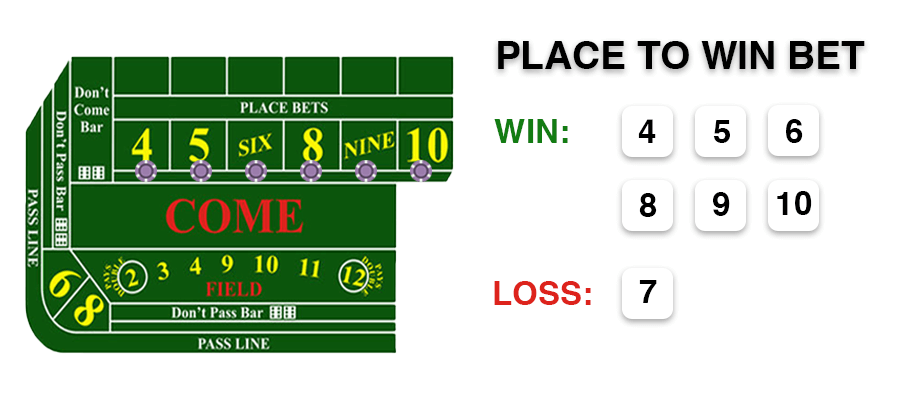
The numbers you’re betting on sit across the top of the craps table layout in individual point boxes. Your chips go into those boxes, but here’s the thing: you don’t place them yourself. Place bets are dealer-handled. You put your chips in the come area and tell the dealer what you want.
Place bets on 6 and 8 are considered among the best craps bets you can make. The house edge is only 1.52%, which puts them in the same ballpark as the pass line (1.41%). If you’re going to place a number, these two should be your first picks.
Think of it this way: the pass line is your foundation. Place bets are the walls you build on top. They expand your exposure to the numbers being rolled and give you multiple ways to win on every throw.
How to Make a Place Bet at the Craps Table
Making a place bet isn’t complicated, but it does require you to communicate with the dealer. This is not a self-service bet. You can’t just toss chips onto the number boxes yourself.
Here’s the step-by-step process:
You walk up to a table where the point is already 8. You want action on the 6. Drop your $12 in chips into the come area (the large open section in front of you) and say, “Place the 6, please.” The dealer picks up your chips and sets them in the 6 point box in a position that corresponds to your spot at the table. That’s it. You’re live. If the shooter rolls a 6 before a 7, you win $14 (paid at 7:6). If the 7 comes first, your $12 is gone.
A few things matter here. First, get the dealer’s attention before you act. Don’t throw chips while the dice are in motion. Wait for the dealer to acknowledge you. Second, be specific. Say the number and the amount. “Place the 8 for $6” is crystal clear. “Gimme that one” is not.
After a winning roll, the dealer will pay you and leave your original bet in place unless you say otherwise. This catches some new players off guard. If you want your bet back, say “down on the 6” or “take my place bets down.” If you want to increase your bet with the winnings, say “press it.” If you want to let everything ride as-is, just stay quiet.
After your place bet wins, the dealer pays you but keeps your bet active. If you don’t speak up, the bet stays working. Know your options: “same bet” (keep it), “press it” (double it), “down” (remove it), or “off” (temporarily deactivate it for the next roll).
Understanding craps etiquette at a live table will save you from those awkward moments where the dealer is staring at you waiting for instructions. Know what you want before the dice stop rolling.
Place Bet Payouts, House Edge, and True Odds
Not all place bet numbers are created equal. The 6 and 8 are the clear winners. The 4 and 10 carry the steepest house cut. Here’s the full breakdown:
| Number Placed | Payout | True Odds | House Edge |
|---|---|---|---|
| 4 or 10 | 9:5 | 2:1 | 6.67% |
| 5 or 9 | 7:5 | 3:2 | 4.00% |
| 6 or 8 | 7:6 | 6:5 | 1.52% |
Let’s talk about what this means in plain terms. The “true odds” column shows what you’d be paid if the casino had zero edge. The “payout” column shows what you actually get. The gap between those two numbers is the casino’s profit margin.
For the 6 and 8, that gap is tiny. You’re paid 7:6 on a bet whose real odds are 6:5. That works out to just 1.52% for the house. Compare that to proposition bets or the any seven bet, where the house edge can hit 16.67%, and you’ll see why experienced players gravitate toward place bets on inside numbers.
Because the 6 and 8 pay at 7:6, your bets on these numbers should be in multiples of $6 ($6, $12, $18, $24, etc.). For the 5 and 9, bet in multiples of $5. For the 4 and 10, also in multiples of $5. Betting odd amounts means the casino rounds down your payout, effectively increasing the house edge.
If you want the full picture of how every bet on the layout compares, the craps payout chart breaks it all down in one view.
Place to Lose Bet Explained
Most craps players never hear about this one. The Place to Lose bet is the mirror image of a standard place bet. Instead of betting that your number hits before the 7, you’re betting the 7 comes first.

Place to Lose bets show up in some European and Australian casinos, along with certain craps game variants and online platforms. They’re similar in spirit to the don’t pass bet and the don’t come bet, where you’re betting with the house against the shooter.
Here are the payouts for Place to Lose bets:
| Number | Place to Lose Payout | House Edge |
|---|---|---|
| 4 or 10 | 5:11 | 3.03% |
| 5 or 9 | 5:8 | 2.50% |
| 6 or 8 | 4:5 | 1.82% |
Notice something interesting? The house edge on Place to Lose bets is actually lower than regular place bets on the 4/10 and 5/9. That’s because you’re on the “wrong” side, and the math slightly favors that position. Just be aware: betting against the shooter at a hot table won’t win you any friends.
Like standard place bets, Place to Lose bets can be adjusted, called off, or removed at any point during the round. You’re never locked in.
Place Bet Walkthrough: A Real Table Scenario
Theory is one thing. Seeing it play out is another. Let’s run through a realistic scenario so you can picture exactly what happens when you place bets at a live table.
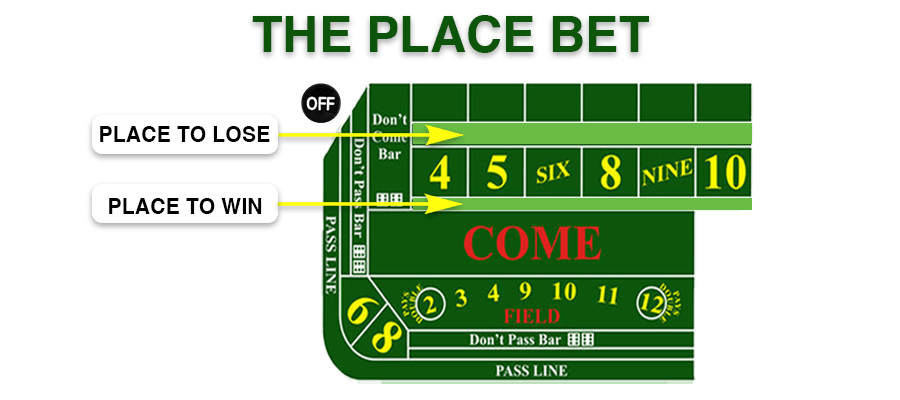
You buy in at a $10 minimum table with $200. The come-out roll has already happened, and the point is 9. You decide to place the 6 and 8 for $12 each.
Roll 1: The shooter throws a 4. Nothing happens to your bets. The 4 and 9 bettors care, but you don’t.
Roll 2: An 8 hits. The dealer pays you $14 (7:6 on your $12 bet). You say “same bet,” so your $12 stays on the 8. You pocket the $14.
Roll 3: Another 8. Another $14. This time you say “press it.” The dealer adds $12 from your winnings to your 8 bet (now $24 on the 8) and gives you back the remaining $2.
Roll 4: A 6 lands. Your original $12 bet pays $14. You take the money and leave the bet.
Roll 5: Seven out. Both of your place bets lose. But you’ve collected $28 in winnings and only lost $12 on the 6 plus $24 on the pressed 8. You’re down $8 on this round, but you played smart.
The scenario above shows why managing your bets after each roll matters just as much as choosing the right numbers. If you’d pressed both bets after the first hit and the 7 came early, the math looks very different.
Place Bet Strategies That Work
There’s no formula that beats the house edge over time. Let’s get that out of the way. But there are approaches that manage your risk better and take advantage of streaks when they happen.
The Hit-and-Run
This is the conservative play. You place a number, wait for it to hit once, collect your payout, and pull the bet down. One and done. This strategy reduces your exposure to the 7 and locks in profit quickly.
It works best at cold or choppy tables where long rolls are rare. If the dice combinations aren’t falling your way, there’s no shame in taking the money and walking.
On a cold table, place the 6 and 8 for one hit each. The moment one pays off, pull both bets down. You collect $14 on a $12 bet and remove $12 of risk from the other number. Small wins, but they add up.
The Press Strategy
The opposite approach. When your number hits, you “press” (double) your bet. This is how small bets turn into big paydays during hot rolls. But it also means you’re putting money back at risk.
A common variation is the “collect and press” method. First hit, you collect the payout. Second hit, you press. Third hit, collect. Fourth, press. You’re locking in profit every other roll while still growing your bet.
Inside Numbers Coverage
“Inside” numbers are 5, 6, 8, and 9. Placing all four gives you coverage on 18 out of 36 possible dice combinations. That means you have a winner on half of all rolls (excluding the 7).
The cost at a $10 table: $12 on the 6, $12 on the 8, $10 on the 5, $10 on the 9. Total: $44. It’s not cheap, but it puts the probability curve in your favor for short sessions.
Covering all four inside numbers ties up a significant chunk of your bankroll per round. If you only brought $100 to the table, putting $44 at risk on place bets alone leaves almost no cushion. Good bankroll management means never putting more than 10-15% of your session bankroll on a single round.
Pairing Place Bets with Pass Line and Odds
The smartest craps players don’t rely on one bet type. They layer. A pass line bet with free odds gives you the lowest house edge on the table. Adding place bets on the 6 and/or 8 expands your coverage without dramatically increasing the house cut. This combination shows up in nearly every craps strategy guide for a reason.
Big 6 and Big 8 vs. Place Bets: Why It’s No Contest
You’ll see two boxes on the craps layout labeled “Big 6” and “Big 8.” They sit in the corners, easy to reach, self-service. Don’t touch them.
| Bet | Payout | House Edge |
|---|---|---|
| Place 6 or Place 8 | 7:6 | 1.52% |
| Big 6 or Big 8 | 1:1 (even money) | 9.09% |
Same number, same winning condition, but the Big 6 and Big 8 bets pay even money while place bets pay 7:6. On a $6 bet, that’s the difference between winning $7 (place bet) and winning $6 (Big 6/8). Over time, that gap costs you real money.
There is zero reason to make a Big 6 or Big 8 bet. Ever. A place bet on the same number gives you a better payout on the exact same outcome. Many experienced dealers will even suggest you place the number instead.
Some newer craps game variants have actually removed the Big 6/8 boxes from the layout entirely. Good riddance.
Common Place Bet Mistakes to Avoid
Even a straightforward bet like the place bet has pitfalls. Here are the ones that cost players the most money:
- Betting wrong denominations (like $5 on the 6, where you lose payout value because 7:6 doesn’t divide evenly)
- Leaving place bets active on the come-out roll without realizing they’re “off” by default (unless you tell the dealer “keep my bets working”)
- Placing the 4 or 10 when a buy bet on the same numbers often has a lower effective house edge
- Spreading bets across all six numbers instead of focusing on the 6 and 8, which have the best odds
- Never taking bets down during cold streaks because of the sunk cost fallacy
That fourth point deserves extra attention. Buy bets on the 4 and 10 pay at true odds (2:1) minus a 5% commission. At many casinos, that commission is only charged on wins, which drops the effective house edge to about 4.76%. Compare that to the 6.67% house edge on place bets for 4 and 10, and the buy bet wins. Check your casino’s craps rules before sitting down; commission policies vary.
By default, place bets are “off” during the come-out roll. This means even if your number is rolled during the come-out, you don’t win. You can tell the dealer to keep your place bets “on” during the come-out, but most experienced players leave them off since the 7 is the most common roll and works against you.
Place Bets vs. Other Craps Wagers: Where Do They Rank?
If you’re still deciding whether place bets deserve a spot in your game plan, here’s how they stack up against other common craps wagers:
- You can jump in at any point during a round without waiting for a new come-out roll
- The 6 and 8 carry a house edge (1.52%) that rivals the best bets on the table
- Full control: increase, decrease, remove, or pause your bets between any roll
- Multiple numbers give you action on nearly every throw
- No ability to back them with free odds like pass/come bets, so the house edge is fixed
- The 4 and 10 carry a hefty 6.67% edge, making them poor value compared to buy bets on the same numbers
- Spreading across too many numbers inflates your total risk per round
For the complete picture on how all craps wagers compare, the craps bets explained page covers every option on the layout. And if you’re still building your foundation, our how to play craps guide is the best starting point.
Mastering the Place Bet: Your Next Move
The place bet sits in a sweet spot. It’s simple enough for any beginner to pick up in one session, yet flexible enough that veterans use it as a core piece of their strategy. The 6 and 8 offer some of the best odds on the entire craps table, and the ability to turn bets on and off gives you a level of control that most casino wagers don’t.
Start with the 6 and 8. Get comfortable with the dealer interaction. Learn the rhythm of pressing and pulling bets. Once that becomes second nature, explore how place bets fit alongside pass line and odds in a layered approach. That’s where the game really opens up.
If you want to practice without risking a cent, try our free craps simulator and test different place bet strategies until you’re confident at the table.
See you at the rail.
Best Online Craps Casinos (Last Updated September 2026)






Place Bet in Craps FAQs
The 6 and 8 are the best place bet numbers. Both carry a house edge of just 1.52% and pay out at 7:6. They also have the highest probability of hitting among place bet numbers, with five dice combinations each out of 36 possible rolls. For a deeper breakdown of odds across all numbers, check the craps payout chart.
Both bets wager that a number will be rolled before the 7. The difference is in how you’re paid. Place bets pay at preset odds (like 7:6 for the 6/8), while buy bets pay at true odds minus a 5% commission. For the 4 and 10, buy bets are often the better deal because the commission is lower than the house edge on a place bet (4.76% vs. 6.67%).
Yes. Place bets give you full control. You can remove them, increase them, decrease them, or call them “off” for any number of rolls. Just tell the dealer what you want. This flexibility is one of the biggest advantages place bets have over pass line and come bets, which are locked in once the point is set.
By default, place bets are off during the come-out roll. This protects you from losing to a 7 on the come-out (which is actually a good roll for pass line bettors). You can request that the dealer keep your place bets “working” during the come-out, but most players don’t.
Both bets win when a 6 is rolled before the 7. But a place bet on the 6 pays 7:6, while the Big 6 only pays even money. That means on a $6 wager, you’d win $7 with a place bet but only $6 with the Big 6. The house edge jumps from 1.52% to 9.09%. There’s no scenario where the Big 6 is the smarter bet.
Pressing means increasing your bet after a win, usually by doubling it. For example, if your $12 place bet on the 8 wins $14, you could “press” it to $24. The dealer adds $12 from your winnings to the bet and gives you the remaining $2. Pressing lets you capitalize on hot streaks, but it also increases what you stand to lose on the next 7-out.
