The Field Bet in Craps: Odds, Payouts, and Smart Strategies
 Jake Wilfred
Count the numbers on the field bet section of any craps table layout and you’ll see seven of them: 2, 3, 4, 9, 10, 11, and 12. Seven winners out of eleven possible totals. That looks like a majority, and your brain immediately says “good bet.” Your brain is wrong. The field bet in craps is one of the most misunderstood wagers on the table because it exploits a gap between how many numbers win and how often those numbers actually appear.
The winning numbers cover 16 out of 36 possible dice combinations. The losing numbers (5, 6, 7, and 8) cover 20 out of 36. That math flips the whole picture. Still, the field bet has a real place in craps, especially as part of strategies like the Iron Cross. This guide covers the full breakdown: how the field works, what it pays, the true house edge, and when it actually makes sense to bet it.
- The field bet wins on 2, 3, 4, 9, 10, 11, and 12, but loses on the four most frequently rolled numbers: 5, 6, 7, and 8
- Standard house edge is 5.56% (double on 2 and 12); it drops to 2.78% at tables paying triple on the 12
- The field is a one-roll bet, meaning it resolves immediately on the next throw and doesn’t carry over
- 16 of 36 dice combinations win the field bet versus 20 that lose, despite seven winning numbers versus only four losing numbers
- The field bet’s best use is inside the Iron Cross strategy, where it pairs with place bets on 5, 6, and 8 to cover every number except 7
What Is the Field Bet in Craps?
The field bet is a one-roll wager that the next throw of the dice will land on 2, 3, 4, 9, 10, 11, or 12. If any of those numbers come up, you win. If a 5, 6, 7, or 8 appears, you lose. The bet resolves on a single roll and doesn’t carry over. You place it fresh each time you want the action.
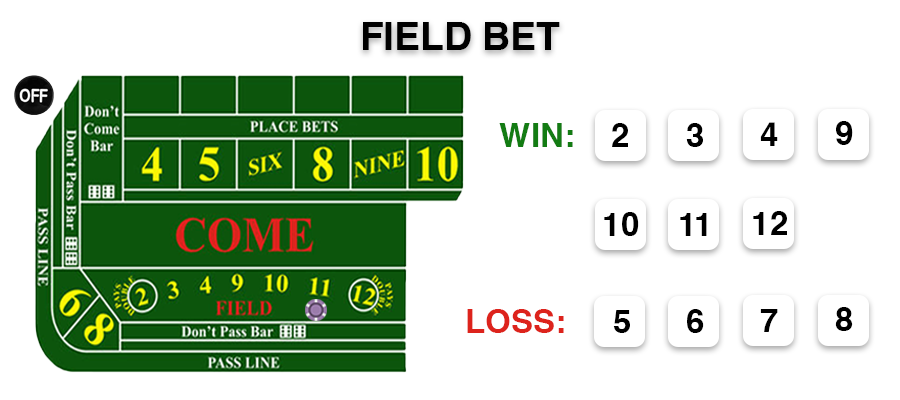
You’ll find the field bet area stretched across a large section of the craps table, directly in front of each player position. Unlike center-table proposition bets that require the stickman to handle, you place the field bet yourself. Just set your chips in the “FIELD” section before the next roll.
The field bet is available on every roll, regardless of the game phase. You can bet it during the come-out roll, during a point, or anytime in between. There’s no restriction on timing, which makes it one of the most accessible bets on the table. If you’re still learning the basics, our how to play craps guide covers the full game flow.
The field’s appeal is obvious at first glance. Seven winning numbers versus four losing numbers sounds like a good deal. But craps isn’t about how many numbers win. It’s about how often they show up. And the four losing numbers (5, 6, 7, 8) happen to be the four most common totals on two dice. That’s where the house gets its edge.
Field Bet Payouts and Odds
The payout structure on the field bet varies slightly depending on the craps casino where you play, but the standard version works like this:
| Roll | Payout | Dice Combinations | Probability |
|---|---|---|---|
| 2 | 2:1 | 1 (1+1) | 2.78% |
| 3 | 1:1 | 2 (1+2, 2+1) | 5.56% |
| 4 | 1:1 | 3 (1+3, 3+1, 2+2) | 8.33% |
| 9 | 1:1 | 4 (3+6, 6+3, 4+5, 5+4) | 11.11% |
| 10 | 1:1 | 3 (4+6, 6+4, 5+5) | 8.33% |
| 11 | 1:1 | 2 (5+6, 6+5) | 5.56% |
| 12 | 2:1 (or 3:1 at some tables) | 1 (6+6) | 2.78% |
| 5 (LOSS) | Lose | 4 | 11.11% |
| 6 (LOSS) | Lose | 5 | 13.89% |
| 7 (LOSS) | Lose | 6 | 16.67% |
| 8 (LOSS) | Lose | 5 | 13.89% |
The numbers tell the story. You have 16 winning combinations and 20 losing combinations out of 36 total. The bonus payouts on 2 and 12 (2:1) partially offset that imbalance, but not enough to erase the house advantage.
Standard Field (Double 2, Double 12): 5.56% House Edge
At most tables, both the 2 and 12 pay 2:1. Running the math across all 36 outcomes:
Winning outcomes: 14 rolls pay even money (net +14 units) + 2 rolls pay double (net +4 units) = +18 units. Losing outcomes: 20 rolls lose (net -20 units). Net result: -2 units per 36 rolls. House edge: 2/36 = 5.56%.
Triple 12 Field: 2.78% House Edge
Some casinos pay 3:1 on the 12 instead of 2:1. This single change cuts the house edge in half.
With a triple 12: net result becomes -1 unit per 36 rolls. House edge: 1/36 = 2.78%.
Always check whether the table pays double or triple on the 12 before placing a field bet. At 2.78%, the triple-12 field is competitive with place bets on 6 and 8 (1.52%) and significantly better than most other one-roll wagers. If the table only pays double on both 2 and 12, you’re paying twice the house edge for the same action. This single detail can be the difference between a reasonable bet and a mediocre one.
Why the Field Bet Fools So Many Players
The field bet is a masterclass in how casinos exploit human psychology. Understanding why it looks better than it is will make you a sharper player across the board.
The Number Count Illusion
Your eyes see seven winning numbers and four losing numbers. Your brain does quick napkin math: 7 out of 11 possibilities, that’s roughly 64% winners. But that calculation treats each number as equally likely, and they aren’t.
The 7 alone has six ways to appear. The 6 and 8 each have five. The 5 has four. Those four “losing” numbers represent 20 of the 36 possible dice outcomes, or 55.6% of all rolls. Meanwhile, the 2 and 12 (your bonus-payout numbers) have just one way each to appear. They’re the rarest outcomes on the table.
Say you bet $10 on the field for every roll in a perfect 36-roll cycle. You’d win 14 times at even money ($140), win once on the 2 at 2:1 ($20), and win once on the 12 at 2:1 ($20). Total winnings: $180. You’d lose 20 times at $10 each: $200. Net loss: $20. That’s $20 lost on $360 wagered, which is the 5.56% house edge in action. At a triple-12 table, your 12 win pays $30 instead of $20, cutting the net loss to $10 and the edge to 2.78%.
The “Almost Winning” Effect
The field bet loses on only four numbers. That means you’ll see wins frequently, which creates a psychological feedback loop. You win, you win again, you feel smart, you bet more. Then the 5s, 6s, 7s, and 8s start rolling (as they statistically must), and those losses add up faster than the wins accumulated.
This pattern is especially dangerous because the field resolves on every single roll. You’re making a new decision every 15 to 20 seconds. Compare that to a pass line bet that might take 5 to 10 rolls to resolve. The speed of the field bet means you’re exposed to the house edge far more frequently per hour.
Field Bet Strategies That Actually Work
The field bet isn’t a great standalone wager. But as a component of a broader strategy, it can serve a real purpose. Here are the approaches that make the most of it.
The Iron Cross Strategy
The Iron Cross (also called the “No Seven” system) is the field bet’s natural habitat. The strategy covers every possible number except 7 by combining a field bet with place bets on the 5, 6, and 8.
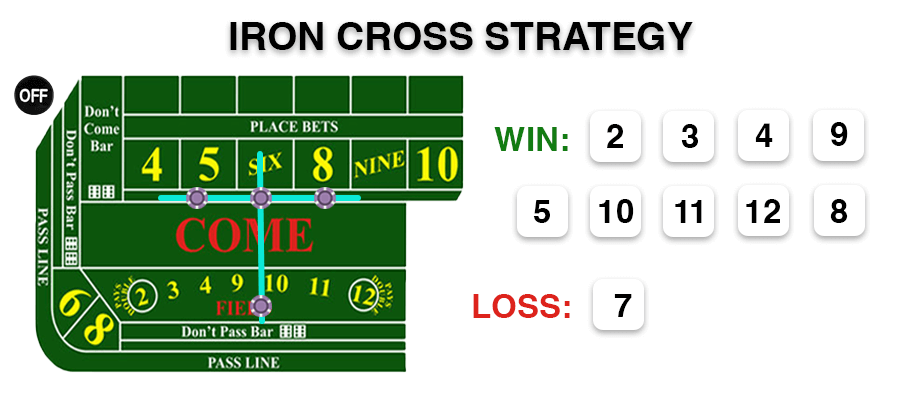
Here’s the logic: the field covers 2, 3, 4, 9, 10, 11, and 12. Place bets cover 5, 6, and 8. Together, that’s every number from 2 through 12 except the 7. You win on 30 out of 36 rolls and lose only when the 7 shows.
After a point is established, you place $10 on the field, $10 on the 5, $12 on the 6, and $12 on the 8. Total at risk: $44. If the roll is a field number (2, 3, 4, 9, 10, 11, or 12), you win $10 to $20 on the field while your place bets sit untouched. If a 5 rolls, you win $14 on the place bet but lose your $10 field bet (net +$4). If 6 or 8 rolls, you win $14 on the place bet and lose $10 on the field (net +$4). Only a 7 wipes everything out, costing you the full $44.
The Iron Cross wins on 30 out of 36 rolls, which feels incredible. The catch: that one losing outcome (the 7) costs you $44 while most winning rolls only net $4 to $20. Over time, the blended house edge is roughly 3.9%, which is respectable for a system that gives you constant action, but still higher than sticking to pass line with free odds.
The Iron Cross only works after a point is established. On the come-out roll, a 7 is a winner for pass line bettors but a killer for the Iron Cross. Never run this strategy during the come-out. Wait for the point, then set up your bets. For the full breakdown, read our dedicated Iron Cross strategy guide.
Selective Field Betting
Rather than betting the field on every roll, some players wait for specific conditions. The most common approach: bet the field only after several consecutive non-field numbers (5, 6, 7, 8) have appeared.
Let’s be clear about the math here. Each roll is independent. Previous rolls don’t influence future outcomes. The dice don’t remember what they just rolled, and believing otherwise is one of the biggest craps myths around.
That said, selective betting has a practical benefit: it reduces the number of bets you make per session, which reduces your total exposure to the house edge. Betting the field 10 times instead of 50 times means you’re paying 5.56% on 10 bets instead of 50. Your expected loss per session drops proportionally.
If you’re going to bet the field selectively, set a hard rule. Something like “field bet only on the first roll after a point is established” or “field bet once every five rolls maximum.” The rule itself doesn’t matter much. What matters is that it limits your total action and keeps the field from becoming an every-roll habit that chips away at your bankroll.
The Field Bet vs. Other One-Roll Craps Bets
How does the field stack up against other wagers that resolve in a single throw?
| Bet | Payout | House Edge | Win Probability |
|---|---|---|---|
| Field (triple 12) | 1:1, 2:1, 3:1 | 2.78% | 44.4% |
| Field (double 12) | 1:1, 2:1 | 5.56% | 44.4% |
| Any Craps | 7:1 | 11.11% | 11.1% |
| Yo (11) | 15:1 | 11.11% | 5.6% |
| Any Seven | 4:1 | 16.67% | 16.7% |
| Snake Eyes (2) | 30:1 | 13.89% | 2.8% |
| Boxcars (12) | 30:1 | 13.89% | 2.8% |
The field bet is the best one-roll wager on the table at a triple-12 casino, and the second-best even at standard tables. Everything else in the one-roll category carries a house edge above 11%. If you want quick-resolution action, the field is the least expensive way to get it.
Compare it to multi-roll bets, though, and the picture changes. The pass line at 1.41%, don’t pass at 1.36%, and place bets on 6 or 8 at 1.52% are all significantly cheaper. Those bets take multiple rolls to resolve, but your money faces the house edge far less frequently per dollar wagered. For a detailed comparison of every bet, see our craps payout chart.
Is the Field Bet Worth It?
It depends entirely on how you use it.
- Simplest bet on the table: place chips in the “FIELD” area, done
- Best one-roll bet available, especially at triple-12 tables (2.78% house edge)
- Can be placed on any roll with no timing restrictions
- Core component of the Iron Cross strategy, which covers 30 of 36 outcomes
- You place it yourself; no need to toss chips to the stickman or ask the dealer
- Standard 5.56% house edge is roughly 4x worse than the pass line’s 1.41%
- Resolves every roll, so you’re exposed to the house edge on every single throw
- The “seven numbers win” visual illusion makes it feel better than it is mathematically
- Can become habitual: one field bet per roll across a 2-hour session adds up fast
- Money on the field is money not backing your pass line with odds (0% house edge)
For beginners, the field bet is a fine way to get comfortable with the table. It’s easy to understand, it resolves quickly, and it doesn’t require any interaction with the crew. But as you grow more experienced, you’ll likely shift that money toward free odds bets and place bets where the math works harder in your favor.
For experienced players, the field is best used inside the Iron Cross or as an occasional one-off during a session. It’s not a foundation bet. It’s a spice.
The Field Bet in Craps: Play It Smart, Not Often
The field bet sits in an interesting spot on the craps table. It’s the best of the one-roll bets, but it’s still a one-roll bet. It covers seven numbers, but the four it misses happen more often. It pays 2:1 on the 2 and 12, but those hits are rare enough that they don’t fully offset the math working against you.
Use the field bet with intention, not impulse. At a triple-12 table, it’s a 2.78% house edge wager that gives you instant action on every throw. Inside an Iron Cross setup, it covers the gap left by your place bets. As a standalone habit on every roll, it’ll quietly drain your stack at a rate of $5.56 per $100 wagered. Know the difference, bet accordingly, and practice it on our free craps simulator until the math becomes second nature.
Best Online Craps Casinos (Last Updated September 2026)







Field Bet FAQs
The “field” is a designated betting area on the craps table where you can wager that the next roll will be a 2, 3, 4, 9, 10, 11, or 12. It’s one of the largest sections on the layout and sits directly in front of each player position. You place the bet yourself without dealer assistance.
The standard field bet house edge is 5.56% when both the 2 and 12 pay 2:1. At casinos that pay 3:1 (triple) on the 12, the house edge drops to 2.78%. Always check the table’s payout structure before betting. The full odds breakdown is in our craps payout chart.
It’s the best one-roll bet on the table, but it’s still a one-roll bet with a higher house edge than the pass line (1.41%) or don’t pass (1.36%). The field works well as part of the Iron Cross strategy or as occasional action. It’s not ideal as a primary bet for every roll.
The field bet wins on 2, 3, 4, 9, 10, 11, and 12. It loses on 5, 6, 7, and 8. The winning numbers cover 16 out of 36 possible dice combinations (44.4%), while the losing numbers cover 20 out of 36 (55.6%). The 2 and 12 pay bonus payouts of 2:1 or 3:1 depending on the table.
The Iron Cross combines a field bet with place bets on 5, 6, and 8. Together, these bets cover every number except 7. You win on 30 out of 36 possible rolls. The catch is that a 7 wipes out all four bets simultaneously. The blended house edge is roughly 3.9%. Read the full breakdown in our Iron Cross guide.
Yes. The field bet is available on every roll, including the come-out. There are no phase restrictions. However, if you’re also running the Iron Cross strategy, you should only start your field bet after a point is established, since a come-out 7 would win your pass line bet but wipe out your Iron Cross setup.
