Come Bet in Craps: The Complete Guide
 Jake Wilfred
The shooter’s been rolling for five minutes. The point is 8. You missed the pass line bet because you just walked up. Most new players would stand there waiting for the next come-out roll. But experienced players?
They drop chips on the come. The come bet in craps gives you a fresh start on any roll after the point is established. It works exactly like a pass line bet, with the same 1.41% house edge and the same ability to take free odds behind it. The difference? You can place it at any time during a shooter’s turn, not just on the come-out.
This makes the come bet one of the most powerful and flexible wagers on the craps table, and it’s the foundation of some of the smartest strategies in the game, including the Three Point Molly.
- The come bet has a 1.41% house edge, identical to the pass line, making it one of the best bets on the table
- You place a come bet after the point is established; it then works like its own mini pass line sequence
- A 7 or 11 on the come bet’s first roll wins immediately; a 2, 3, or 12 loses immediately
- If any other number rolls (4, 5, 6, 8, 9, 10), that number becomes your “come point,” and you win if it repeats before a 7
- Adding free odds behind come bets drops the combined house edge as low as 0.37% with 3x-4x-5x odds
- The Three Point Molly strategy uses pass line + come bets + odds to keep multiple low-edge numbers working simultaneously
What Is the Come Bet and How Does It Work?
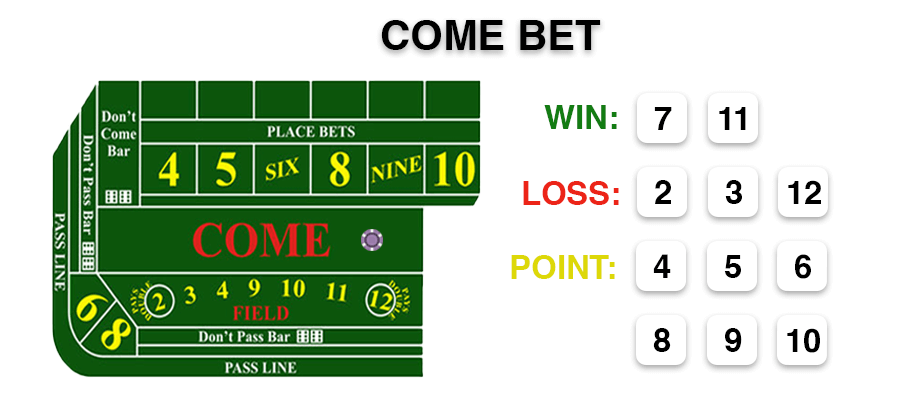
A come bet is essentially a pass line bet that you can make at any time after the point has been established. Place your chips in the “COME” area of the table (located just above the pass line section), and the very next roll becomes your personal come-out roll.
Here’s the sequence:
If the next roll is a 7 or 11, your come bet wins immediately, paying even money (1:1).
If the next roll is a 2, 3, or 12, your come bet loses immediately.
If the next roll is a 4, 5, 6, 8, 9, or 10, that number becomes your come point. The dealer moves your chips from the COME area to the corresponding number box on the layout. From that moment, your come bet wins if the come point repeats before a 7, and loses if a 7 comes first.
The point is 9. You place $10 in the COME area. The shooter rolls a 6. Your $10 moves to the 6 box. This is now your come point. Over the next several rolls, the shooter throws an 8, a 4, a 10, and then a 6. Your come bet wins. The dealer pays you $10 (even money). If the shooter had rolled a 7 before that 6, you’d have lost the $10.
The come bet is a multi-roll wager. Once your come point is established, the bet sits on that number until it resolves, which could take one roll or dozens. You can have multiple come bets active on different numbers at the same time, each tracking its own come point independently.
The come bet and the pass line bet are mathematically identical. Same house edge (1.41%), same payout structure, same odds. The only difference is timing: the pass line is placed before or on the come-out roll, while the come bet is placed after the point has been established. If you understand the pass line, you already understand the come bet.
How to Place a Come Bet
Placing a come bet is one of the simplest actions at the craps table. You handle it yourself, no dealer or stickman needed.
Wait until a point has been established (the puck shows “ON” and sits on a number). Then place your chips directly into the large “COME” area on the layout in front of you. That’s it. The next roll determines what happens.
If the roll establishes a come point, the dealer picks up your chips and moves them to the number box. You don’t touch them again. The dealer tracks which chips belong to which player based on their position within the number box. If your come point hits, the dealer places your original bet plus winnings back in the COME area for you to pick up.
You can make a new come bet on every roll after the point is established. This is how strategies like the Three Point Molly work: you build up multiple come points over successive rolls. Each one operates independently, giving you several numbers working in your favor simultaneously.
One thing that trips up beginners: once your come bet moves to a number, you can’t remove it. It stays there until it wins or loses. This is different from place bets, which you can call off or remove at any time. The inability to pull back a come bet is the trade-off for its lower house edge. For a visual reference of where everything sits, see our craps table layout guide.
Come Bet Odds, Payouts, and House Edge
The come bet pays even money (1:1) on winning bets. The house edge is 1.41%, identical to the pass line. This makes it one of the best bets on the craps table.
But the real power of the come bet unlocks when you add free odds behind it.
Come Bet With Free Odds
After your come bet moves to a number, you can tell the dealer you want to “take odds” on it. The dealer places your additional odds chips on top of (slightly offset from) your original come bet in the number box.
The free odds bet pays at true odds, meaning zero house edge. The payout depends on the come point:
| Come Point | True Odds | Odds Payout | Combined House Edge (with 1x odds) |
|---|---|---|---|
| 4 or 10 | 2 to 1 | 2:1 | 0.85% |
| 5 or 9 | 3 to 2 | 3:2 | 0.85% |
| 6 or 8 | 6 to 5 | 6:5 | 0.85% |
The more odds you take, the lower the combined house edge drops. With 2x odds, it falls to roughly 0.61%. With 3x-4x-5x odds (the most common structure in casinos today), it drops to approximately 0.37%. That’s less than 40 cents lost per $100 wagered over time.
You place $10 in the COME area. The shooter rolls an 8. Your $10 moves to the 8 box. You tell the dealer “odds on the come” and hand over $20 (2x odds). Now you have $30 total riding on the 8: $10 flat bet + $20 odds. If the 8 hits before a 7, you win $10 (even money on the flat) plus $24 (6:5 on the $20 odds) = $34 total profit. If the 7 comes first, you lose all $30.
Free odds on come bets are typically “off” during the come-out roll unless you specifically tell the dealer to keep them “working.” This means if the shooter makes the point and a new come-out begins, your come bet odds are temporarily inactive. A 7 on the come-out will lose your flat come bet but return your odds. If you want your odds working during the come-out, say “odds working” and the dealer will place an “ON” marker on your chips.
Come Bet vs. Place Bet: Which Is Better?
This is one of the most common debates among craps players. Both bets put your money on specific numbers. Both win when that number is rolled before a 7. But they work differently, and the math isn’t the same.
| Feature | Come Bet | Place Bet |
|---|---|---|
| House Edge (flat bet) | 1.41% | 1.52% (6/8), 4.00% (5/9), 6.67% (4/10) |
| Can Take True Odds? | Yes (0% house edge) | No |
| Can Remove Anytime? | No (locked in after come point set) | Yes |
| Exposed to Come-Out Roll? | Yes (wins on 7/11, loses on 2/3/12) | No (typically “off” on come-out) |
| Payout | Even money (1:1) + odds at true odds | 7:6 (6/8), 7:5 (5/9), 9:5 (4/10) |
The come bet wins on house edge, especially when backed with odds. A $10 come bet on the 6 with $20 in odds has a combined edge of roughly 0.61%. A $12 place bet on the 6 has a 1.52% edge with no way to reduce it.
The place bet wins on flexibility. You can call it off or take it down at any time. And it’s never exposed to the come-out roll, where a 7 would kill an active come bet.
If you’re playing at a table with generous odds limits (3x-4x-5x or higher), come bets with odds are almost always the superior choice. The ability to back them with true-odds wagers is a mathematical advantage no place bet can match. If the table only allows 1x odds, or you prefer the ability to turn bets on and off at will, place bets on 6 and 8 are a solid alternative at just 1.52%. Read more in our place bet guide.
Come Bet vs. Don’t Come Bet
The don’t come bet is the mirror image of the come bet. Where the come bet wins on 7 or 11 and loses on 2, 3, or 12 on its first roll, the don’t come wins on 2 or 3 (12 is a push) and loses on 7 or 11. After a come point is established, the don’t come wins if the 7 appears before the come point, which is the opposite of the come bet.
The don’t come bet has a slightly lower house edge at 1.36% compared to the come bet’s 1.41%. The difference is tiny. Where it matters more is that don’t come bettors are “laying” odds instead of “taking” them, meaning they risk more to win less on the odds portion.
Most players prefer come bets for one simple reason: you’re cheering for numbers, which is what everyone else at the table wants. Don’t come bettors are rooting for the 7 after a point is set, which puts you at odds with the table’s energy. Neither is wrong mathematically. But if craps etiquette and table atmosphere matter to you, come bets keep you on the popular side.
- 1.41% house edge, among the lowest on the table
- Can take free odds at 0% house edge, dropping combined edge below 0.50%
- Available on every roll after the point is established, giving you constant opportunities
- Allows multiple numbers working simultaneously, increasing action without increasing the house edge
- You’re betting with the majority of the table, which is more enjoyable socially
- Can’t be removed once a come point is set (locked in until resolved)
- Vulnerable on the come-out roll: a 7 wins your new pass line but kills active come bets
- Having multiple come bets active means a seven-out can wipe out several bets at once
- Odds are typically “off” during come-out rolls unless you request them “working”
The Three Point Molly: The Best Come Bet Strategy
The Three Point Molly is the gold standard strategy for come bet players. It’s simple, conservative, and keeps the house edge razor-thin.
How the Three Point Molly Works
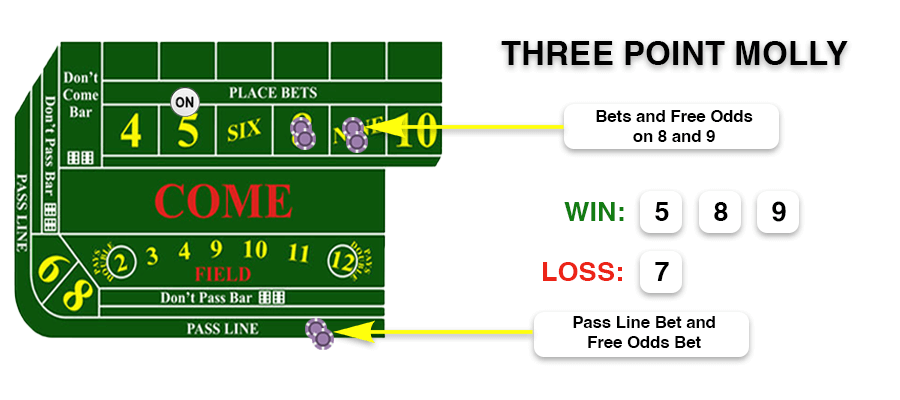
Start with a pass line bet. Once the point is established, take maximum odds behind your pass line bet. On the next roll, place a come bet. If it moves to a number, take odds on it. On the following roll, place another come bet and take odds again.
Your goal is to have three numbers working at all times: the pass line point plus two come points, all backed with maximum odds.
You bet $10 on the pass line. The point is 9. You take $20 in odds behind it. Next roll, you place $10 in COME. The shooter rolls a 5. Your come bet moves to the 5; you take $20 in odds. Next roll, you place another $10 in COME. The shooter rolls a 6. Your second come bet moves to the 6; you take $20 in odds. You now have three numbers working: 9 (pass line + odds), 5 (come + odds), and 6 (come + odds). Total investment: $90 across three bets. Combined house edge on all of it: approximately 0.61% with 2x odds.
If one of your numbers hits, collect the payout and immediately replace it with a new come bet. The aim is to always have three numbers alive. If the pass line point hits, the shooter starts a new come-out; place a new pass line bet and continue the cycle.
Why the Three Point Molly Works
Two reasons. First, you’re only ever exposed to three numbers at a time, which limits your total risk if a 7 appears. Second, with full odds behind every bet, your combined house edge stays below 1% (often below 0.50%), which is as good as it gets anywhere in the casino.
The biggest risk with the Three Point Molly comes during the come-out roll after a point is made. Your two come bets are still active, and a 7 on the come-out wins your new pass line bet but kills both come bets. This is the strategy’s Achilles’ heel. Your odds are typically returned on a come-out 7, but the flat bets are gone. Budget for this happening periodically. It’s part of the math. For full details, check our dedicated Three Point Molly strategy guide.
Advanced Come Bet Tactics
Once you’re comfortable with the basic come bet and the Three Point Molly, a few refinements can sharpen your game further.
Pressing Come Bet Wins
After a come bet wins, you can press your next come bet to a higher amount using house money. Say your $10 come bet on the 5 with $20 odds pays out $40 ($10 flat + $30 odds payout). You could increase your next come bet to $15 and take odds behind it. This grows your action during hot rolls without risking money from your original buy-in.
Managing Multiple Come Bets During Cold Streaks
If a seven-out wipes your come bets, don’t reload all three at once. Start with just the pass line bet. Then add come bets gradually. This pacing reduces the psychological sting of a quick seven-out on fresh bets and keeps your bankroll management intact.
Always max out your odds before adding more come bets. A single come bet with 3x-4x-5x odds has a lower combined house edge than three come bets with no odds. Depth (more odds per bet) beats width (more bets with less odds) every time from a pure math perspective. Only spread to multiple come bets after you’ve maxed odds on each one. For more on building the right approach, see our craps strategy guide.
Keeping Odds “Working” on the Come-Out
By default, odds on come bets are turned off during the come-out roll. This protects you from losing the odds portion on a come-out 7. But some players prefer to keep them working to take advantage of numbers hitting during the come-out. If the shooter rolls your come point on the come-out, you’ll win both the flat bet and the odds, which is a bigger payout.
The trade-off: if the come-out roll is a 7, you lose the flat come bet AND the odds instead of just the flat bet. Whether to keep odds working is a personal risk preference. The math is neutral either way over the long run.
Come Bet: A Smart Player’s Cornerstone Wager
The come bet is one of the most mathematically sound wagers in any casino, even online craps sites. At 1.41%, its house edge sits right alongside the pass line as the foundation of smart craps play. Add free odds behind it, and you’re playing a game where the house advantage barely exists.
It’s flexible enough to use on any roll after the point. It pairs perfectly with the pass line for multi-number coverage. And inside the Three Point Molly framework, it creates one of the lowest-edge betting structures available to any table game player in 2026.
If you’re still getting comfortable with the table, start with the pass line and one come bet. As your confidence grows, add a second come bet and take odds on everything. Practice the rhythm on our free craps simulator and you’ll be running the Three Point Molly at a Vegas table before you know it. The come bet isn’t flashy. It doesn’t pay 30:1 or make the table erupt. But it does something better: it keeps your money alive, roll after roll, at one of the lowest costs in the building.
Best Online Craps Casinos (Last Updated September 2026)







Come Bet FAQs
A come bet is a wager placed after the point is established that works exactly like a pass line bet. If the next roll is a 7 or 11, it wins immediately. If it’s a 2, 3, or 12, it loses. Any other number becomes your “come point,” and you win if that number repeats before a 7. The house edge is 1.41%. For a complete breakdown of all craps wagers, see our craps bets explained guide.
The flat come bet pays even money (1:1). If you bet $10, you win $10. If you take free odds behind the come bet, the odds portion pays at true odds: 2:1 on the 4 or 10, 3:2 on the 5 or 9, and 6:5 on the 6 or 8. The full payout breakdown is in our craps payout chart.
No. Once your come bet moves to a number (the come point), it’s locked in until it resolves. You cannot remove it or call it off. However, you can remove or call off the odds portion behind it at any time. This differs from place bets, which can be taken down or turned off whenever you want.
Yes. The come bet has a 1.41% house edge, making it one of the best bets on the table. With free odds behind it, the combined edge drops below 0.50%. It’s a core bet for serious craps players and the foundation of strategies like the Three Point Molly.
Come bets remain active during the come-out roll. If the come-out is a 7, your pass line bet wins but your active come bets lose. The flat portion of the come bet is lost; the odds portion is typically returned to you (since odds are “off” during the come-out by default). You can request that odds stay “working” during the come-out by telling the dealer.
Both put money on specific numbers, but the come bet has a lower house edge (1.41% vs. 1.52% to 6.67% for place bets) and can be backed with free odds at 0% house edge. The trade-off is that come bets can’t be removed once a come point is set, while place bets can be taken down anytime. Come bets are also exposed to the come-out roll, where a 7 or craps numbers can affect them.
