Don’t Pass Line Bet Guide: Betting The Darkside
 Jake Wilfred
Every craps table has a quiet player standing at the end of the rail, chips on the don’t pass, collecting while everyone else groans. The rest of the table calls them a “wrong bettor” or a “dark sider.” The math calls them smart. The don’t pass bet in craps carries a 1.36% house edge, making it the single lowest-edge line bet on the table, 0.05% better than the pass line.
It wins when shooters lose. It profits when the 7 shows up after the point. And it comes with a social cost that keeps most players away from it, which is exactly why it’s worth understanding. Whether you play the dark side full-time or just want to know how the other half lives, this guide covers every angle of the don’t pass bet: how it works, what it pays, when to lay odds, and how to handle the table dynamics that come with betting against the shooter.
- The don’t pass bet has a 1.36% house edge, the lowest of any line bet in craps
- It wins on the come-out if the shooter rolls a 2 or 3 (12 is a push/bar); it loses on 7 or 11
- After a point is established, the don’t pass wins if a 7 is rolled before the point number repeats
- Laying odds behind the don’t pass has a 0% house edge, just like taking odds on the pass line
- You can remove a don’t pass bet after the point is set (but you almost never should, since the math is in your favor at that stage)
- The don’t pass is the foundation of “dark side” craps strategies that pair with don’t come bets and lay odds
What Is the Don’t Pass Bet?
The don’t pass bet is the mirror image of the pass line bet. Where pass line bettors root for the shooter to make their point, don’t pass bettors root for the shooter to seven out. You’re betting against the shooter, which is why it’s called “playing the dark side.”
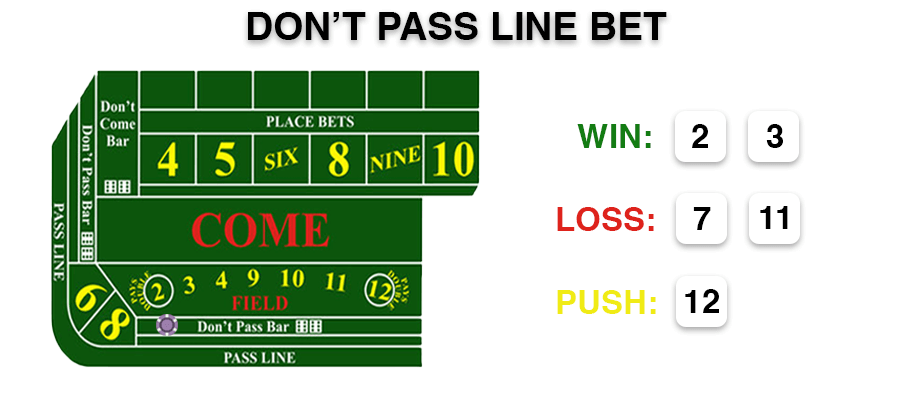
Place your chips on the “DON’T PASS BAR” section of the craps table layout. This area runs along the back edge of the layout, just behind the pass line. You make this bet before the come-out roll, the same timing as a pass line bet.
Here’s what happens:
Come-out roll outcomes: If the shooter rolls a 7 or 11, your don’t pass bet loses. If the shooter rolls a 2 or 3, your don’t pass bet wins (pays even money, 1:1). If the shooter rolls a 12, it’s a push (your bet is returned). This is the “bar” in “Don’t Pass Bar.” Without barring the 12, the don’t pass would actually have an edge over the house.
After a point is established (4, 5, 6, 8, 9, or 10): Your don’t pass bet wins if the shooter rolls a 7 before repeating the point. Your don’t pass bet loses if the shooter rolls the point number before a 7.
You place $10 on don’t pass. The come-out roll is a 4. The point is now 4. Over the next several rolls, the shooter throws a 9, an 11, a 3, and then a 7. Your don’t pass bet wins $10. The 7 showed up before the shooter could roll another 4. If the shooter had rolled a 4 before the 7, you’d have lost your $10.
That’s the entire bet. Simple in mechanics, complicated in social dynamics. More on that later.
Don’t Pass Bet Odds and House Edge
The don’t pass bet has a house edge of 1.36%. That’s 0.05% lower than the pass line’s 1.41%. The difference is tiny per bet, but over thousands of wagers it adds up.
Why is it lower? Because of how the come-out roll math works. On the come-out, the don’t pass loses on 7 or 11 (8 combinations out of 36) and wins on 2 or 3 (3 combinations). The 12 is a push (1 combination). That leaves 24 combinations that establish a point. Once a point is set, the don’t pass bettor has the mathematical advantage because the 7 (6 ways to roll) is more likely than any single point number.
| Point Number | Ways to Roll Point | Ways to Roll 7 | Don’t Pass Win Probability (After Point Set) |
|---|---|---|---|
| 4 or 10 | 3 | 6 | 66.67% |
| 5 or 9 | 4 | 6 | 60.00% |
| 6 or 8 | 5 | 6 | 54.55% |
Look at those numbers. Once a point is established, the don’t pass bettor has a statistical advantage on every single point. The 4 and 10 are the best scenarios: you have a 2-to-1 edge. Even on the 6 and 8, the toughest points for a dark side player, you still win more often than you lose.
The come-out roll is the don’t pass bettor’s vulnerable moment. You lose on 8 out of 36 outcomes (7 or 11) and win on only 3 (2 or 3), with 1 push (12). But once you survive the come-out and a point is set, the math shifts in your favor for the rest of that shooter’s turn.
The bar 12 rule exists specifically to prevent the don’t pass from being a player-edge bet. Without it, the don’t pass would have a positive expected value for the player. Some casinos bar the 2 instead of the 12. The effect is identical: one craps number becomes a push to preserve the house edge. Check the table layout to see which number is barred at your casino. For more on dice probabilities, see our dice combinations guide.
How to Lay Odds on the Don’t Pass
After a point is established, you can place an additional wager called laying odds behind your don’t pass bet. This is the dark side equivalent of “taking odds” on the pass line, and it’s one of the best bets in craps.
Lay odds pay at true odds with a 0% house edge. The catch: since you’re betting that the 7 will come before the point (and the 7 is more likely), you have to risk more than you stand to win.
Lay Odds Payouts
| Point Number | Lay Odds Payout | You Risk | You Win |
|---|---|---|---|
| 4 or 10 | 1:2 | $20 | $10 |
| 5 or 9 | 2:3 | $30 | $20 |
| 6 or 8 | 5:6 | $30 | $25 |
The payouts look backwards compared to taking odds on the pass line. That’s because you’re on the favorable side of the probability. The 7 is more likely to appear than any point, so you lay more to win less, but you win more often.
You bet $10 on don’t pass. The come-out roll is a 4. You lay $40 in odds (your casino allows up to 6x odds on the don’t pass). The odds payout on the 4 is 1:2, meaning you win $20 on the $40 odds bet. If the 7 comes before the 4, you collect $10 (even money on the flat bet) + $20 (odds) = $30 total profit. If the 4 comes first, you lose $10 + $40 = $50. The risk is higher per bet, but you win this scenario two-thirds of the time.
To place lay odds, set your chips behind your don’t pass bet in the don’t pass area. The dealer may need to adjust their position. If you’re unsure, just tell the dealer “I want to lay odds” and hand over your chips.
Always lay maximum odds when playing don’t pass. The flat bet carries the 1.36% house edge. The odds carry 0%. The more of your total action that sits in the odds portion, the lower your combined house edge drops. With 3x-4x-5x lay odds (the most common structure), your blended edge falls to roughly 0.34%. That’s the lowest combined house edge available on any standard craps bet. Check the full numbers in our craps payout chart.
Don’t Pass vs. Pass Line: The Complete Comparison
This is the central decision every craps player faces. Both bets are excellent. Both rank among the best wagers in any craps casino. But they play very differently in practice.
| Feature | Don’t Pass | Pass Line |
|---|---|---|
| House Edge | 1.36% | 1.41% |
| Come-Out Win | 2 or 3 (3 ways) | 7 or 11 (8 ways) |
| Come-Out Loss | 7 or 11 (8 ways) | 2, 3, or 12 (4 ways) |
| Come-Out Push | 12 (1 way) | None |
| After Point Set | Favored (7 more likely than any point) | Underdog (point less likely than 7) |
| Can Remove After Point? | Yes (but you shouldn’t) | No |
| Odds Bet Style | Lay (risk more to win less) | Take (risk less to win more) |
| Table Social Dynamic | Against the table | With the table |
The come-out roll is where these two bets diverge most dramatically. Pass line bettors have 8 ways to win (7 or 11) and only 4 ways to lose (2, 3, 12) on the come-out. Don’t pass bettors have only 3 ways to win (2 or 3) and 8 ways to lose (7 or 11). That’s a tough start.
But after the point is established, the math flips. The don’t pass bettor becomes the favorite on every single point number. This is the core trade-off: survive the come-out, and the rest of the hand works in your favor.
You can technically remove your don’t pass bet after the point is set. The casino allows it because at that stage, the math favors you. Taking the bet down is giving up your advantage. It’s one of the worst moves you can make in craps. Never remove a don’t pass bet after the point is established. You already survived the dangerous part (the come-out). Now let the math work for you.
Playing the Dark Side: Strategies for Don’t Pass Bettors
The dark side has a few proven approaches. Each one builds on the don’t pass bet’s low house edge and pairs it with smart odds play.
Don’t Pass With Lay Odds (Foundation Strategy)
The simplest and most effective approach: bet don’t pass, lay maximum odds after the point, and repeat. This is the dark side mirror of the standard pass line with odds strategy, and it produces the lowest combined house edge available in craps.
With 3x-4x-5x lay odds, you’re looking at a combined edge around 0.34%. That’s lower than basic strategy blackjack at most tables. The cost? You need to risk more per bet since lay odds require larger wagers to produce smaller payouts. Budget accordingly with solid bankroll management.
Combining Don’t Pass With Don’t Come Bets
For more table coverage, add don’t come bets after the point is established. These work like don’t pass bets but can be placed on any roll. Each don’t come bet establishes its own point, and you can lay odds on each one.
This gives you multiple numbers working in your favor. If the shooter sevens out, all your don’t pass and don’t come bets win simultaneously. The downside: if the shooter gets hot and starts hitting numbers, you can lose several bets in quick succession.
You bet $10 don’t pass. The point is 8. You lay $30 in odds. Next roll, you place $10 on don’t come. The shooter rolls a 5; your don’t come moves to the 5. You lay $30 in odds on it. Next roll, another $10 don’t come. The shooter rolls a 9; it moves to the 9. You lay $30 in odds. You now have three numbers working: 8, 5, and 9, all with lay odds. Total risk: $120. If the 7 shows, you win on all three. If the shooter hits any of your numbers before the 7, that individual bet loses while the others stay alive.
Limit yourself to two or three don’t bets active at any time. More than that and a hot shooter who hits several numbers in a row can wipe out your session bank fast. Two don’t come bets plus your don’t pass gives you three numbers, which is enough coverage without overexposure. Our craps strategy guide covers how to structure this approach for different bankroll sizes.
Don’t Pass as a Hedge
Some players use a small don’t pass bet to hedge other wagers. For instance, if you have several come bets or place bets working, a don’t pass bet on the next come-out gives you a safety net if the 7 shows.
Does it work mathematically? Not perfectly. Hedging adds a second house edge bet on top of your existing ones. The combined cost is usually higher than just accepting the risk on your original bets. But from a practical standpoint, it can reduce variance and help you preserve your bankroll during choppy sessions. Just don’t hedge with high-edge bets like Any Seven (16.67% house edge). The hedge should be a low-edge bet or it defeats the purpose.
The Social Reality of Playing Don’t Pass
Let’s talk about the elephant at the table. When you bet don’t pass, you’re cheering for the 7 after the point is set. Everyone else is cheering against it. This creates an awkward dynamic that some players love and others hate.
Here’s the honest reality: most experienced craps players and dealers won’t give you a hard time for playing the dark side. They understand it’s a valid bet with good math. Beginners and casual players might shoot you a look when you win on their seven-out, but that’s about it.
- Lowest house edge of any line bet at 1.36%
- After the point is set, the math strongly favors you (especially on 4 and 10)
- Lay odds at 0% house edge further reduce the combined cost
- You can remove the bet after the point (though you shouldn’t)
- Works well with don’t come bets for multi-number dark side coverage
- Come-out roll is tough: 8 ways to lose (7/11) versus 3 ways to win (2/3)
- Laying odds means risking more to win less, which requires a larger bankroll
- You’re betting against the rest of the table, which can feel socially uncomfortable
- Hot shooters can be devastating if you have multiple don’t bets working
- Less “fun” for many players since you’re not cheering for numbers to hit
The best craps etiquette for dark side players: be discreet about your wins. Don’t celebrate when the shooter sevens out. Collect your chips quietly. A little tact goes a long way. You can play the math without rubbing it in anyone’s face.
Some players believe that betting don’t pass is “bad luck” or violates unwritten rules. These are craps superstitions, not facts. The don’t pass bet is a standard, fully legal wager that the casino offers on every table. You’re playing the math, not cursing the table. For more on common misconceptions, check our craps myths guide.
The Don’t Pass Bet: The Mathematically Sharpest Line Bet in Craps
The don’t pass bet isn’t popular. It isn’t flashy. It puts you on the opposite side of the table’s energy. And it carries the lowest house edge of any line bet in craps at 1.36%. Add lay odds behind it, and you’re playing a game where the house advantage nearly vanishes.
If you can handle the social dynamic of betting against the shooter, the don’t pass is objectively the smartest flat bet on the layout. Survive the come-out roll, set your lay odds, and let the 7 do what it does best: show up more than any other number. That’s not superstition. That’s dice math. Practice the feel of dark side play on our free craps simulator and you’ll be comfortable with it long before you put real money on the line. The math doesn’t care what side of the table you’re on. But the don’t pass side? It costs you a fraction less to play.
Best Online Craps Casinos (Last Updated September 2026)






Don’t Pass Bet FAQs
The don’t pass flat bet pays even money (1:1). If you bet $10 and win, you receive $10 in profit. Lay odds behind the don’t pass pay at true odds: 1:2 on the 4 or 10, 2:3 on the 5 or 9, and 5:6 on the 6 or 8. See our craps payout chart for the full breakdown.
Mathematically, yes, by a small margin. The don’t pass has a 1.36% house edge versus 1.41% for the pass line. The difference is 0.05%, which adds up slowly over thousands of bets. The practical difference for most players is negligible. Choose based on your comfort level with betting against the table. Both are among the best craps bets available.
Yes, the casino allows you to remove a don’t pass bet at any time after the point is established. However, this is a terrible move. After the point is set, the don’t pass bettor has the mathematical advantage since the 7 is more likely than any single point number. Removing the bet gives up that advantage. Never take down a don’t pass bet after a point is established.
A 12 on the come-out roll is a push (tie) for don’t pass bettors. Your bet is returned, and you neither win nor lose. This is the “bar” indicated on the layout (“Don’t Pass Bar 12”). Some casinos bar the 2 instead. The bar exists to prevent the don’t pass from being a player-edge bet.
Lay the maximum the table allows. Most casinos offer 3x-4x-5x lay odds, which drops the combined house edge to approximately 0.34%. The odds portion has a 0% house edge, so the more of your total wager that sits in odds, the lower your overall cost. Just make sure your bankroll can handle the larger lay amounts, since you risk more to win less on lay odds.
Not rude, but it can feel socially awkward. Most of the table bets with the shooter, so your wins come at the same moment everyone else loses. Experienced players and dealers understand it’s a legitimate bet. The best approach: be quiet about your wins, don’t celebrate when the shooter sevens out, and follow general craps etiquette. You’re playing the math, not the crowd.
